Midweek briefing: smaller wireless, denser power and a wider UK technology base
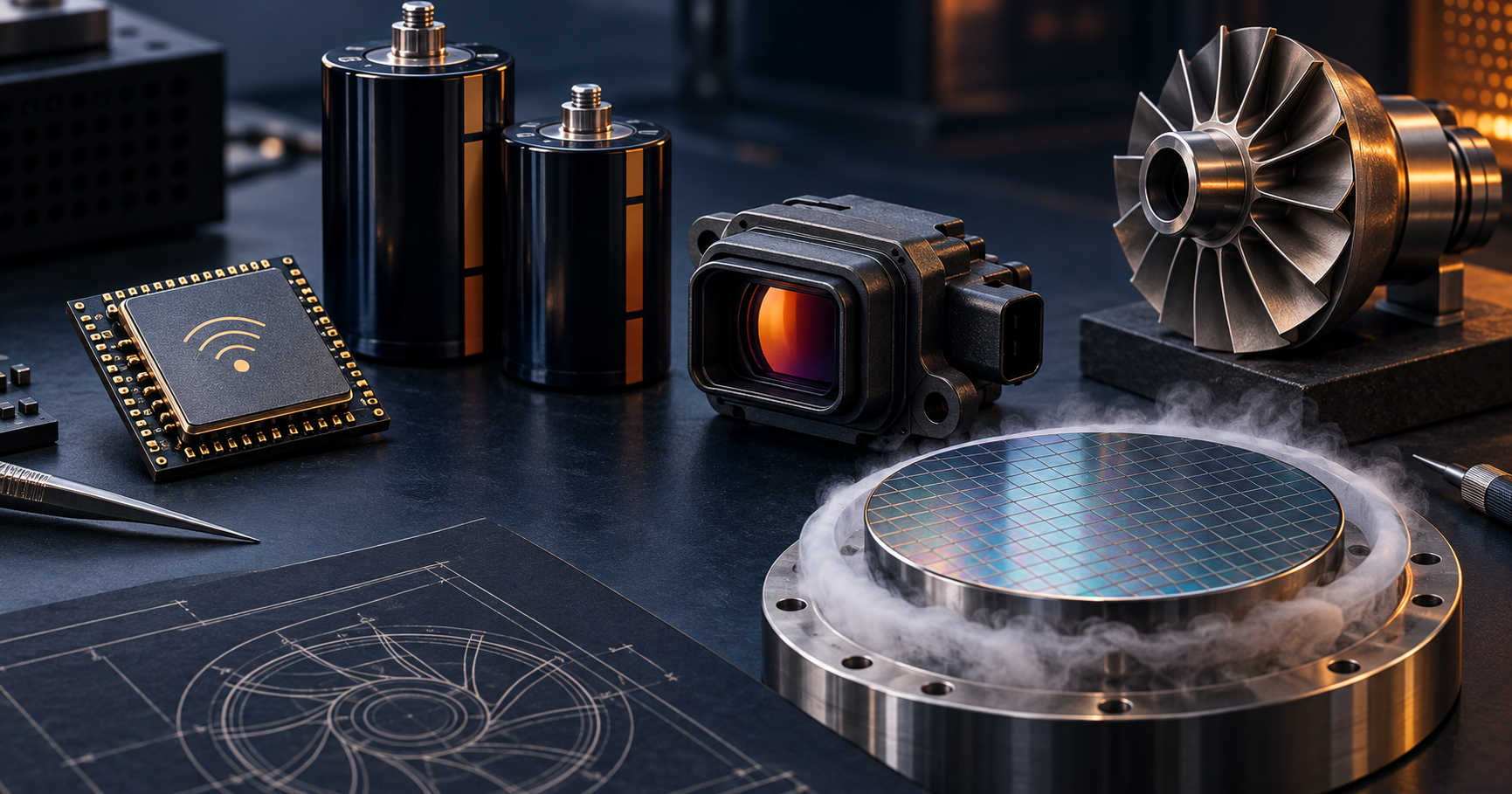
Illustration created for The Electronics Brief.
This week's announcements range from an entry-level wireless SoC to superconducting interconnect research. They sit at very different levels of readiness. Nordic's device is sampling ahead of planned production; TDK has expanded named capacitor series; ST says samples of its new automotive sensor are available; and imec is describing a research platform. Treating all four as equivalent “new technology” would obscure the questions readers actually need to ask.
Nordic narrows the nRF54L footprint
Nordic's nRF54LC10A combines a 128MHz Cortex-M33, a RISC-V coprocessor, 1MB non-volatile memory and 192KB RAM with Bluetooth LE, Thread, Zigbee, Matter support for simple sensors and proprietary 2.4GHz operation. Two chip-scale packages measure 1.9mm by 2.3mm, with a QFN option also planned. Nordic quotes 4.0mA receive current, 5.8mA transmit current at 0dBm and sleep modes from 0.5µA to 1.6µA. Samples are available, with production expected by Q2 2027 and development kits generally available by Q1 2027. Any programme starting now should plan around that gap rather than treating sampling as volume availability.
TDK raises voltage within existing capacitor families
TDK has taken selected snap-in aluminium electrolytic capacitor series to 500V. The range targets dense power supplies and covers materially different lifetime and ripple-current ratings. Engineers should use the exact application conditions in the supplier's lifetime calculation; buyers should avoid collapsing six families into a single availability assumption.
ST targets higher-volume in-cabin sensing
ST's 1.1MP VD56GA infrared automotive sensor is offered in a 3.7mm by 3.2mm CSP package and integrates functions including crop, dark calibration and auto exposure. ST claims higher sharpness and infrared quantum efficiency than its previous generation. Samples are available. Camera teams will need the complete optical, illumination, thermal and automotive-qualification evidence before converting those component claims into module performance.
Imec moves superconducting routing to 30nm
Imec's NbTiN work demonstrates three metal levels, dense Josephson-junction circuits and 30nm wires using a 300mm-compatible research platform. The result strengthens the process case for superconducting logic but leaves system integration, cryogenic I/O and design enablement as central constraints.
The UK count gets firmer
The government's updated sector study identifies 703 UK companies with semiconductor activity and estimates £10.6bn of revenue among dedicated businesses. The breadth is encouraging; the concentration of revenue and continued scale-up barriers mean customers should still qualify the exact production and support chain behind a UK-developed technology.
Sources: Nordic Semiconductor; TDK Electronics; STMicroelectronics; imec; UK Semiconductor Sector Study 2026.