The cheaper PCB quote may have changed your circuit
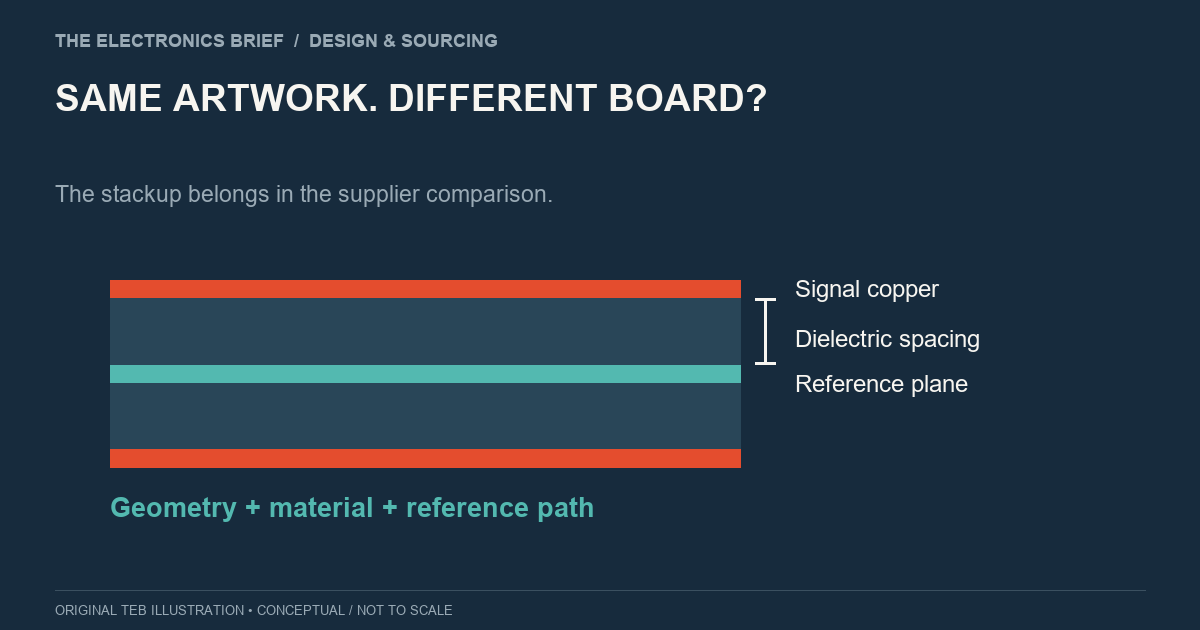
Illustration: The Electronics Brief. Conceptual diagram.
A lower PCB quote is welcome until engineering discovers that the saving depends on a different board construction. The copper artwork may be unchanged, but that does not settle whether the new board will behave like the one already qualified.
This is worth resolving while the quote is still on the table. Once a production order is waiting for approval, a question about dielectric thickness can quickly become an argument about delivery dates.
What is the fabricator actually quoting?
The stackup describes the copper and insulating layers through the board. Track geometry, dielectric properties and spacing to the reference plane affect transmission-line behaviour. TI's high-speed layout guidance also explains why breaks in a signal's reference plane can cause trouble. Specifying the layer count and finished thickness leaves important details unanswered.
Nor does a low clock frequency automatically make the construction unimportant: fast signal edges can still demand care. The assessment needs to reflect the interfaces on this board, rather than a loose description such as “low speed”.
Ask for the proposed stackup alongside the price. That gives engineering something concrete to compare with the released design: materials, layer order, dielectric thicknesses, finished copper and controlled-impedance requirements. If the supplier proposes a substitution or trace-width adjustment, it should be visible in that comparison.
Eurocircuits makes these choices explicit in its material and buildup tools, including an impedance calculator for its defined-impedance service. It also notes that alternative materials can affect price and lead time. The commercial and electrical decisions are already connected; the quotation needs to show how.
Agree the evidence before ordering
The response need not be a complete requalification for every difference. Start with the affected circuits and decide what evidence will resolve the question. That might include a fabricator's calculation, an impedance test coupon or measurements on an assembled board.
An impedance coupon is a test structure used to check the specified manufacturing characteristic. It cannot establish that every interface in the finished product works. Equally, a successful boot tells little about performance across the intended operating range. Both can be useful evidence within a test plan; neither answers every question.
Record the accepted construction in the manufacturing release, including any agreed changes. Purchasing then has a defined specification to order against, and the fabricator has a clear basis for notifying future substitutions.
Does the saving survive the engineering cost?
For a UK equipment maker introducing a second fabricator, the comparison should include the review and verification work as well as the board price. A cheaper construction may be entirely suitable. It may also be worth accepting a one-off qualification cost to secure another source.
What makes the decision difficult is finding out about that cost after the supplier has been selected. Requesting the stackup with the quotation puts it back where it belongs: in the original comparison.
Related reading: qualifying a second-source component.