CubeSat antenna harvests 74 µW from a 2.4 GHz signal on the bench
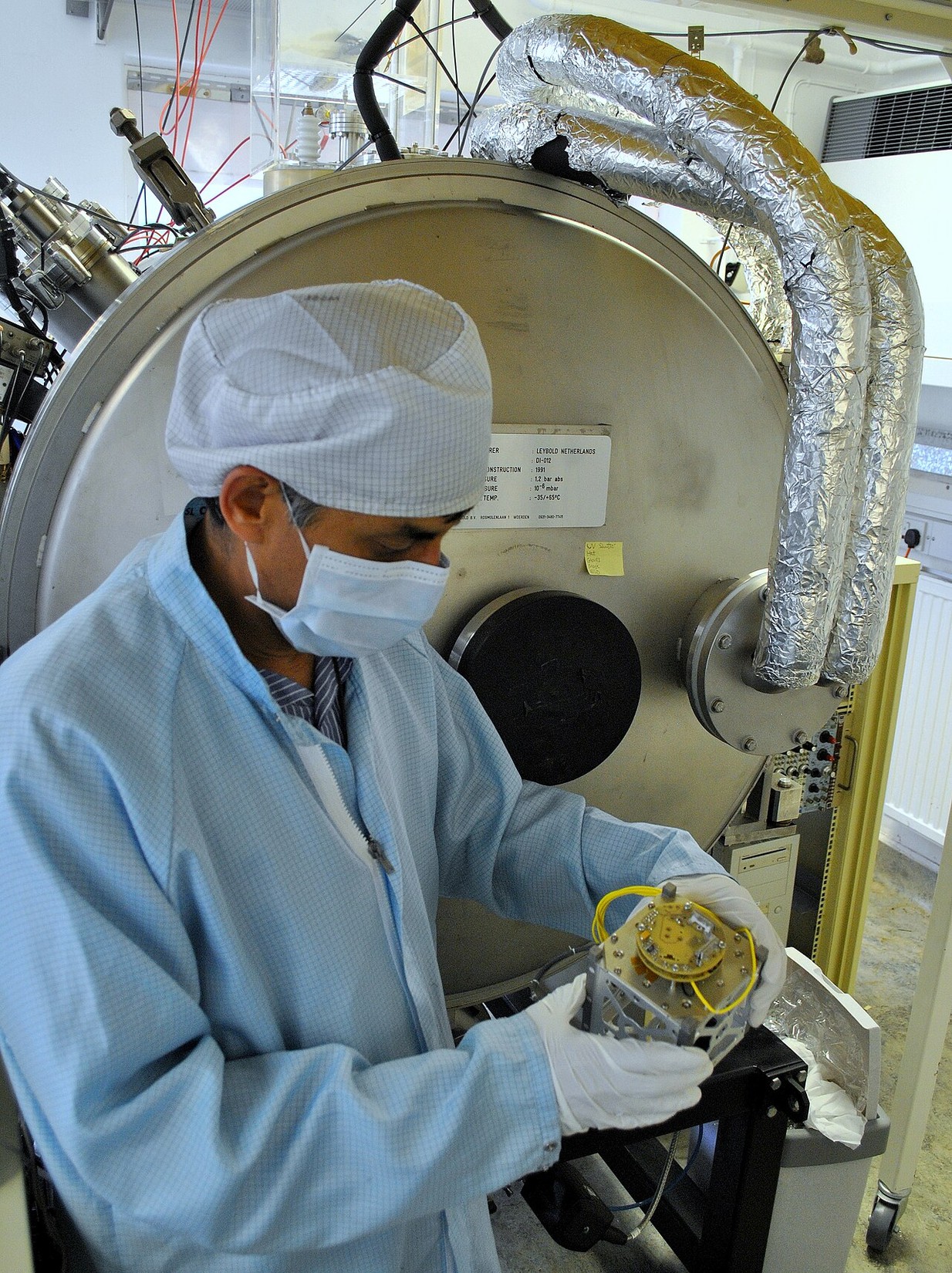
A team working with Mexico’s Instituto Politécnico Nacional has built a circuit that fits on one face of a 1U CubeSat and uses a 2.4 GHz radio signal to produce DC power. It delivered 74 µW into a 10 kΩ load on the bench, a level the team proposes using to build up a small reserve of energy between occasional tasks.
The team measured 858 mV across the load and estimated that about 209 µW of RF power reached the antenna, equivalent to −6.8 dBm. The reported 35.2% efficiency runs from received RF to the DC load, excluding transmission losses that would depend on range and antenna alignment during a pass.
On the FR4 board, a rectangular patch picks up the signal and feeds an RF path with a third-order Chebyshev low-pass filter, while a three-stage Dickson multiplier rectifies the signal and raises its DC voltage. The 858 mV reading belongs to that combination of input power and load: connecting a different circuit can change the voltage as well as how much power the rectifier can deliver.
At the measured output, it would take about 14 seconds to collect 1 mJ if the signal stayed steady and storage were lossless. In practice, a power management circuit would have to start at the available voltage and draw little enough current to leave energy for storage. For scale, NASA’s small spacecraft survey lists a 1U body-mounted solar panel rated at 2.3 W peak at the beginning of its life. The rectenna is proposed as an auxiliary source and its contribution would depend on how much of each pass the satellite receives a usable signal. The researchers tested the circuit on the ground.
Sources: Scientific Reports: rectenna construction and laboratory measurements; NASA: small spacecraft power, including 1U solar panel ratings in Table 3-2.