A jacket that powers its sensors and carries their data
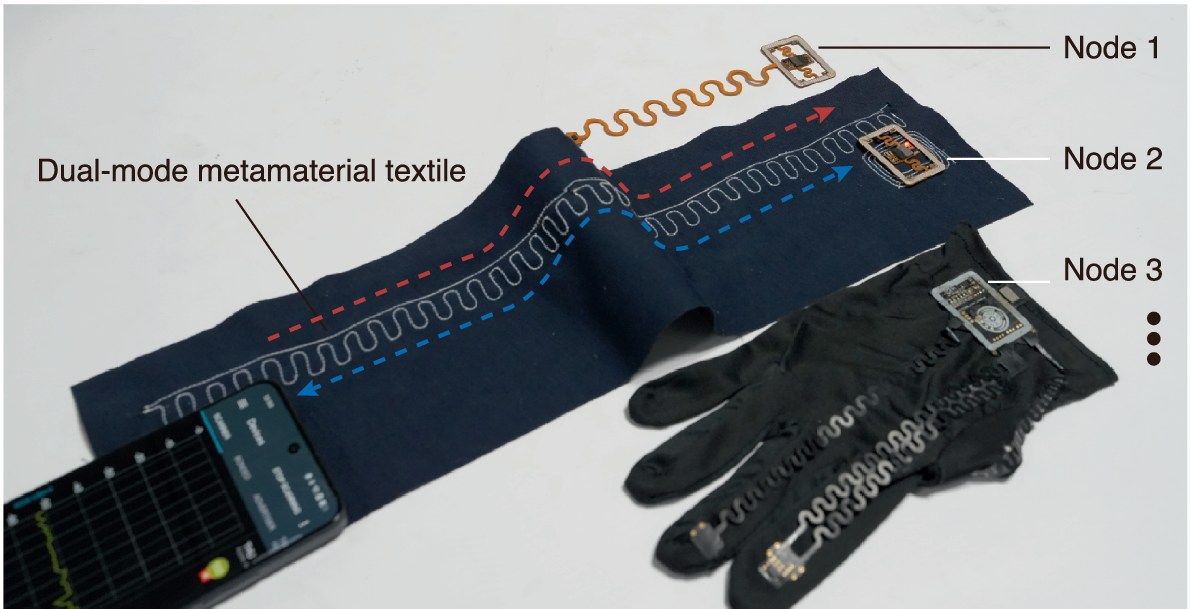
A team writing in Nature Communications built a wearable network in which an NFC-enabled phone supplies energy to sensors elsewhere on the body. The garment passes the energy between embroidered coils, so an individual sensor does not have to carry a battery. The phone also receives the data, but it does so over Bluetooth, through a second structure stitched into the same fabric.
The researchers filled flexible tubing with a gallium, indium and tin alloy. They used the resulting fibres to make both the coils that couple power at 13.56 MHz and the periodic waveguide that carries the 2.4 GHz Bluetooth signal along the garment. At each node a Schottky bridge rectifies the received power, which is filtered and regulated to 1.8 V for the inertial sensor and Bluetooth microcontroller.
Movement matters because it can change the alignment of the coils and reduce the voltage at a node. The team recorded a minimum of 2.80 V at its lowest-reading node during running, still above that regulator’s minimum input requirement. No node disconnected or restarted in the reported tests.
The authors reported twice the power transfer efficiency and 37.8 times the data throughput of the near-field clothing used as their reference. They also demonstrated the garment in two applications that depend on a continuous stream of motion data: robot control and virtual reality.
Sources: Original Nature Communications paper and supplementary data · Research team’s project repository