Broadcom's AI network showcase puts congestion control alongside faster silicon
Broadcom will show its AI-networking portfolio at the OCP Global Summit from 12 to 15 October, combining Ethernet switches, NICs, PCIe components and integrated optics with rack-based demonstrations.
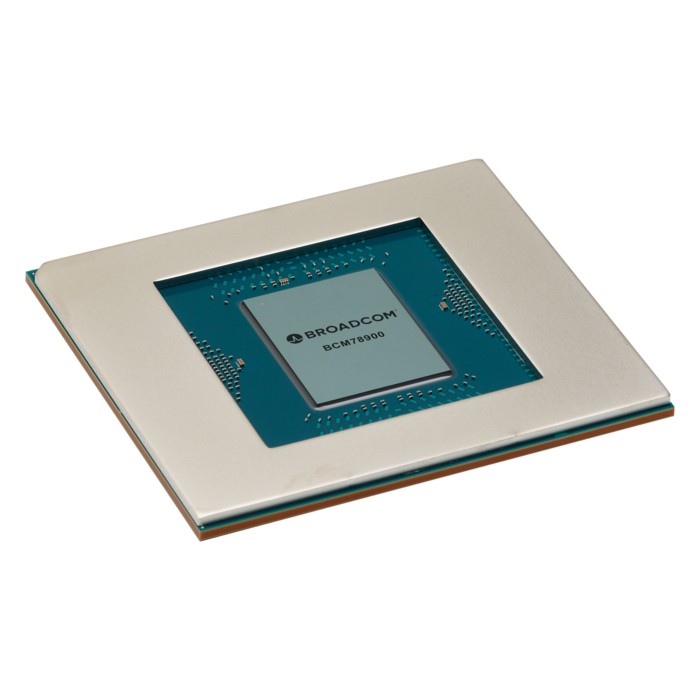
The 8 October announcement names Tomahawk 6, Tomahawk Ultra and Jericho 4 switches, Thor Ultra 800G and Thor 2 400G NICs and TH6-Davisson co-packaged optics. Celestica, Delta and Micas will demonstrate the 102.4Tbps Davisson platform.
The programme also includes Multi-path Reliable Connections, optical-fabric configurations, deep buffering and scale-up Ethernet transport. Those sessions describe an engineering agenda beyond increasing a switch's aggregate bit rate.
A fast link can still spend time waiting
AI training involves coordinated data transfers between accelerators. A delayed transfer can hold up progress even when the fabric has substantial unused capacity elsewhere. Local congestion and the way endpoints react to it therefore influence application performance alongside headline bandwidth.
Broadcom's May technical account of Multi-path Reliable Connections describes a response to this problem. MRC supports out-of-order data placement so packets belonging to a connection can travel over multiple paths. Senders adapt their distribution using feedback from those paths.
It also uses selective acknowledgements and switch packet trimming to identify losses and request retransmission. In this design, transport reliability is handled without requiring the entire fabric to behave as a lossless network.
The company identifies Thor Ultra NICs and Tomahawk 5 and 6 switches as supporting the specification. MRC resulted from work with AMD, Intel, Microsoft, Nvidia and OpenAI and is available under an OCP open licence.
NIC and switch choices become coupled
The endpoint has to understand the transport behaviour and the switch has to provide the required forwarding and congestion functions. These are capabilities to match across a system, rather than features that become interchangeable because both products advertise an Ethernet data rate.
Broadcom's March production announcement describes Tomahawk 6 options supporting 512 lanes at 200G or 1,024 at 100G. The port arrangement matters because it influences how many endpoints a switch can connect and how many tiers are needed in the fabric.
Higher radix can reduce the number of stages between endpoints. It also changes the distribution of cabling, optical interfaces and failure domains. The appropriate topology depends on the cluster and transport implementation, so the aggregate capacity figure does not specify a complete network by itself.
The OCP demonstrations bring those choices into rack-level systems. The useful evidence is how the NIC, switch and transport operate together under the intended traffic and failure conditions. That is a different question from whether a single optical link reaches its rated speed, and a more complete explanation of why Broadcom is presenting protocols and hardware in the same programme.
Sources
Broadcom's 2026 OCP announcement; MRC technical account, 6 May 2026; Tomahawk 6 production announcement, 12 March 2026.