Why reversing the test current can fix a drifting milliohm reading
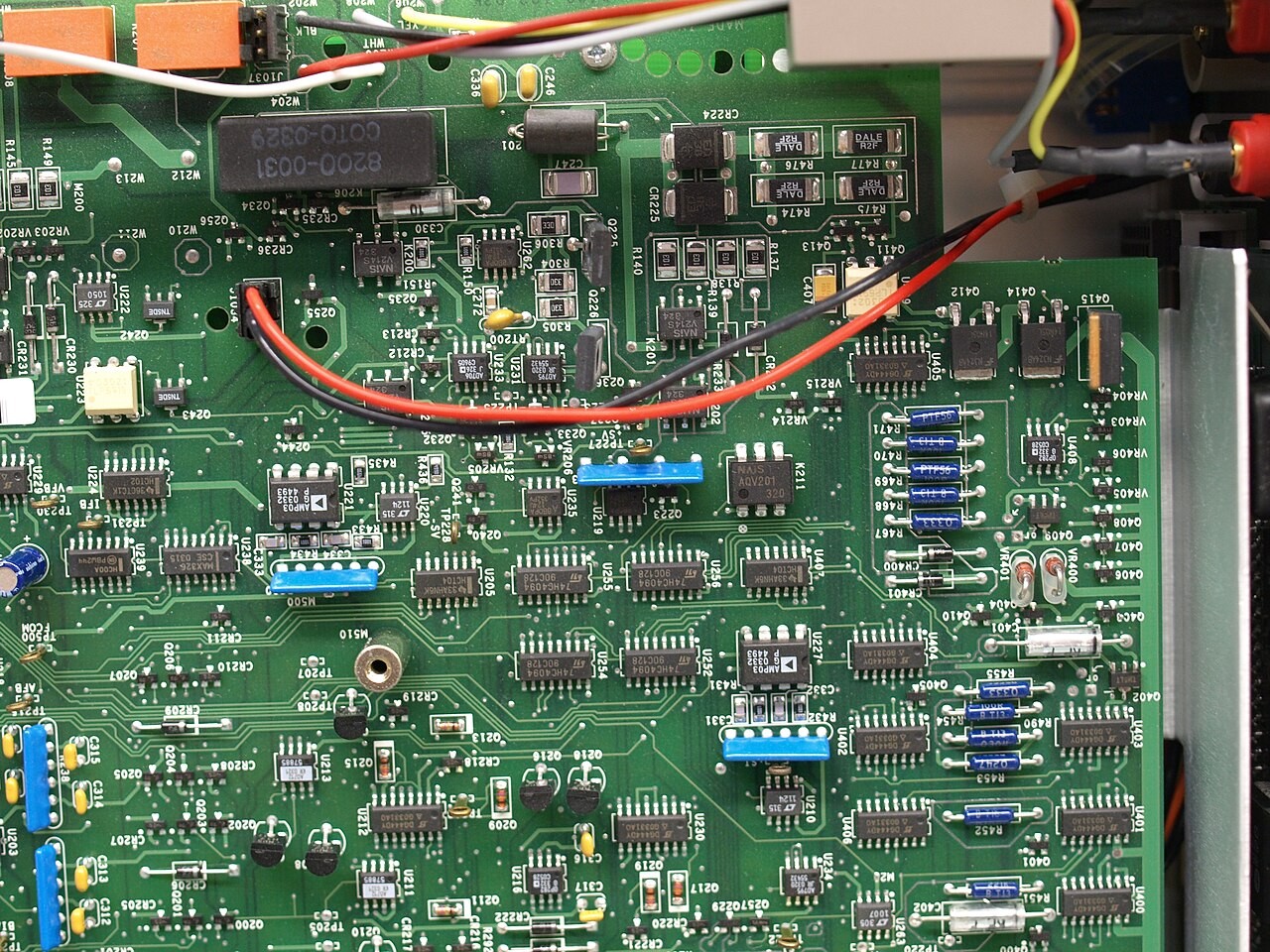
Image: Dave Jones / EEVblog · CC BY 2.0
A connector contact can appear to gain 20 µΩ as the fixture warms up, even when its resistance has not changed. At a test current of 100 mA, a thermal voltage of only 2 µV can account for the whole shift. That voltage can come from a temperature difference between junctions of dissimilar metals and still appears in the reading when the sense leads are connected directly across the contact.
Take two readings with the sense leads fixed
Run the same magnitude of current in both directions, leaving the voltage sense polarity unchanged. With +100 mA through a 5.00 mΩ contact, the resistive drop is +500 µV. Suppose a steady thermal offset of +2 µV gives a reading of +502 µV. Reverse the current and the resistive drop becomes −500 µV, while the offset still contributes +2 µV, giving −498 µV. Subtracting the readings and dividing by twice the current gives 1,000 µV ÷ 0.200 A = 5.00 mΩ.
That calculation assumes the offset does not change appreciably between readings. If the fixture is still warming up, use an instrument that can take the two readings close together while allowing the electrical transient to settle. With equally spaced readings, a positive–negative–positive delta sequence can also cancel an offset that drifts linearly. Average the two outer voltage readings, subtract the middle reading and divide by twice the current. For linear drift, the average of the outer offsets equals the offset at the middle reading, so subtracting it cancels the drift term.
Leave the contact in the state you wanted to measure
Too much test voltage can break through an oxide film and change the contact under test. Where the part specification calls for a dry circuit measurement, use its prescribed voltage and current limits and perform the low-level measurement before a test that applies higher voltage or current. Keithley describes dry circuit modes that typically limit voltage to below 20 mV. If the measured resistance still depends on current magnitude or polarity after offset compensation, check for settling, contact non-linearity or self-heating before treating the result as a single stable resistance.
Sources: Keithley Low Level Measurements Handbook: current reversal, delta mode and dry circuit testing.