ASUS gives AI agents a server for the work around the model
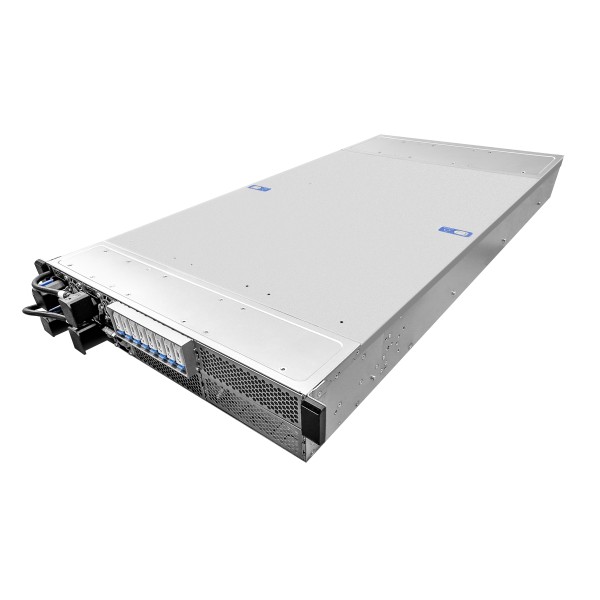
Image: ASUS
Running an AI model is only part of an agent’s workload. The surrounding application may execute code, call tools, process files, manage sandboxes and coordinate several tasks. Those operations create demands on CPUs, memory and I/O alongside GPU inference.
ASUS positions its XA P2N-E2 around that execution layer. The 2U server uses two NVIDIA Vera CPUs and supports up to two dual-slot RTX PRO 6000 Blackwell Server Edition GPUs. ASUS identifies code execution, tool use, orchestration and reinforcement-learning workloads among its intended applications.
The configuration is distinct from a rack built primarily around a large GPU count. It combines substantial CPU resources with optional acceleration in an air-cooled chassis.
ASUS lists 88 cores and 176 threads per Vera processor. Sixteen SOCAMM2 memory modules provide up to 1.5 TB of LPDDR5X memory at 9,600 MT/s. The two CPUs communicate through second-generation NVLink-C2C, with stated coherent bandwidth up to 1.8 TB/s.
Those resources address different possible constraints. CPU execution affects how quickly an agent can complete non-model tasks. Memory capacity limits the working data available locally, while memory bandwidth affects the rate at which processors can access it. GPU acceleration can then be added where the workload benefits from it.
This is an architectural reading of the specification, rather than a measured claim that one configuration will run every agent faster.
The server’s MGX structure includes independently serviceable CPU and GPU trays. ASUS also lists two PCIe Gen6 ×16 networking slots, a dedicated dual-slot DPU/NIC position and eight hot-swap E1.S drives.
The appropriate performance test is consequently an application-level one: model calls, tool execution and data processing running together. A GPU-only benchmark would leave much of the work ASUS intends this platform to handle outside the measurement.