
A flexible quantum dot sensor reads temperature through light
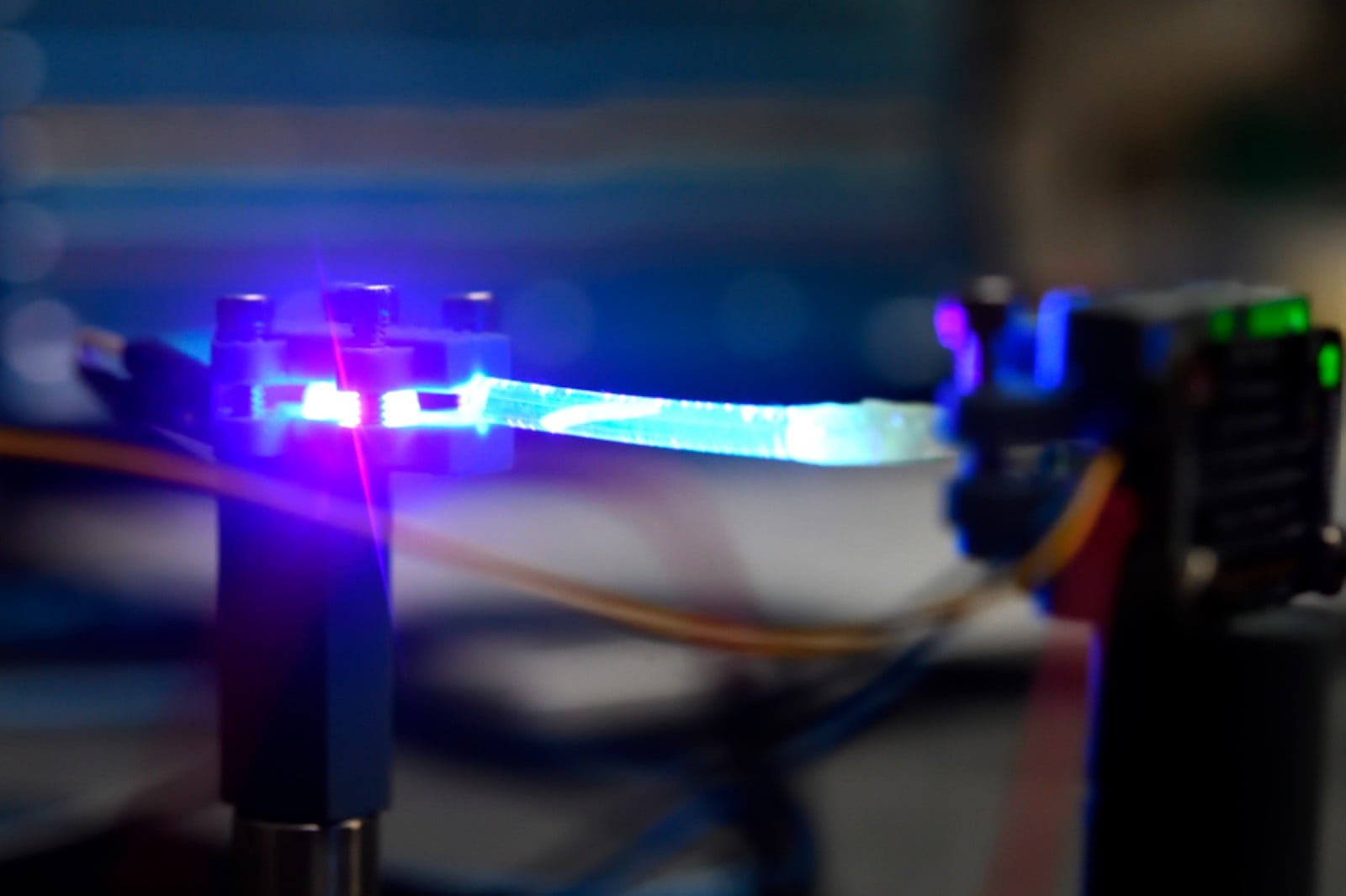
The green strip bends, but it still carries a temperature measurement. Johns Hopkins engineering students have built a flexible optical sensor by embedding quantum dots inside a printed silicone waveguide, producing a prototype with a reported materials cost of $36.63.
Ultraviolet LEDs excite the quantum dots, which emit light into the waveguide. The readout follows a shift in emission wavelength as temperature changes. It does not simply judge whether the strip looks brighter or greener.
That distinction matters in an optical instrument. Brightness can change because of illumination, alignment or deterioration of the light-emitting material. The team’s conference abstract describes wavelength as a way to make the measurement less sensitive to variations in optical intensity.
The construction combines a supporting silicone shell, a light-guiding core and a region containing the quantum dots. Producing it required a material that could be printed, remain optically transparent and preserve the dots’ behaviour through curing. The university reports calibration from 5°C to 50°C.
### Accuracy and repeatability are different results
The published conference abstract reports temperature accuracy of ±1°C, alongside a manufacturing error of ±4°C across three sensor sets. Both figures belong in the account. A well-characterised individual sensor can give a useful reading while nominally identical printed devices still differ enough to need attention during manufacture.
The abstract also reports an acceptable optical signal when the waveguide is bent to a radius of 1.5 inches. That supports the case for conformable sensing, although it does not establish that every combination of bend, strain and temperature has been independently resolved.
Strain is one of the remaining technical questions because it can also affect the optical response. The team is working on separating its contribution from temperature, improving fabrication consistency and reducing the quantity of quantum dots required.
This is a student-developed research sensor with potential uses on curved structures. Its interest lies in the fabrication and readout approach: a flexible printed optical path, inexpensive components and a wavelength measurement, with device-to-device consistency now a defined part of the work. <p><a href="https://me.jhu.edu/news/student-engineers-invent-bendy-temperature-sensor-to-avoid-overheated-devices/">Johns Hopkins engineering project report</a>. <a href="https://epapers2.org/sensors2026/ESR/paper_details.php?paper_id=9061">IEEE Sensors 2026 accepted paper abstract</a>.</p>


