What nine-axis sensing adds to a robot’s heading estimate
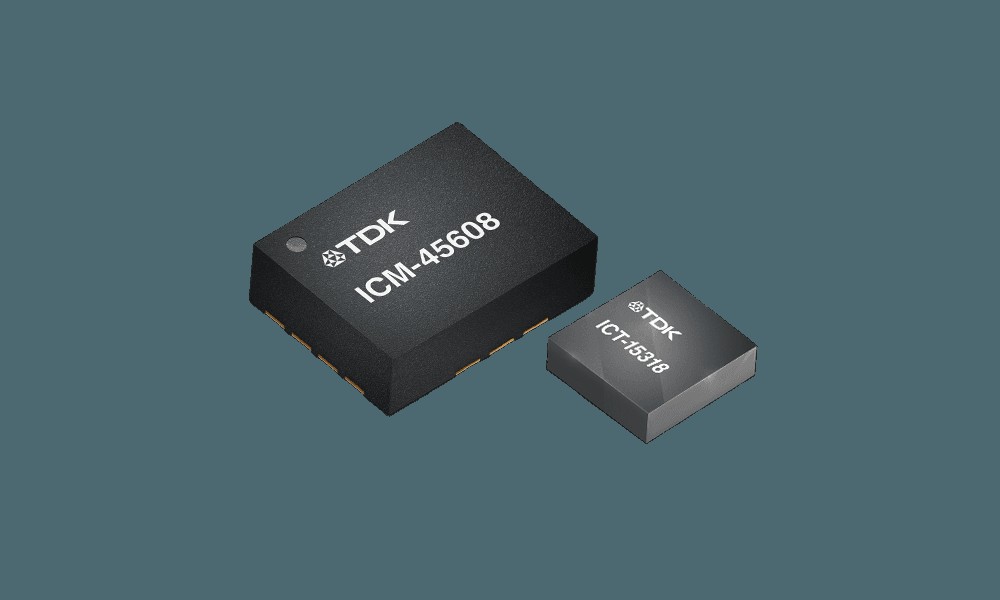
Image: TDK InvenSense
A gyroscope measures how quickly a device rotates. Integrating that signal produces an estimate of angle, but a small bias also accumulates over time. The estimate gradually drifts unless another measurement provides a reference.
An accelerometer can use gravity to help correct pitch and roll. Heading needs an additional reference, which is one reason a nine-axis sensing system adds a three-axis magnetometer to a six-axis inertial measurement unit. Analog Devices describes the magnetic measurement as a reference that can help mitigate yaw-axis gyroscope drift.
TDK’s PositionSense implements that combination using two chips: a MEMS accelerometer/gyroscope and a tunnel-magnetoresistance magnetometer. Sensor-fusion and calibration software combine their outputs to estimate orientation.
TDK has made four configurations available through distribution. The ICM-45608 combinations offer accelerometer and gyroscope ranges of ±16 g and ±2,000 degrees per second. ICM-45689 combinations extend those ranges to ±32 g and ±4,000 degrees per second. Interface options depend on the paired magnetometer: ICT-15318 configurations use 1.8 V I/O with I²C, SPI and I3C support, while ICT-15312 configurations use 1.2 V I/O with I²C and SPI.
Orientation is one input to navigation
An orientation estimate describes which way a robot is facing. It does not, by itself, establish where the robot is on a warehouse floor.
A complete localisation system may combine inertial measurements with other observations. Analog Devices’ robotic-localisation material describes sensor fusion as a way to estimate states while correcting noise and bias errors across the system. The distinction matters when interpreting a component supplier’s positioning claims.
Magnetic conditions are another part of the measurement. Nearby ferrous material and electrical equipment can alter the field used as a heading reference. TDK identifies magnetic-interference recalibration as a development challenge for PositionSense and includes gyro-assisted calibration and magnetic-shock recovery in its implementation.
Range selection also has a concrete purpose. The higher-range configuration provides more measurement headroom when acceleration or rotation would exceed the standard device’s limits. That does not automatically make it the more accurate choice for every motion profile.
The two-chip approach packages sensing and calibration functions together. Its contribution to navigation remains the quality and consistency of the orientation information supplied to the wider system.