Choosing a system-on-module: who supports the finished product?
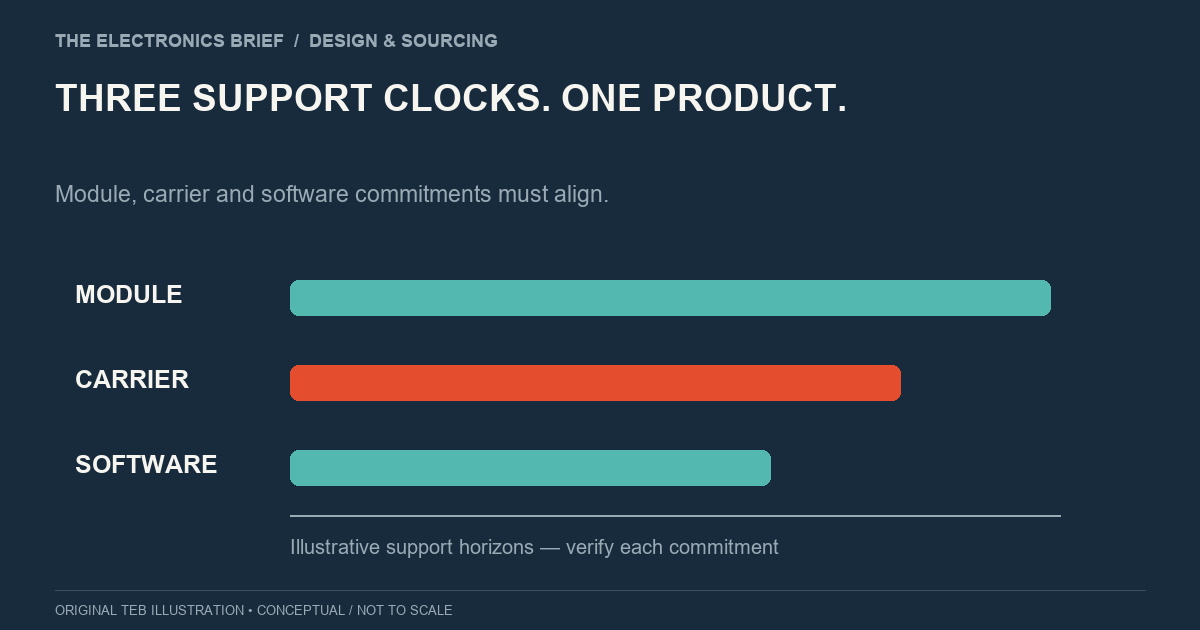
Illustration: The Electronics Brief. Conceptual diagram.
Getting a processor platform running quickly is a strong argument for a system-on-module. The attraction is obvious when the alternative is a demanding board design and a longer route to working software.
Before that development platform becomes the production choice, however, someone needs to put the support dates beside the product plan. The module may remain available after the chosen carrier board or software release has reached the end of its supported life.
Three commitments to check
Toradex's published policy shows why the distinctions matter. It directs customers to minimum product commitments for individual modules, specifies no lifetime for evaluation carrier boards, and treats production carriers separately. Its embedded Linux support policy is separate again.
That is one supplier's approach, rather than an industry-wide guarantee. It does suggest a sensible way to question any module offer: which exact module, which production carrier and which software release does the commitment cover?
A long availability claim for a module family is encouraging. It does not, on its own, establish the remaining support period for the particular configuration you intend to ship.
Compare production costs at realistic volumes
The module price is easy to put in a spreadsheet. Carrier development, cooling, production programming and ongoing software maintenance take more work to estimate. Leaving them out will not make the comparison more accurate.
Separate one-off engineering costs from recurring costs, then compare the options at more than one plausible production volume. A custom processor board may recover its development cost at one volume and make little financial sense at another. A module's premium may be justified by an earlier launch or by work the team would otherwise have to maintain itself. State those assumptions so they can be revisited when forecasts change.
What would a migration involve?
Ask about the successor before the current module becomes difficult to obtain. A common connector or family name is useful information, but it is not a completed compatibility assessment. The proposed replacement still needs a review of the interfaces, power, thermal requirements, boot behaviour and supported software.
The engineering estimate should cover getting a repeatable production build running on the intended carrier, not just demonstrating that a development image boots. Keep that estimate with the commercial comparison. It tells the business what flexibility it is actually buying.
Before the first volume commitment, bring together the qualified configuration, supplier commitments and the service period promised to customers. A mismatch does not necessarily rule the module out: it may justify a funded migration or a different support arrangement.
It does need an owner. Otherwise, the development time saved today can leave a maintenance job that nobody has budgeted for.