Silex files for US approval as Pennsylvania MEMS fab plans progress
Silex Microsystems has submitted its planned Pennsylvania fab acquisition to the Committee on Foreign Investment in the United States, according to its third-quarter report released on 4 November. The filing is a further step towards acquiring and converting an onsemi facility, with completion still expected around the turn of 2027 and 2028.[1]
The July agreement set a $40 million purchase price, with $10 million paid at signing and the remaining $30 million due at closing. It is an asset purchase covering the facility, property, infrastructure and manufacturing equipment, rather than the acquisition of a legal entity. Silex says it will not take over onsemi’s existing revenue from integrated circuit production.[2]
The Mountain Top site is a 200 mm wafer fab with approximately 3,000 square metres of existing cleanroom space and about 12,000 square metres available for future expansion. Silex plans to turn it into a MEMS factory, using infrastructure and staff already associated with semiconductor production while introducing its own processes and operating model. Its total investment plan, including purchase and conversion, remains approximately SEK1.6 billion through 2030.[2]
The company has already started product qualification activities for MEMS intended to be manufactured there, alongside conversion planning. It expects the US operation to relieve pressure on Swedish production and bring manufacturing closer to major customers, with a stated goal of reaching operating break-even in 2029–2030.[1][2]
MEMS combines microscopic mechanical structures with electronic control, allowing a foundry to produce devices that sense, move or redirect signals rather than only perform logic. In an optical circuit switch, movable structures can redirect light between paths, changing a connection without converting all the traffic into an electrical data stream at that switching point. The fabrication therefore has to control the mechanical structure as well as its electrical interface.[3][4]
Optical circuit switches now account for roughly 30% of Silex’s sales. Its report describes growing hyperscaler interest and a transition from development projects into commercial deployments, while life science applications contribute around 20% of sales. Third-quarter revenue rose 21.7% to SEK413 million, and expansion is also under way at Järfälla in Sweden, where the company recruited about 30 engineers during the quarter.[1]
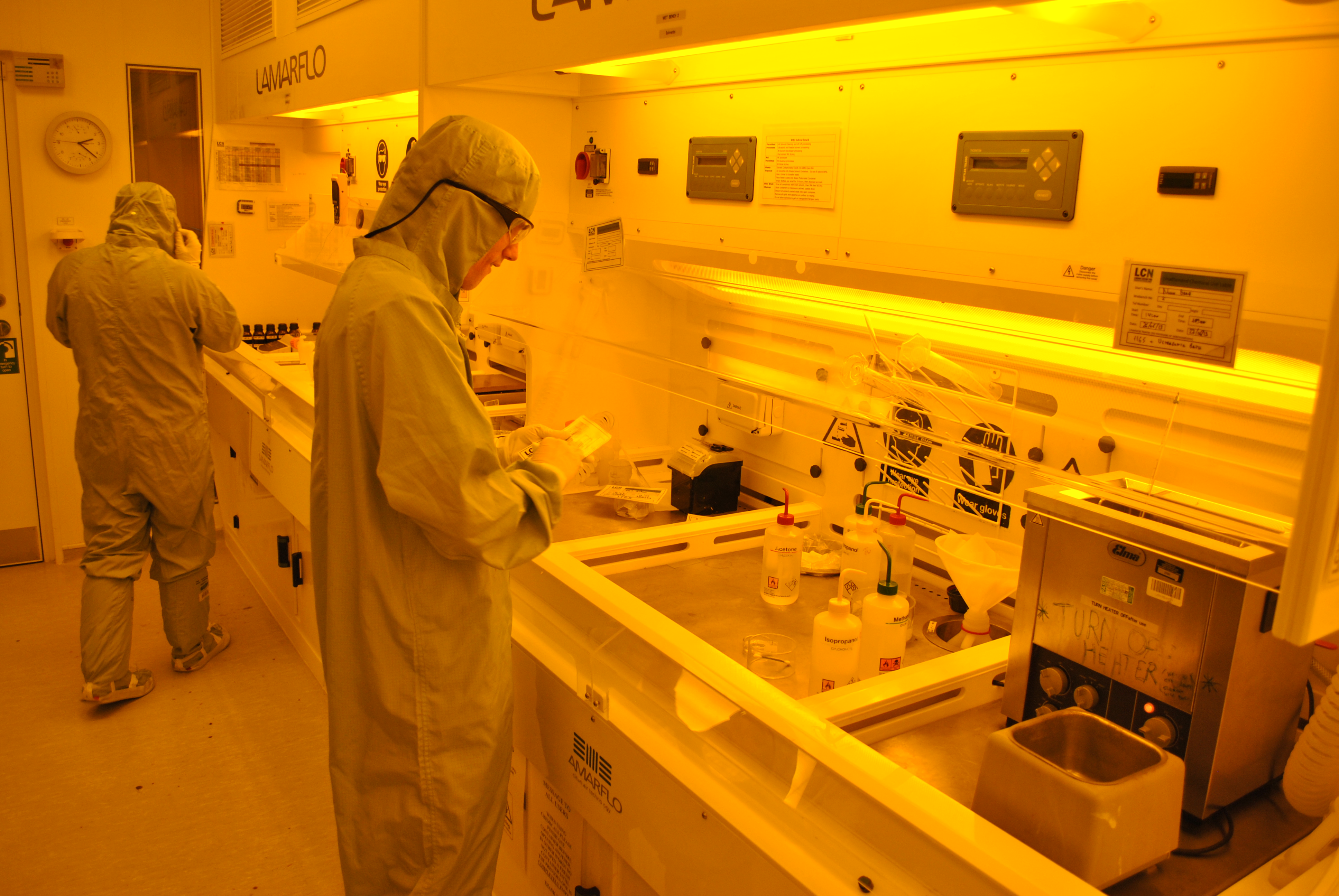
Photolithography laboratory at the London Centre for Nanotechnology. Illustrative archive photograph. Photo: O. Usher (UCL MAPS) / Wikimedia Commons, CC BY 2.0. Image source. CC BY 2.0.