Rohde & Schwarz extends system amplifier range to 53 GHz
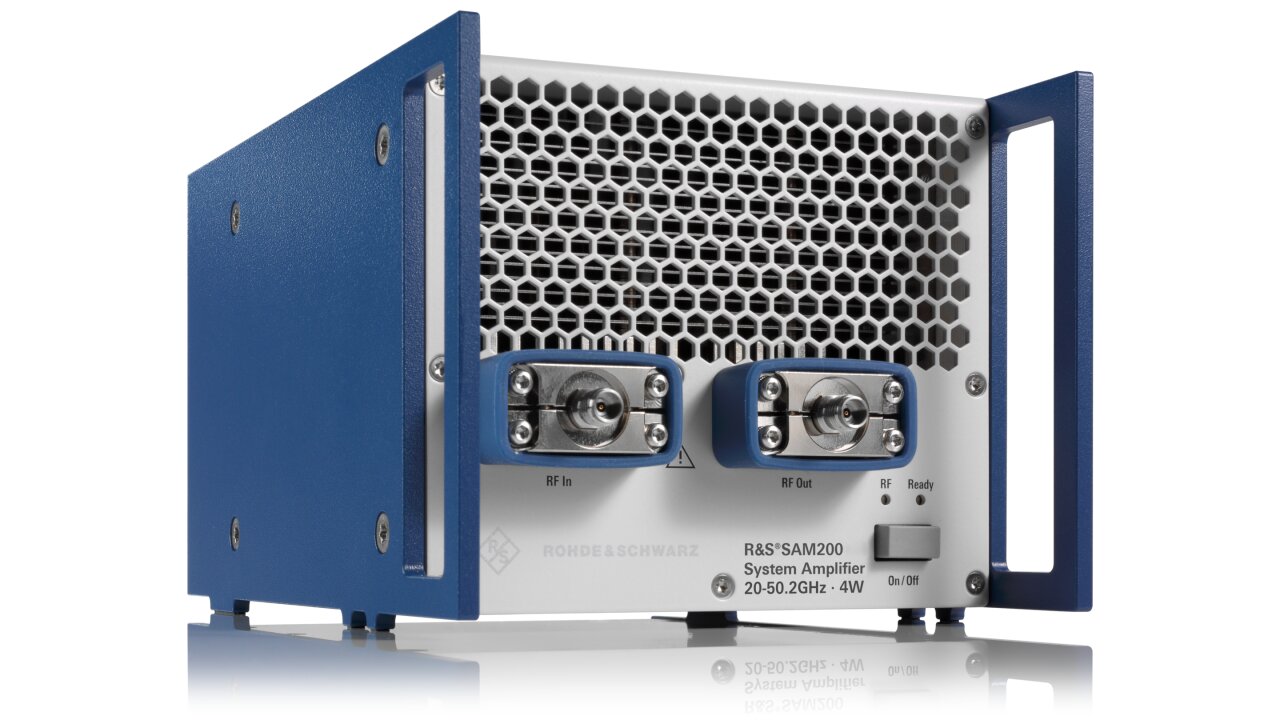
Rohde & Schwarz has introduced the R&S SAM200 family of solid-state system amplifiers, extending its frequency coverage from 20 GHz to 53 GHz with up to 4 W of saturated output power.
The new range follows the existing SAM100, which covers frequencies from 2 GHz to 20 GHz.
Rohde & Schwarz intends the SAM200 to act as an external gain stage when a signal generator or vector network analyser cannot provide sufficient power at the device under test.
This becomes increasingly relevant at millimetre-wave frequencies because cables, connectors, switches and fixtures can introduce substantial losses between the instrument output and the test point.
The SAM200 is offered in standard and Advanced versions. The standard model operates as a wideband gain block, while the Advanced version adds an integrated power detector, USB and LAN control and a browser-based interface.
It also provides three switchable signal paths covering low-noise and high-gain, regular and low-gain operating modes. Rohde & Schwarz says these modes can be used to optimise error vector magnitude when the amplifier is combined with signal generators or network analysers.
The family covers Ka-band, Q-band and parts of V-band testing. Likely applications include satellite communications, aerospace systems and higher-frequency mobile communications.
Its specified output of up to 4 W is a saturated power figure. It should not be treated as the continuously available linear output across the complete 20 GHz to 53 GHz frequency range.
For modulated-signal testing, engineers will need to examine output power at the required compression point, error vector magnitude, adjacent-channel performance and gain flatness. Noise figure and harmonic performance may also determine whether the amplifier is suitable for receiver, converter or component characterisation.
The power available at the device under test will additionally depend on cable and fixture losses. Calibration at the test reference plane may therefore be more important than the amplifier’s front-panel output specification.
Rohde & Schwarz has included output mismatch protection and gradual power foldback. These functions are intended to protect the solid-state output stage when the amplifier encounters a poorly matched load.
That protection could be valuable when testing prototype components, but buyers should establish the permitted voltage standing-wave ratio, foldback behaviour and recovery time for their intended test sequence.
Desktop and 4 HU rack-mounted configurations are available, allowing the amplifier to be used on a bench or integrated into an automated test rack.
The wide frequency range could replace several narrower-band amplifiers in some installations. Whether it reduces overall system cost will depend on the required linear output, calibration method, switching arrangement and frequency coverage of the existing equipment.
Rohde & Schwarz has not included pricing or complete gain and power curves in its announcement. Those details will be needed before buyers can compare the SAM200 with separate band-specific amplifiers.