Tektronix brings 12-bit capture and Bode plots to its 1 Series DPO
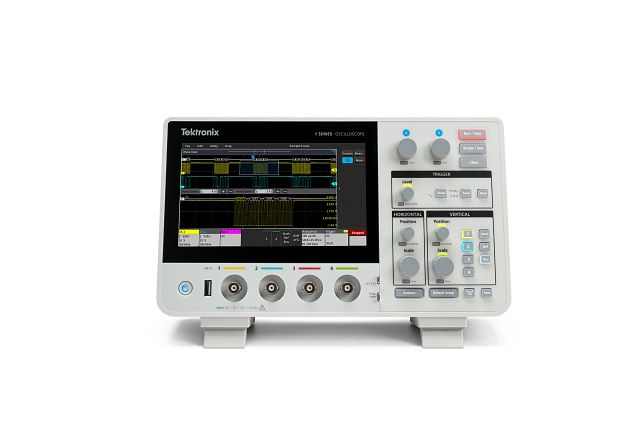
Image: Tektronix
Tektronix introduced its 1 Series DPO at electronica 2026 with a 12-bit digitiser across the range. The extra resolution comes in handy when you’re looking at a small change in voltage, such as ripple on a power rail, and want to see more of the waveform’s detail. The scopes come in 50 MHz, 70 MHz, 100 MHz and 200 MHz versions, each with a choice of two or four analogue inputs.
On a four-channel model, you could follow the analogue output of a sensor alongside the clock, data and chip select lines of an SPI transaction, then use the built-in decoder to see which command the sensor was responding to. Tektronix specifies 10 million samples of record length per channel, with a sample rate of 625 MS/s when all channels are active and 1.25 GS/s when half are active.
From waveforms to frequency response
The models with an S suffix add a 25 MHz arbitrary function generator and Bode plotting. Connect the generator to a filter and use two scope inputs to monitor the signal going in and coming out. The instrument sweeps the frequency and plots how the filter changes the signal’s amplitude and phase. That lets you check where the response starts to roll off without moving the circuit to a separate test setup.
Tektronix has kept physical knobs for everyday adjustments such as timebase and vertical scale alongside the 7-inch touchscreen. That combination makes sense on a teaching bench, where students can start by getting a waveform on screen, then use the same controls as they move on to decoding a bus or measuring a filter’s response.