Microchip's RT PolarFire FPGAs gain new space qualifications
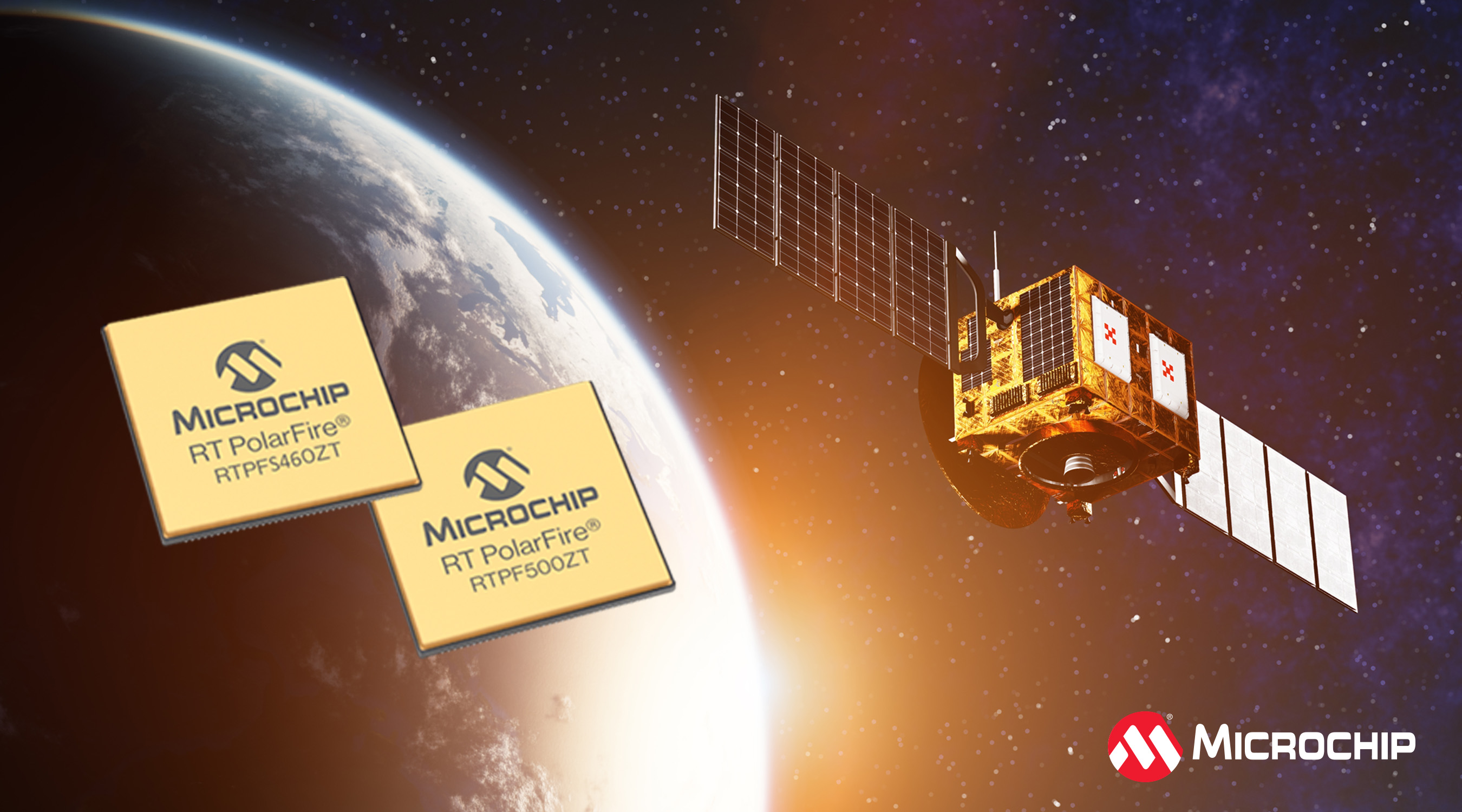
Image: Microchip Technology
Microchip Technology has achieved new spaceflight qualifications for two devices in its radiation-tolerant (RT) PolarFire FPGA and SoC FPGA families, adding flight-ready options for mission-critical space systems, the company said.
The RT PolarFire FPGA RTPF500ZT has achieved Defense Logistics Agency (DLA) Qualified Manufacturers List (QML) Class V qualification, which Microchip describes as the highest qualification standard for space microelectronics. The RT PolarFire SoC FPGA RTPFS460ZT has completed QML Class Q and MIL-STD-883 Class B qualifications.
According to Microchip, most SRAM-based FPGAs require configuration scrubbing to correct radiation-induced upsets, a process during which errors can remain undetected between scrubbing cycles and which adds to power consumption. The company states that RT PolarFire devices use a configuration technology designed to eliminate configuration Single-Event Upset (SEU) concerns altogether, rather than relying on periodic correction.
"As space applications demand greater onboard processing capability within increasingly constrained SWaP budgets, developers need technologies that maximize performance without increasing power consumption or thermal complexity," said Shakeel Peera, corporate vice president of Microchip's FPGA business unit. "Our RT PolarFire portfolio combines a power-efficient, radiation-tolerant architecture designed to be immune to radiation-induced upsets and defense-grade security to help developers reduce system power, simplify thermal management and build highly integrated, mission-critical space systems."
Device specifics
The QML-V qualified RTPF500ZT is described by Microchip as flight proven, with Single-Event Latch-Up (SEL) radiation performance and in-flight programmability intended for mission-critical space applications. The company positions the RT PolarFire family for use from satellite payloads and constellations through to human-rated spacecraft and deep-space missions.
The RTPFS460ZT PolarFire SoC FPGA combines programmable logic with an integrated microprocessor subsystem (MSS) featuring 64-bit RISC-V processor cores, and is qualified to MIL-STD-883 Class B and QML Class Q.
Qualification standards
MIL-STD-883 defines uniform environmental, mechanical and electrical test methods for microelectronic devices used in high-reliability aerospace and defense applications. QML Class V, under MIL-PRF-38535, establishes space-level quality and reliability assurance requirements. Microchip states that together these requirements address reliability and mission assurance needs for critical space applications.
Development support
A development kit is available for the RTPFS460ZT to support evaluation and prototyping. Both devices are supported by Microchip's Libero SoC Design Suite for design and development and the Mi-V ecosystem for RISC-V development, which the company says provides a common architecture and tool flow for evaluating the devices, validating designs and carrying engineering work through to flight hardware.
Microchip has not disclosed pricing, directing enquiries to its sales representatives or authorised distributors.