The last-time buy is a forecast you may have to live with for years
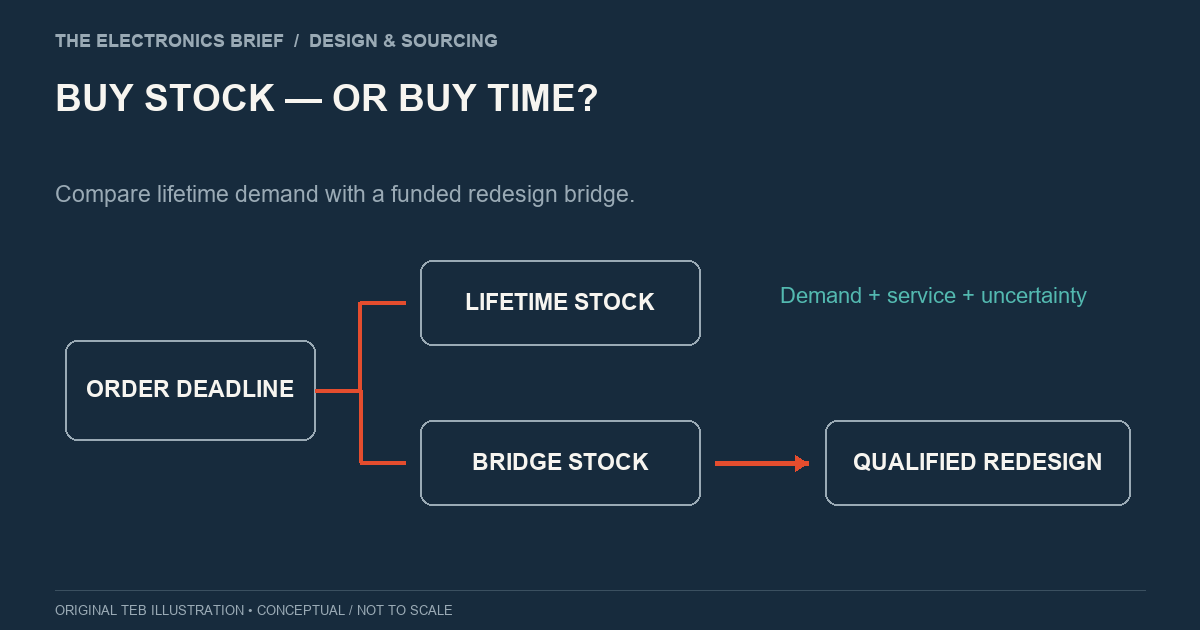
Illustration: The Electronics Brief. Conceptual diagram.
A discontinuation notice can give purchasing a firm order deadline while leaving almost everything behind the order quantity open to debate. Sales expects the product to keep selling. Engineering expects a replacement design. Service expects enough parts to support the installed base.
All three may be reasonable expectations. The trouble starts when they refer to different dates.
Build one forecast that everyone recognises
Keep production demand and service demand separate. Production needs a date for the final build of the old design; service needs an agreed support strategy. Add justified allowances for manufacturing losses and uncertainty, and deduct usable inventory and sufficiently firm incoming supply. Stock already allocated elsewhere should not quietly appear as available in this calculation.
Low, central and high cases are more useful than one unexplained contingency percentage. In particular, separate uncertainty about demand from uncertainty about the redesign schedule. Selling more units and finishing the replacement late can produce similar shortages, but they require different responses.
How much time does a bridge purchase buy?
A lifetime purchase attempts to cover the remaining need for the existing design. A bridge purchase covers the period until a replacement is qualified and introduced. The latter can reduce the amount of stock required, provided the engineering programme is credible.
Include testing, documentation and the production transition in that programme. A target date without allocated engineering time is a poor reason to reduce an irreversible order. Work through a delay case as well: if qualification slips, what happens to production and service stock?
Compare the cash committed to inventory with the cost of redesign, carrying stock and meeting customer obligations. This is where purchasing and engineering need to share a forecast rather than present separate answers to management.
Check the authorised options before committing
There may be authorised support beyond the original manufacturer's final shipment. Rochester, for example, describes end-of-life inventory and licensed manufacturing among its lifecycle services. Coverage is device-specific; it is not a promise that any obsolete part can be made again.
A part-specific quotation and delivery commitment can change the calculation. A stock listing alone cannot replace that commitment. Confirm the supply route, traceability and commercial terms before relying on it to reduce the planned buy.
The order is only the start of the stock plan
Several years of components need an appropriate storage, handling and release plan. Establish the requirements for the actual devices and packaging, who maintains the inventory records, and how stock is allocated between new builds and service. Include those costs when comparing options.
Keep reviewing the assumptions after the order. Even when a purchase cannot be cancelled, changes to the production transition or service allocation may still be possible. The record should explain why the quantity was chosen, so a colleague looking at the remaining reels in three years can understand the decision.
Related reading: a practical workflow for product-change notices.