Gold and tin connector contacts: what changes when the finishes meet
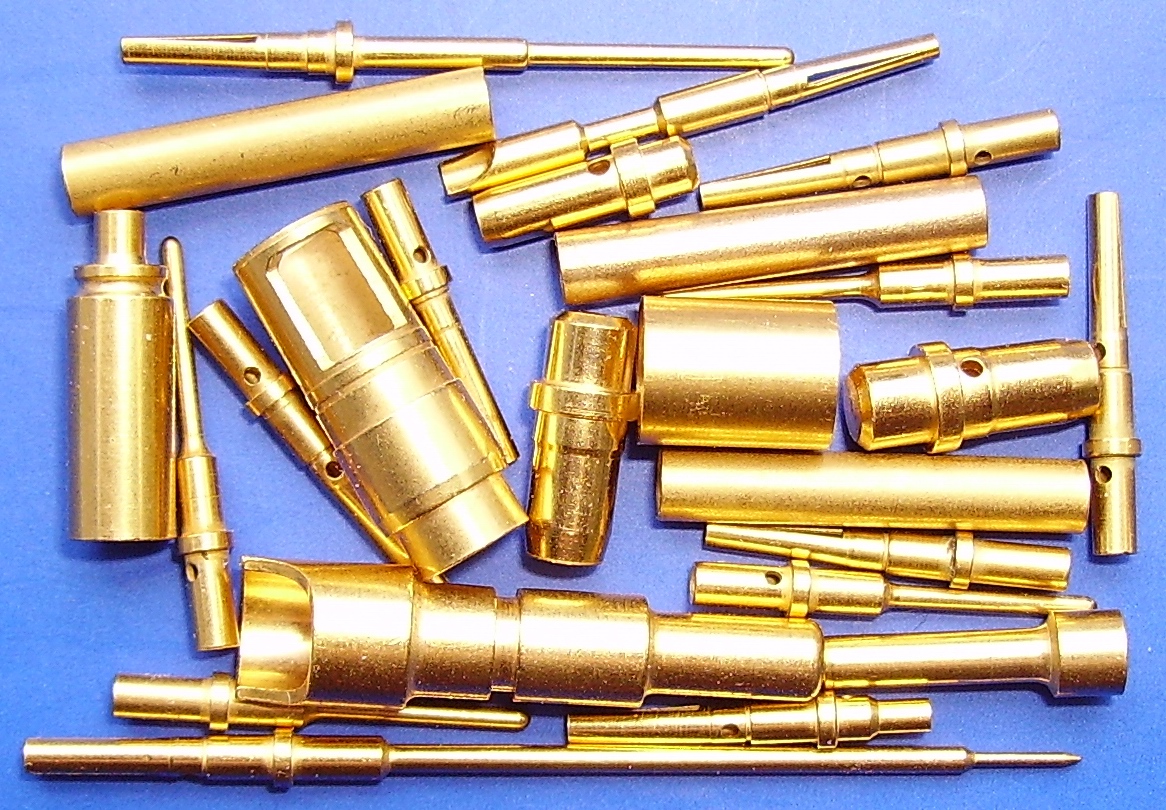
Image: Cjp24 / Wikimedia Commons / · CC BY-SA 3.0
A connector described as gold and tin can have a sound electrical design, while a gold contact mated to a tin contact can introduce a reliability problem. The difference is where the finishes sit: gold on the mating surface and tin on the solder tail serve separate functions, whereas dissimilar finishes meeting at the contact create a single interface with different wear and corrosion behaviour.
Harwin’s M80-8500442 provides a clear example of the first arrangement. The Datamate receptacle uses gold on its contact areas and tin over nickel on its through-board terminations. Both metals belong to the same component, but the tin is provided at the board connection rather than as the intended mating surface.
What the contact has to do
Tin forms an oxide film in air, so the contact design uses normal force and wiping action to establish electrical contact through that surface. Once mated, the joint needs mechanical stability: repeated small movements can break the film again, expose fresh tin and accumulate oxidised wear debris in the contact area.
This is fretting corrosion. AMP’s technical report, The Tin Commandments, describes relative movement driven by vibration, shock and differential thermal expansion, with motion typically in the 10–200 µm range. The connector can remain visibly plugged together throughout the process, while the resistance at the contact rises.
The report treats force, contact geometry and lubrication as connected design choices. Increasing normal force can improve stability and break through surface films, but it also increases the force needed to mate a multi-contact connector and can accelerate wear through repeated engagement.
Why the mixed pair needs attention
Molex advises against mating gold and tin contacts. Its engineering discussion identifies oxidation, fretting and intermetallic formation among the concerns, and recommends thermal cycling and vibration tests where a mixed pair cannot be avoided. Gold on one half does not turn the assembled connection into a gold-to-gold system.
A stable tin-to-tin interface can still be appropriate when the contact design, environment and mating duty suit it. Gold avoids the oxide film associated with tin and supports lower-force contact systems, but its own performance depends on the thickness and integrity of the plated layer. Wear or porosity can expose the material beneath it.
Samtec uses nickel beneath its gold plating as a barrier to migration from the copper-based contact. It also distinguishes thin gold flash from thicker finishes tested for more demanding service, reporting tests of its 30 µin gold connectors to 100 mating cycles. That plating thickness is approximately 0.76 µm.
Read the drawing as a pair
A finish description needs to identify the mating zone, its thickness and the underplate, as well as the termination. The mating component and, for an edge connector, the board’s contact-pad finish complete that description. A distributor’s abbreviated “gold/tin” listing can conceal the distinction that the manufacturer’s drawing makes explicit.
Mechanical retention and the mounting arrangement then determine how the pair behaves after assembly. Thermal expansion can move a contact even in equipment with little external vibration, so qualification should represent the temperature changes and mechanical loads of the intended installation as well as the initial mating resistance.
Samtec also notes that current capability depends on contact geometry, ambient conditions and the permitted temperature rise in the assembled system. Harwin’s Datamate example illustrates how the rating changes with loading: it specifies 3.3 A for an individual contact and 3 A when contacts are loaded simultaneously, at 25°C.
Sources: Harwin: M80-8500442 contact and termination finishes; Molex: gold/tin mating guidance; Samtec: plating, underplate, cycling and fretting guidance; AMP/Tyco Electronics: original contact-physics technical report, distributor-hosted PDF.
Image: Cjp24 / Wikimedia Commons, CC BY-SA 3.0.