Cimarron selects SPARK Pro for AURORA space middleware
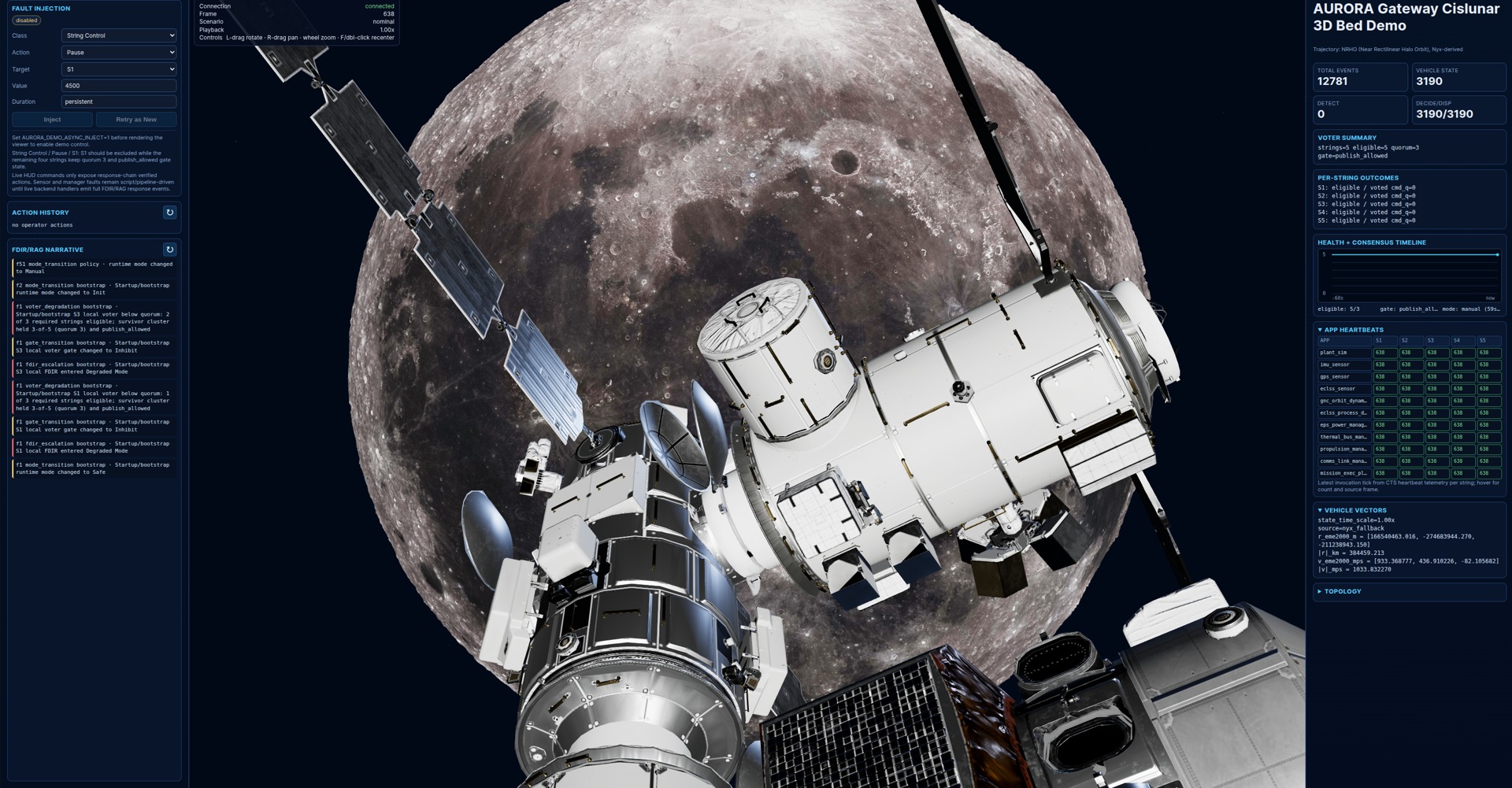
Cimarron selected AdaCore’s SPARK Pro early in the development of AURORA, a reusable middleware framework for space systems. AURORA stands for Advanced Unified Runtime for On-orbit Resilient Applications. Cimarron uses SPARK, the formally verifiable subset of Ada, for the part of the runtime that controls how software decisions translate into physical actions.
That control-critical path covers four functions: deciding which operations can run, limiting actuation, managing redundancy and deciding how to respond to faults. Cimarron wrote the remaining operational and advisory functions in a separate memory-safe language. Defined interfaces connect those functions to the SPARK components within the runtime.
How AURORA handles commands and faults
AURORA runs in deterministic execution frames. Autonomy and AI functions can propose an action, but they cannot command an actuator directly. Before any proposal can reach the actuator path, the verified core applies its actuation limits and checks that the proposal meets the configured agreement policy.
The framework can run in a single execution string or across multiple redundant strings. The agreement policy and fault-tolerance behaviour are configurable. The design accounts for both fail-stop faults, where a component stops operating, and omission faults, where an expected message or response does not arrive.
Kevin Gordon, vice president of advanced product development at Cimarron, said the team chose SPARK for the areas “where we needed the strongest assurance”, pointing to execution arbitration, actuation constraints and fault-response decisions.
Running formal proof in continuous integration
Cimarron runs the SPARK provers in a dedicated stage of its continuous integration workflow. The proof results are produced and reviewed on the same schedule as the project’s other engineering evidence. For the control and fault-response logic in the SPARK core, that gives engineers formal proof to review alongside tests and evidence from the running software.
Tony Aiello, product manager at AdaCore, said the practical challenge for teams new to formal methods is how to bring them into a project without disrupting delivery. He recommended structured training, a carefully scoped pilot and ongoing mentoring, followed by gradual integration into the team’s existing continuous integration and delivery pipeline. He cited Cimarron’s work on AURORA as an example of that approach.