Amazon’s nuclear deal brings the data-centre power chain into focus
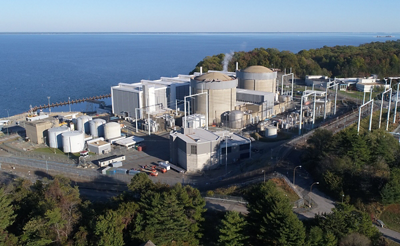
Image: Constellation
Amazon’s latest nuclear-power agreement covers 690 MW over 20 years. For electronics, the interesting part begins after that electricity reaches the data centre.
Constellation announced the Calvert Cliffs agreement on 30 September. It includes a planned 190 MW increase in generating capacity, expected to come online between 2030 and 2032, within more than $3 billion of infrastructure investment in Maryland.
All of Calvert Cliffs’ electricity will continue to enter the PJM regional grid. The agreement is not an announcement of a dedicated electrical connection from the nuclear plant to an AWS server hall, nor does it reveal Amazon’s rack-level power architecture.
That distinction separates two engineering problems: securing energy over years and delivering controlled power to silicon over fractions of a second.
The losses sit between the grid and the chip
Power passes through conversion and distribution stages before reaching a processor’s low-voltage supply rails. Each stage has losses. Resistive losses in cables, busbars, connectors and PCB conductors add to those in the converters themselves.
A technical treatment published by Texas Instruments examines this problem through 48 V distribution and conversion to low-voltage loads. Its central point remains useful: reducing losses in a converter alone does not necessarily minimise losses across the complete power path. The intermediate bus and its conductors must also be included.
Consider an illustrative 10 kW load, ignoring conversion losses. At 12 V it requires approximately 833 A. At 48 V it requires approximately 208 A. With the same conductor resistance, the higher-voltage path would have one-sixteenth of the resistive loss because that loss follows current squared times resistance.
That is a comparison of the distribution path, not a claim that changing rack voltage makes an entire data centre sixteen times more efficient. Real designs also change conductor dimensions, converter topology, protection and operating conditions.
The voltage still has to come down
Processors cannot use the distribution voltage directly. The step down to their supply rails places further demands on switching devices, magnetics, capacitors and control loops. Moving conversion closer to the load shortens high-current paths, but also concentrates heat and competes for physical space near the processor.
Efficiency numbers need a load condition. As a simple illustration, delivering 100 kW through a conversion stage operating at 98% efficiency requires approximately 102.04 kW at its input. The difference, about 2.04 kW, becomes heat. At 97%, the loss rises to approximately 3.09 kW. These are calculations, not measurements of AWS equipment.
An energy contract does not set the transient response
A long-term supply agreement cannot specify how a board responds when processor current changes abruptly. Local energy storage, regulator response and distribution impedance still govern the voltage seen by the load. Backup systems also remain a separate part of continuity planning.
Calvert Cliffs addresses the availability and economics of generation on a large scale. The electronics-design question is how much of that purchased energy reaches useful computation, and whether the power path can maintain the required voltage during changing workloads. Answering it requires measurements across the actual system, from conversion losses and thermal conditions to load-step behaviour.
Sources
- Constellation announcement, 30 September 2026
- TI technical article, August 2016; used for established power-conversion principles, not current market forecasts
- Original TEB calculations: P = VI; resistive loss = I²R; converter input = output / efficiency. Illustrative values, not AWS measurements.