A second patterned layer cuts reflections in a flat lens
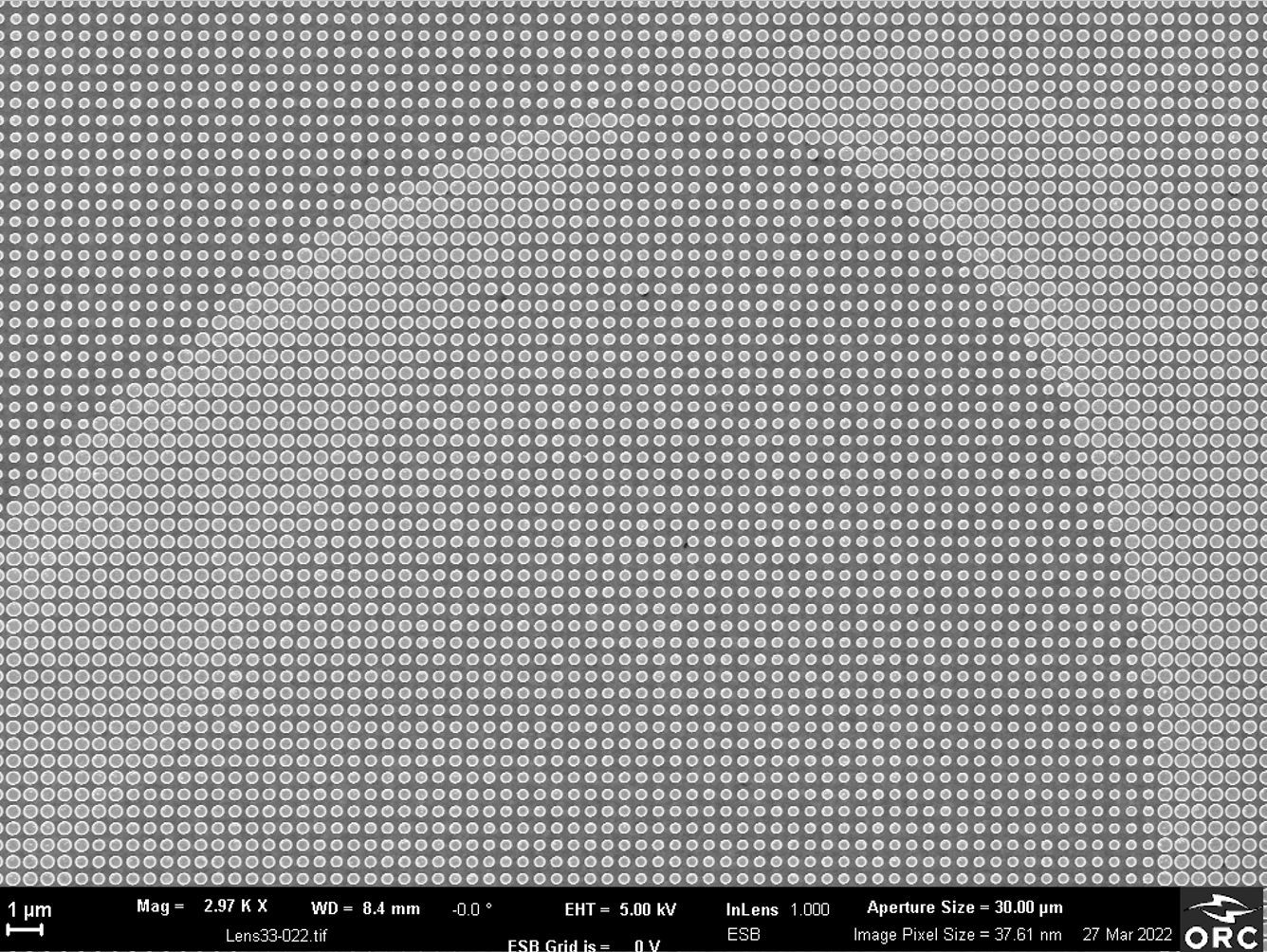
Image: Rmdigh · CC BY-SA 4.0
Researchers have built a flat lens whose microscopic features are designed to control how much light they reflect as well as where they focus it. Using two patterned layers of titanium dioxide, the team measured about 90% focusing efficiency near 1,310 nm, against 86% for a single-layer control with the same aperture and focal length. Both figures use the transmitted power through bare glass as the reference.
A metalens brings light to a focus by imposing a different phase delay at each point across its aperture. The phase profile comes from variations in the geometry of structures smaller than the wavelength. Those same variations also change the optical properties that determine reflection at the surface. A conventional uniform coating has no way to follow them across the lens.
The additional patterned layer provides another geometry to vary. The researchers designed it together with the focusing layer so the two could preserve the intended phase delay while reducing the reflection from each part of the surface. In full-device simulations, calculated reflectance fell from 5.1% for the single layer to 1.2% for the two-layer design.
In the lab, the team patterned the two layers separately with electron beam lithography, using alignment marks to register the upper features with the ones beneath. The finished lens had a 250 µm diameter and a 1 mm focal length. It retained a diffraction-limited focus near 1,310 nm and outperformed the control across a measured wavelength span of at least 200 nm.
Electron micrograph showing the edge of a patterned metalens.