TI’s analogue withdrawals reopen the question of what counts as a replacement
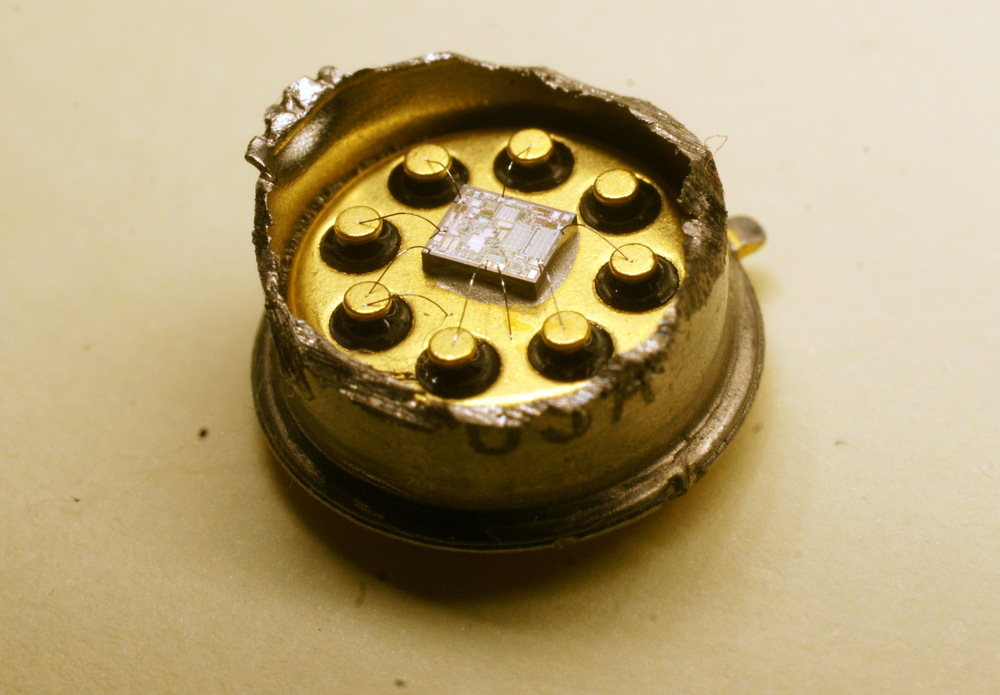
TI’s withdrawal notice names OPA4140AIDR as a replacement for OPA404AG, then marks it as a different package with no pin-to-pin match. That is an unusually useful starting point for an obsolescence decision: the manufacturer has identified a possible direction, while leaving a substantial amount of circuit work between the recommendation and a released design.
The affected ordering codes appear in notice 20251218007.3A. Final orders are due on 18 December 2026, with final shipment on 18 December 2027. The January revision explicitly corrects the shipment date printed in the earlier notice. TI cites unavailable manufacturing support and offers a final buy on terms that prevent cancellation or refunds.
More bandwidth, less output slope
The amplifier comparison shows why a newer device can improve several headline specifications and still need careful examination in the old circuit. OPA404’s data sheet lists a typical gain-bandwidth product of 6.4 MHz and a typical slew rate of 35 V/μs. The OPAx140 family data sheet lists 11 MHz and 20 V/μs respectively. More small-signal bandwidth therefore sits alongside a lower stated rate of output-voltage change. The figures are typical values under each data sheet’s specified conditions, rather than measurements of both parts in the same circuit. Even so, they identify a question that a simple bandwidth comparison would miss.
For an illustrative 1 MHz sine-wave output at 10 V peak-to-peak, the maximum slope is 2πfVpeak: 2 × π × 1,000,000 × 5, or approximately 31.4 V/μs. That requirement is already above the successor’s listed typical slew rate. A circuit working at a much smaller amplitude asks a different question of the amplifier, which is why an apparently satisfactory frequency sweep can leave a large-signal problem undiscovered.
The comparison changes again at DC. At 25°C, the OPA4140 family specification gives a maximum offset of 120 μV and maximum input bias current of 10 pA. OPA404AG’s corresponding table gives ±1 mV maximum offset and ±8 pA maximum bias current at ±15 V supplies. The successor’s lower offset is attractive, but the source impedance and temperature range determine how much weight the bias-current difference deserves.
There is no single ranking that captures those trade-offs. A slowly varying measurement may benefit from lower offset, while a circuit producing a large, fast waveform may be more constrained by slew rate. The package change adds physical work before either electrical outcome can be established. The notice contains several other kinds of migration. OPA637AU is paired with a pin-matching OPA828 ordering code; selected programmable-gain amplifiers point towards PGA280, while BUF634F/500 and ACF2101BU have no similar device listed. These are different engineering tasks, despite arriving in one withdrawal document.
For OPA404AG, the package change alone prevents a simple substitution on the existing footprint. The separate bandwidth and slew-rate questions then determine how much of the original circuit can survive the physical redesign.
Sources
- TI corrected withdrawal notice 20251218007.3A, January 2026
- OPA404 data sheet
- OPAx140 family data sheet
Image: Opened OPA627 operational amplifier package. ZeptoBars.ru. Image source. CC BY 3.0.