Replacing obsolete glue logic means reproducing the circuit’s behaviour
Force Technologies describes rebuilding obsolete 74-series logic in programmable devices, with one device able to absorb functions previously spread across several simple parts. The attraction is straightforward: it offers a way to preserve an otherwise useful system when particular logic components disappear from the supply chain.
Consolidating the Boolean functions is only part of that job. The original circuit also established when signals changed, how they behaved between valid states and what happened as power arrived. Those details can be absent from a truth table even though the surrounding hardware depends on them. Force’s account, published on 21 October, is retrospective. It describes the company’s approach to building and testing replacements rather than announcing a new universal substitute for the 74 series. It does not identify the programmable device used in the example.
Microchip’s ATF1502AS provides an independent example of the architecture: a 5 V CPLD with 32 macrocells, configurable registers, individual output enables and programmable output slew control. Its 44-lead packages also expose the physical work involved. Keeping a board of small logic ICs unchanged can require an engineered replacement assembly, including the appropriate pin mapping and interconnection.
The input has electrical behaviour of its own
The electrical behaviour at an input can be just as significant as the logic behind it. Consider an inverter used to clean up a slow signal from an RC network. A Schmitt-trigger input switches at different voltages as the signal rises and falls, providing hysteresis. Replacing it with an ordinary programmable input and the same inversion function would leave that hysteresis unaccounted for. TI’s application brief explains how a slow or noisy transition can cause repeated switching and excess current at a conventional input. A static test applying a firm low followed by a firm high could miss the entire problem, because the troublesome behaviour occurs while the voltage passes through the threshold region.
Timing creates another trap. Suppose two signals travel through different paths before meeting at a gate. Changing their relative delays can alter a pulse or expose a brief intermediate state, even when the final result is logically correct. A faster implementation may therefore disturb a circuit that depended, deliberately or otherwise, on the original propagation delays. If qualification covered only settled input and output states, it would provide little evidence about a pulse created by the relative delays of two paths. The replacement could pass those static checks while changing the waveform seen by the next stage.
What happens as power returns
Startup deserves the same attention. The ATF1502AS data sheet, for example, places conditions on its internal power-up reset: the supply must rise monotonically, the clock must remain stable during reset and setup times must be met before clocking begins. Its output state after reset also depends on buffer polarity. A system with a slow supply ramp or an independently powered neighbour can exercise conditions that ordinary functional operation never reaches.
Microchip also describes a reset option with larger hysteresis. With that option selected, a supply that falls below 2 V must shut off completely before the device is turned on again. That is a specific operating condition to reproduce in a system whose original glue logic may have had a different response to a supply dip.
Sources
- Force Technologies account of 74-series replacement work, 21 October 2026
- Microchip ATF1502AS/ATF1502ASL data sheet
- TI: Understanding Schmitt Triggers
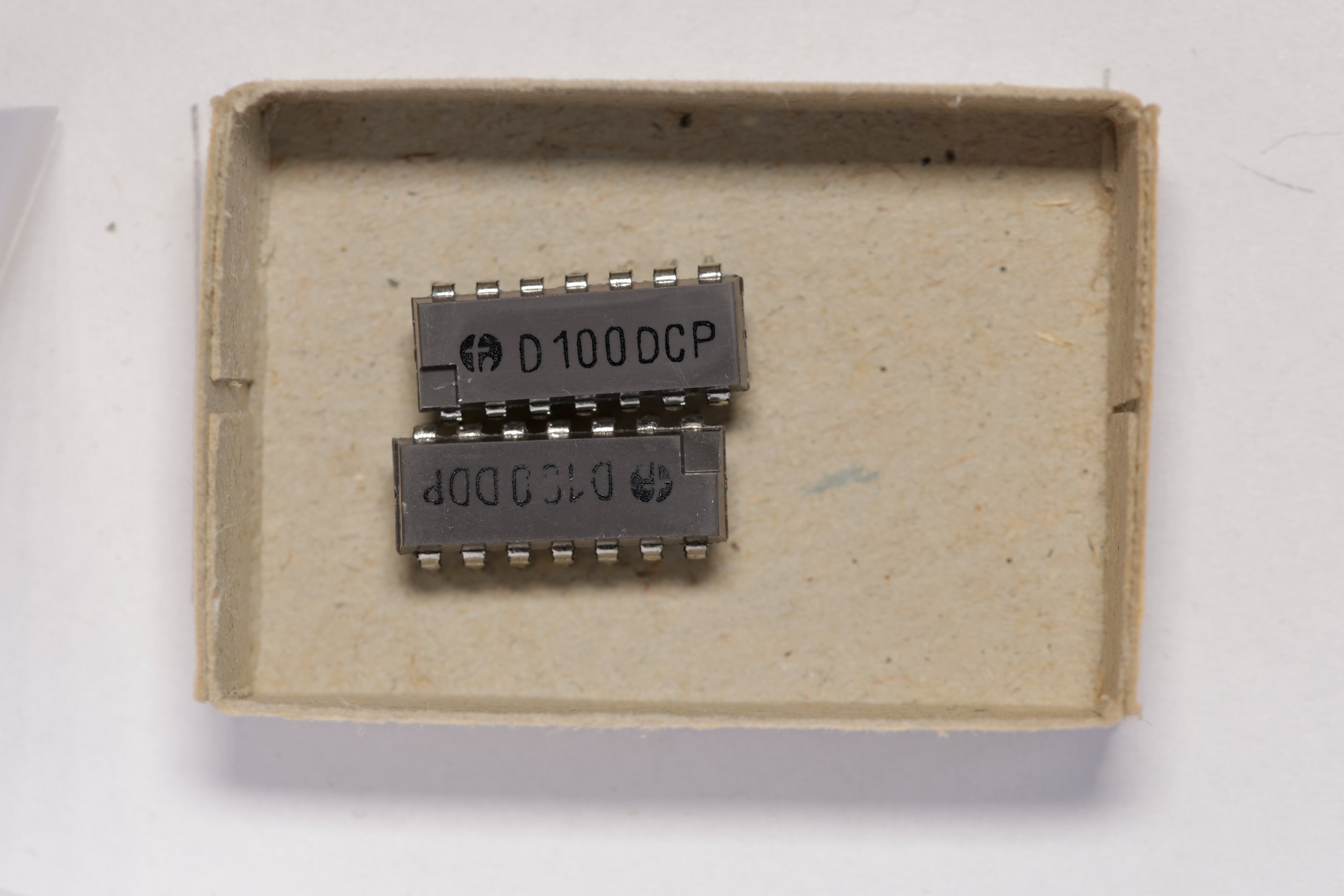
Image: HFO D100D 7400-compatible logic integrated circuits. Archive photograph. ZCOM Zuse-Computer-Museum / Frank Zörner. Image source. CC0.