The electronics behind Tesla’s upside-down Roadster
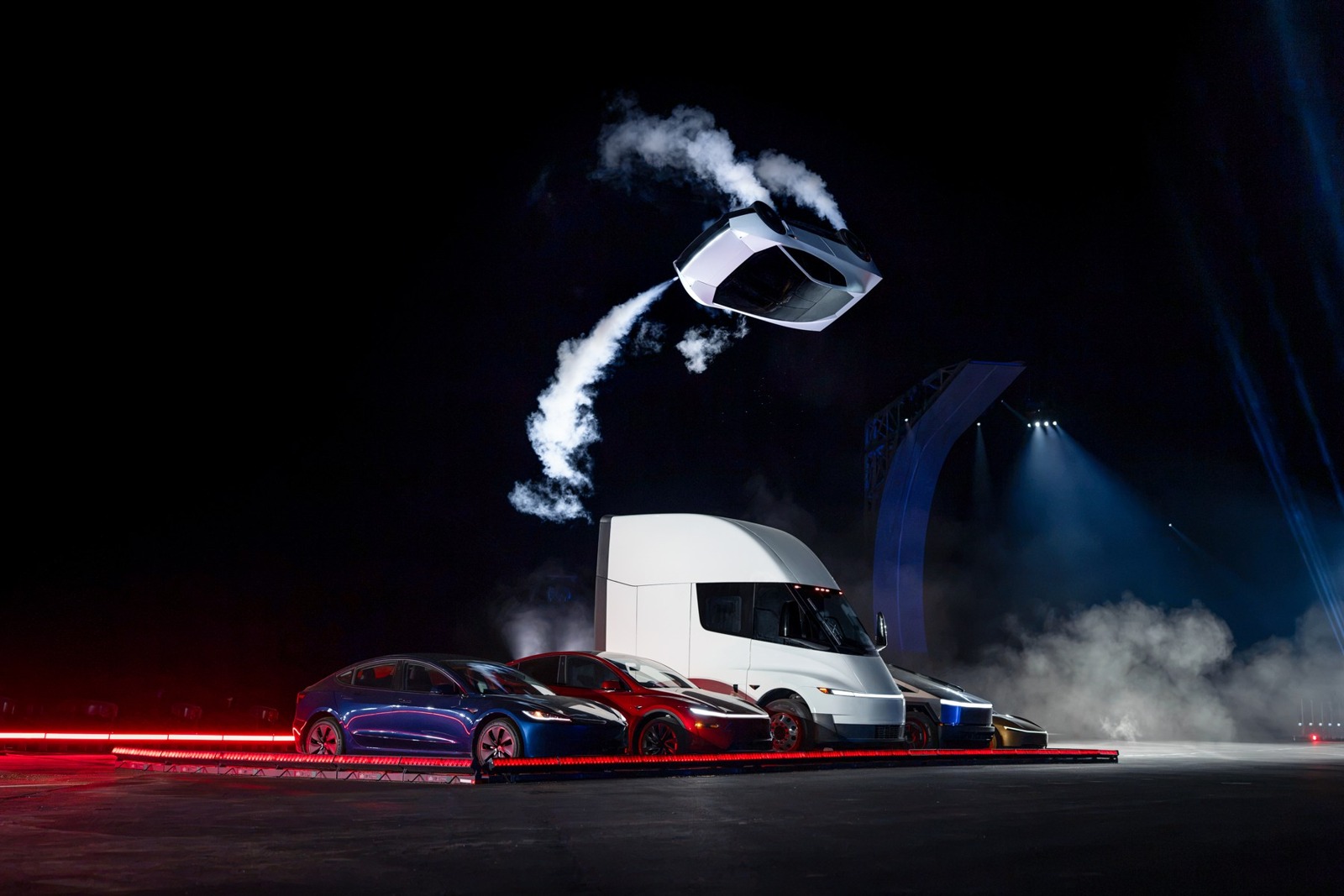
Image: Courtesy of Tesla, Inc.
Once a car’s tyres leave the ground, steering becomes a rather different proposition. The dramatic part of Tesla’s Roadster demonstration was the flip. The more interesting engineering question is how a vehicle changes from being controlled through its contact with a road to being controlled by forces applied around its body.
Tesla’s public description gives us several pieces of that system: powered suction fans, active aerodynamic surfaces, steer-by-wire and cold-gas thrusters with electric actuators. It does not provide the electronic architecture or control software. There is enough to explain the engineering involved, but not to produce a credible list of the car’s sensors and chips.
The demonstration at SpaceX’s Texas facility showed a vehicle driving upside down on a curved ramp before an airborne manoeuvre. Tesla says production is planned for 2028. What has been demonstrated should therefore be kept separate from the specification and approval of a vehicle customers can buy.
Two ways of applying force
The suction system draws air from beneath the Roadster. Tesla says it can generate sufficient downforce to hold the vehicle against an inverted surface even when stationary. Unlike the aerodynamic force from a conventional wing, this does not depend on the car first reaching a high road speed.
In electronics terms, the fan is an actuator: electrical power is converted into a controlled mechanical effect. Holding a requested force under changing conditions is a control task, not simply a matter of switching a fan on. The pressure difference, the effective area and the air escaping beneath the vehicle all influence the resulting force. Tesla has not published enough detail to identify how it measures or regulates that force.
Cold-gas thrusters do another job. They expel stored gas to create thrust, so their force does not require a tyre to push against the road. Tesla explicitly describes electric actuators making rapid adjustments to help stabilise the vehicle in flight. The electricity operates the actuators; the expelled gas supplies the reaction force.
Where a thruster acts matters as much as its output. A force through the centre of mass principally changes translation. A force acting away from it also produces a turning moment. Several thrusters can therefore influence both movement and orientation, depending on their positions and which ones are operating.
That is familiar territory in spacecraft control. NASA’s guidance on attitude control explains why thruster placement and unwanted torque have to be considered together. The underlying mechanics apply here too, although a short hop in Earth’s gravity is a very different operating environment from a spacecraft manoeuvre.

Knowing when to stop turning
Starting a rotation is only half the problem. The vehicle must also arrest it before touchdown. A controller needs information about motion, a requested state and an actuator command that moves the system towards that state. Delay between measurement and force application changes the response, particularly during a rapid manoeuvre.
NASA’s published work on reaction-control systems treats actuator behaviour, jet selection, filtering and control stability as connected subjects. It is a useful explanation of the problem, not evidence that Tesla uses NASA’s algorithms or a particular aerospace controller.
Steer-by-wire introduces a separate electronic control path while the tyres remain in contact with a surface. The general architecture replaces the mechanical steering connection with sensing, communications, actuators and software. Bosch’s description of its own steering systems highlights redundant safeguards for safety-critical functions. Bosch is cited here to explain the technology, not as an identified Roadster supplier.
Tesla has not disclosed its sensor set, processor selection, network timing or fault-handling architecture for the airborne system. Its published specification also limits some capabilities to particular configurations and regions. The company describes the Rocket version as a single-seat vehicle, distinct from the two-seat road-oriented configurations.
Sources: Tesla Roadster: manufacturer’s system descriptions and configuration qualifications; Reuters: demonstration and planned production; NASA: guidance, navigation and control, section 5.2.4; NASA: reaction-control design and stability; Bosch: by-wire architecture and redundancy; Official image collection and editorial-use terms.