RAPTORS targets analogue computation in the radio front end

AI-generated illustration: The Electronics Brief
The RAPTORS research programme is being designed around a radio front end that does more than receive and pass on signals. By combining reconfigurable metamaterial antennas with analogue computation, researchers at Duke, Northeastern and Yale aim to extract useful information closer to the antenna, reducing the data that must travel through the rest of a sensing system.
The six-year, $9m US Army-funded programme, which also involves Raytheon, was announced by Duke in September. Northeastern’s account of its contribution, published on 19 November, describes RF integrated circuits being developed by Aravind Nagulu’s laboratory with Yale professor Arun Natarajan. Their work brings computation into the analogue signal path for workloads including radar, spectrum sensing and multiple-input, multiple-output systems.
“The closer we can process information to where the signal is actually received, the less data we need to move through the system,” Nagulu said. In this architecture, the front end would pass on information extracted from the received waveform, rather than leaving all interpretation to a digital processor downstream.
Correlation before digital processing
Earlier work from Nagulu’s laboratory provides a concrete example of the approach. A paper published in the IEEE Journal of Solid-State Circuits describes a fully analogue RF correlator fabricated in a 22 nm SOI-CMOS process, using margin propagation and a split-source follower circuit to perform the calculation without conventional multipliers.
Correlation compares a received signal with a template at different time offsets. A matching response can reveal the presence and delay of a coded radar return, so performing that operation in the analogue domain moves a specific piece of signal interpretation into the front end. The laboratory’s chip supports a 256-point cross-correlation across 256 lags, with input and template rates up to 4 GS/s.
The paper reports greater than eight-bit compute accuracy and demonstrates the circuit in a code-domain radar system with multiple-user operation. Its published efficiency of 1,000 1-bit TOPS/W is a normalised metric for the correlator; it does not describe the power consumption of a complete radar, nor is it interchangeable with an eight-bit neural-network accelerator rating.
The design also uses sampling to realise large analogue delays and a four-transistor compute cell to reduce the area and power of the repeated calculation. The authors report operation across process, voltage and temperature variations, addressing a central issue for analogue arithmetic: the calculation must remain useful as the physical circuit changes.
Designing the antenna and electronics together
RAPTORS combines this direction in RF computation with reconfigurable metamaterial antennas being developed at Duke. These antennas can be reprogrammed to change their direction of focus without mechanical movement or sweep across frequencies, producing signals that the closely coupled RF circuits would preprocess.
The programme also includes control systems for unmanned aerial vehicles, led by Duke professor Miroslav Pajic, to move the sensing platform in search of weak or intermittent sources. Raytheon will help define the signal types, system requirements and eventual test scenarios. The antenna, analogue processor and platform controls are being developed together around those tasks; the complete receiver remains a research objective.
Sources: Northeastern: Nagulu laboratory contribution, 19 November 2026; Duke Pratt: original programme announcement, 4 September 2026; Northeastern: original correlator paper abstract, 22 October 2025.
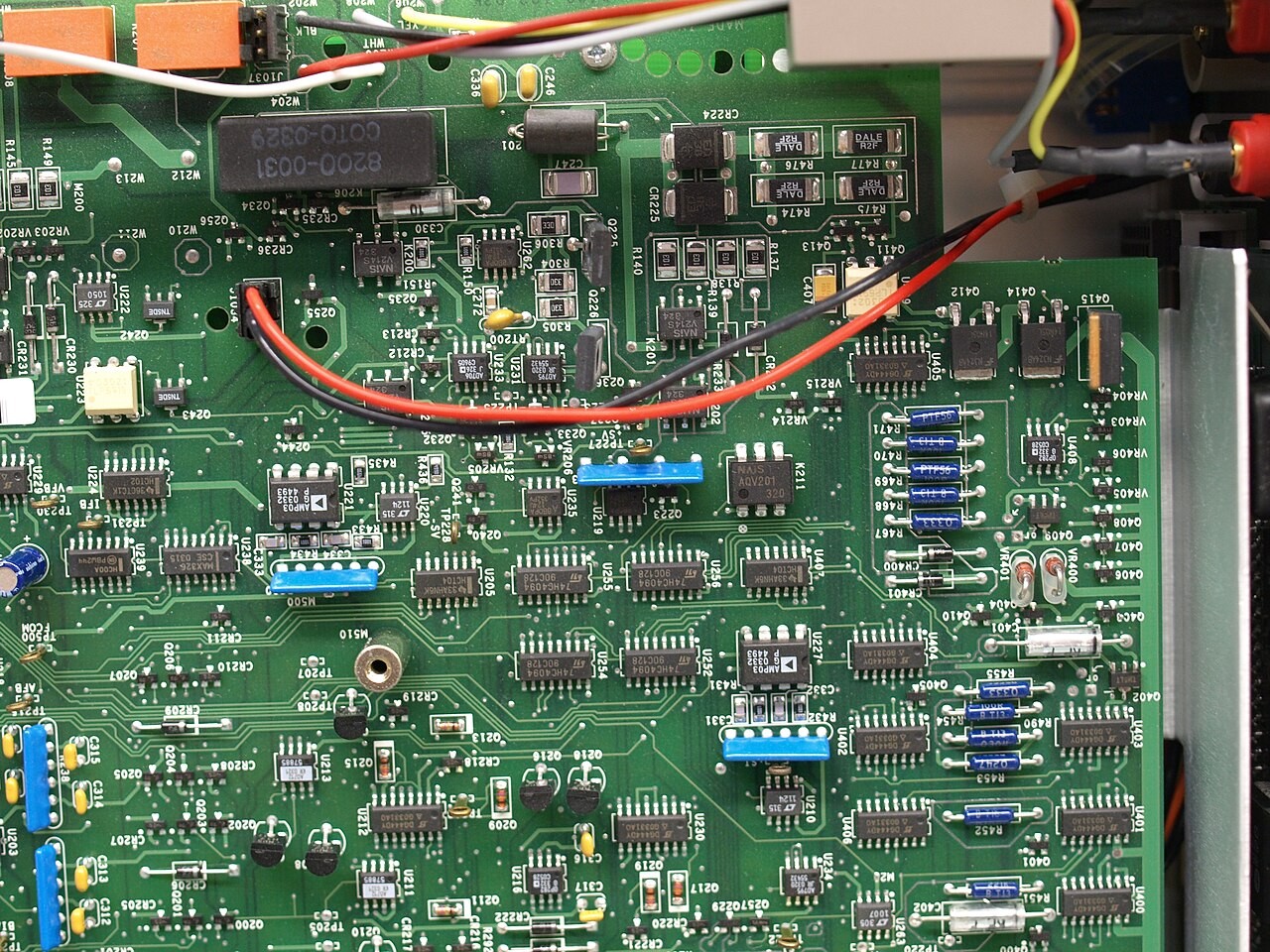
Conceptual illustration of signal processing close to the antenna. Illustration: The Electronics Brief (AI-generated).