Infineon expands ZuriQ tie-up on trapped-ion quantum chips
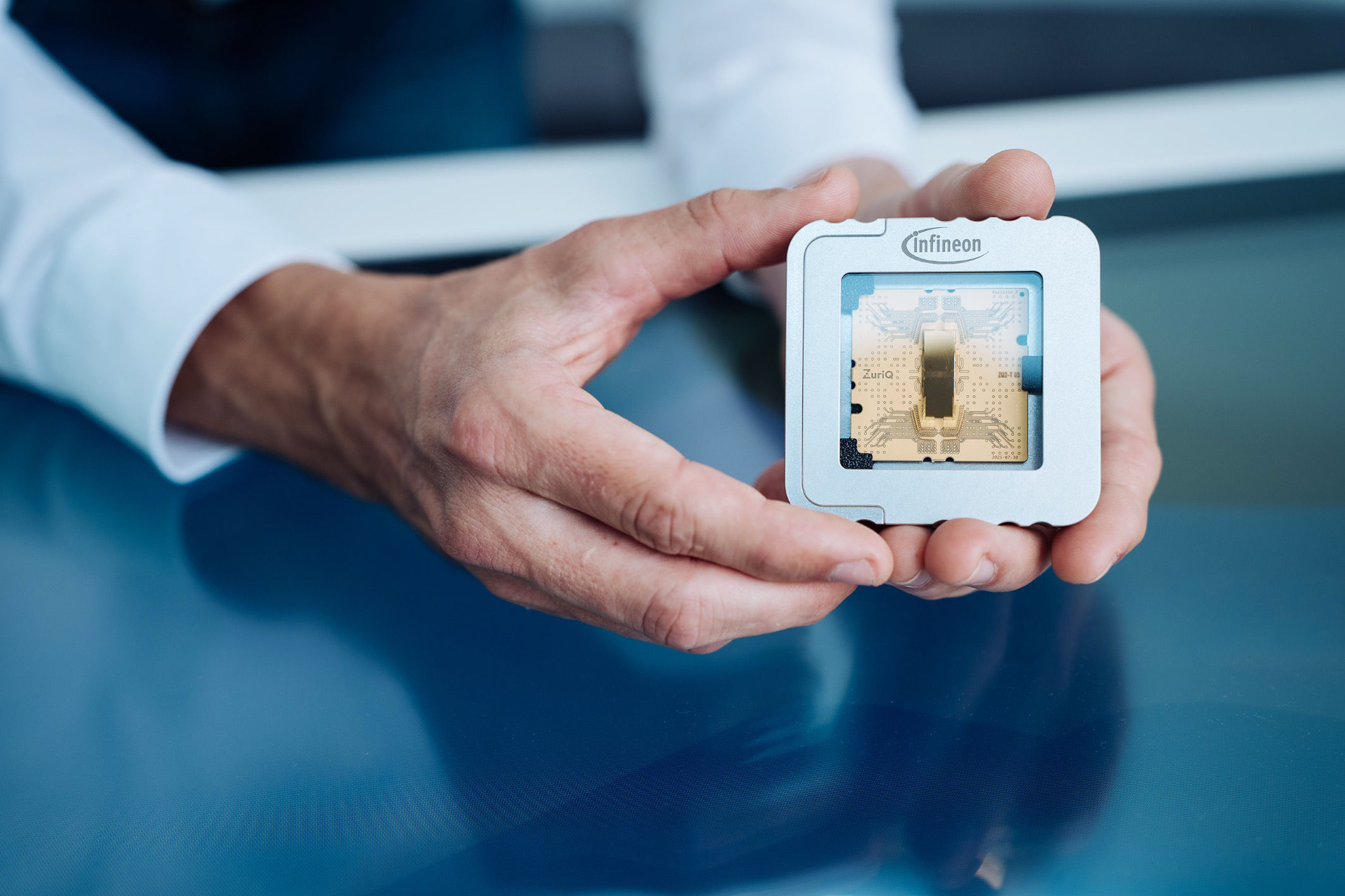
Image: Infineon
Infineon Technologies and Swiss start-up ZuriQ have expanded their collaboration on trapped-ion quantum computing hardware, aiming to scale qubit counts beyond earlier demonstration work.
From nine-ion array to larger systems
According to Infineon, previous joint development showed the feasibility of ZuriQ's architecture by trapping a 3x3 array of nine individually controlled ions, described by the companies as the largest two-dimensional array of its kind to date. The partnership's next step is scaling to significantly larger qubit counts, combining ZuriQ's trap design with Infineon's semiconductor manufacturing, advanced packaging and integrated photonics expertise.
Penning micro-trap architecture
ZuriQ's approach uses a natively two-dimensional Penning micro-trap, applying electric and magnetic fields to move ions directly across the chip. Infineon states this avoids the complex junction structures required by conventional one-dimensional ion-chain designs, making larger qubit arrays easier to accommodate.
Infineon describes the work as a step toward industrialising trapped-ion quantum processing units, moving from laboratory demonstration toward manufacturable hardware. No qubit count target, timeline or system specification was disclosed beyond the nine-ion demonstration already achieved; the announcement covers an expanded research collaboration rather than a shipping product.
ZuriQ, founded in 2024 as an ETH Zurich spin-off, focuses on high-fidelity quantum operations and reconfigurable quantum systems. Infineon's role centres on semiconductor process development, integration and advanced packaging to support future large-scale trapped-ion systems.