GigaDevice puts a 600 MHz MCU on joint control in a six-axis robot
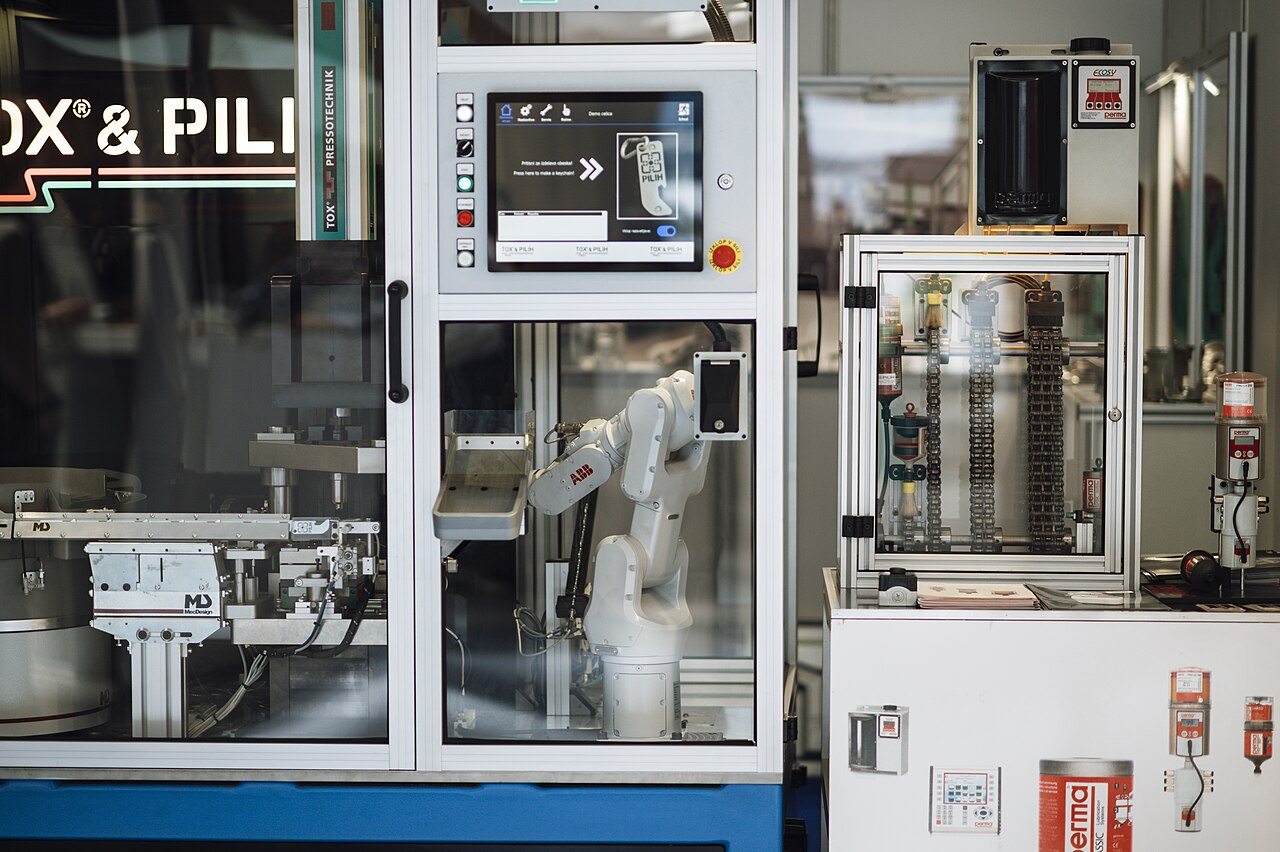
Illustrative industrial robot arm. Nenad Stojković (Shixart1985) / Wikimedia Commons · CC BY 2.0 · Resized for display
GigaDevice is taking a six-axis collaborative robot arm to electronica to demonstrate joint control on its GD32H77R microcontroller. The chip uses an Arm Cortex-M7 core running at up to 600 MHz, with absolute encoders providing position feedback and the drives communicating through CANopen over EtherCAT using CiA 402 drive profiles.
The demonstration divides control between a host that plans the arm’s movement and electronics that execute it at the joints. The host handles trajectory planning, teaching and playback as well as system monitoring. At the axes, the controller has to act on fresh encoder readings while following the commanded motion. That separation lets the host calculate how the arm should move without placing every part of the joint feedback loop in the same software task.
CiA 402 gives the drives a defined interface for commands, operating modes and status. That makes it possible to describe how the host and drives exchange information, but it leaves open how frequently the joints are updated and how they behave if commands are delayed. The core clock is only one part of that picture. Control-loop frequency, EtherCAT cycle time and worst-case timing variation would tell more about how closely the axes stay coordinated when the arm changes direction or encounters a load. GigaDevice has not published those measurements for the show setup.
The company also describes hand-guided teaching, obstacle avoidance and collision protection in its preview. Those are stated functions of the demonstration. The announcement does not establish a safety rating for the arm as a deployed machine.
Sources: GigaDevice electronica announcement.