Why a healthy industrial computer can reset beside a motor cabinet
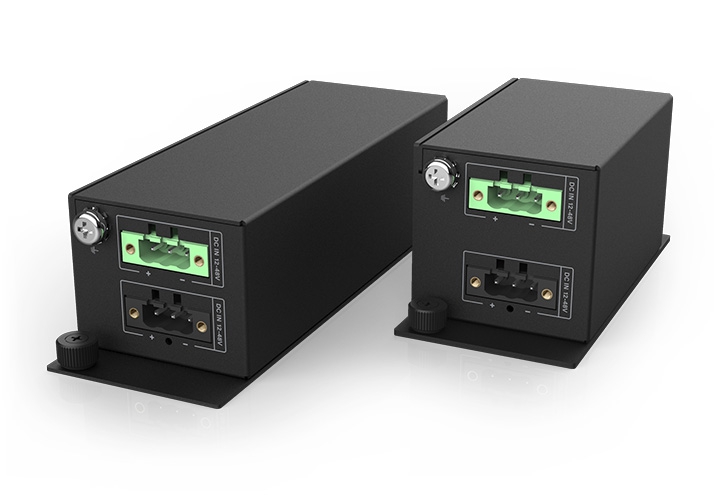
Image: Cincoze
A reset that happens only when a contactor opens is a poor reason to begin rewriting the application. The timing points towards the installation: a disturbance is reaching the computer when something elsewhere in the machine switches.
Electrical fast transients are one possible explanation. Average supply readings may look perfectly reasonable while a much faster event upsets the electronics. Investigating the DC input is therefore sensible, although it is only one of the possible routes into the system.
Cincoze’s external Power Protection Modules address that input connection on specified industrial computers. The PPM-I180 supports 180W systems and the PPM-I360 supports 360W systems, with compatibility defined by computer family. Their slide-rail mounting allows the protection stage to be added outside the computer rather than incorporated into every base configuration.
The larger module’s data sheet is more informative than the power rating alone. It specifies 12–48V DC input and output, reverse-input protection, a 51V overvoltage protection level and a 15A input overcurrent protection figure. Those ratings describe a particular module, rather than a general promise that a computer will tolerate whatever reaches the cabinet.
Filtering and fault protection also perform different jobs. In Texas Instruments’ published 24V servo-drive reference design, an input filter handles common-mode and differential-mode noise, while an eFuse provides functions including current limiting and overvoltage protection. The example shows why a protection stage often contains several functions: attenuating interference and disconnecting a faulty supply are separate electrical problems. It does not establish the circuit used inside Cincoze’s module.
A disturbance entering through an encoder cable or communications connection follows a different route. Protection on the DC input may leave that path essentially untouched. The reset can occur at exactly the same switching event in either case, so the timing identifies a trigger without, on its own, identifying the entry point.
Cincoze refers to EFT immunity testing under EN/IEC 61000-4-4. The industrial standards named in its announcement cover two further categories: 61000-6-2 concerns immunity to electromagnetic disturbances, while 61000-6-4 concerns emissions from the equipment.