EPC Space adds plastic and hermetic packages to its spacecraft GaN range
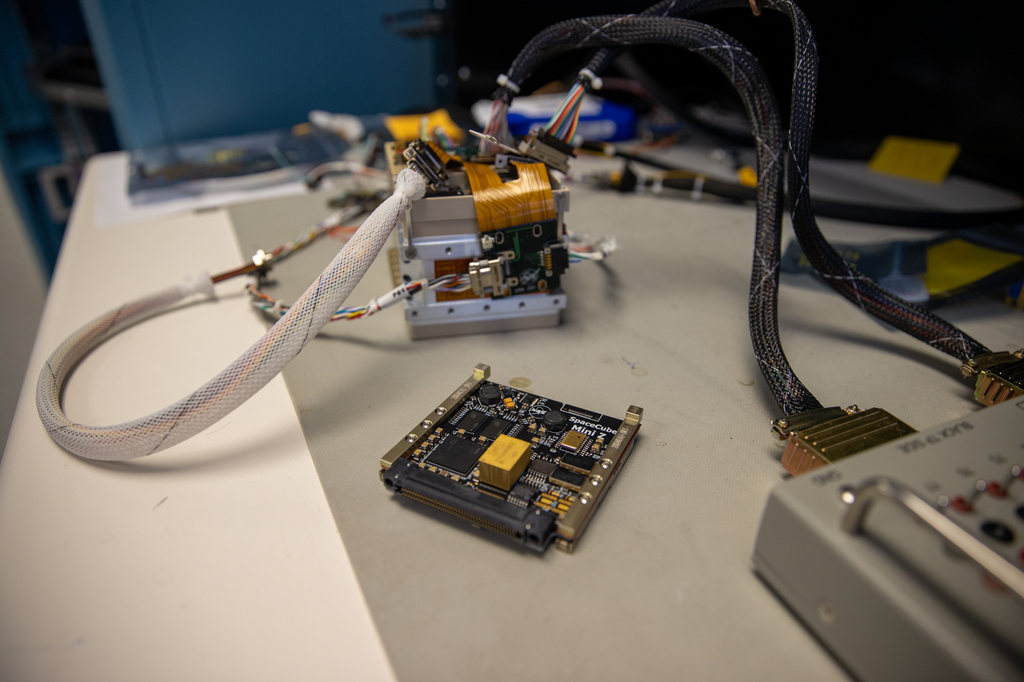
EPC Space has added plastic QFN and hermetic packages to its range of 100 V to 200 V gallium nitride power transistors for spacecraft. It prices the plastic parts at $17 for an engineering model or $68 for a space-qualified device, in quantities of 500.
At 100 V, the plastic EPCS5007PAC has the lowest maximum on-resistance in the family, 1 mΩ. Heat can leave through the top as well as through the board: the exposed surface is electrically connected to the source and has a junction-to-case thermal resistance of about 0.2°C/W. The flank of the package can also be inspected optically for solder wetting after reflow.
The 1 mΩ figure comes from a test that limits self-heating, using four-wire sensing and an 80 µs pulse at no more than 1% duty cycle. With the junction at 25°C, the gate driven to 5 V and 50 A flowing, EPC gives 0.75 mΩ typical and 1 mΩ maximum. At 1 mΩ the device dissipates 2.5 W during the pulse. A continuous 50 A load gives the junction time to warm, raising the on-resistance and with it the power dissipated at the same current. The separate 133 A continuous rating requires the junction to stay below 125°C.
In a converter switching at high frequency, the driver also has to move charge on and off the gate each cycle. EPC specifies 28 nC typical at 50 V drain voltage, 50 A drain current and 5 V gate drive. The device has no body-diode reverse-recovery charge, although charging its output capacitance still costs energy at a switching transition.
Both the 150 V and 200 V families include 63 A and 133 A switches. Where a mission calls for a hermetic 100 V part, the EPCS9001DC offers a 90 A rating at 25°C ambient, a maximum on-resistance of 2.2 mΩ and a separate source-sense pin. EPC also gives a radiation result for this particular device, specifying single-event immunity up to a linear energy transfer of 37 MeV·cm²/mg in silicon with the drain biased at up to 80% of rated breakdown voltage.
Sources: EPC Space: portfolio announcement; EPCS5007PAC datasheet; EPCS9001DC datasheet.