Your eMMC can run out of write life before it runs out of space
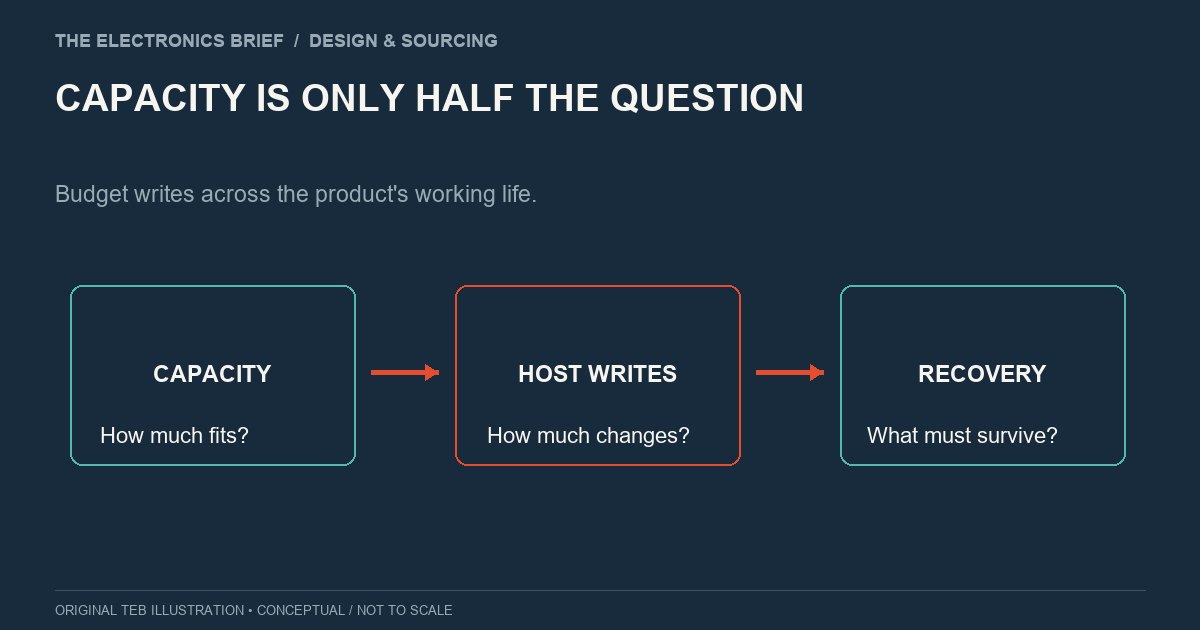
Illustration: The Electronics Brief. Conceptual diagram.
The storage device still has plenty of free space. That is reassuring if the question is whether another software image will fit. It says much less about whether the memory can tolerate years of repeated logging.
An embedded product's storage workload can change without a board revision. A new diagnostic feature, a database update or more frequent telemetry may all change what is written. If the memory was selected against an old workload, the original qualification deserves another look.
Put a number on the writes
Micron describes eMMC as managed NAND, with media management and error correction handled inside the device. That reduces the work required of the host, but the device still needs to be selected for the application. A standard interface is not an endurance specification.
Measure host writes during representative operation, including startup, fault logging and updates. Keep the occasional large transfer visible alongside the daily total. Then ask the supplier to assess that workload against the particular part, its configuration, operating conditions and intended service life.
For scale, a hypothetical 100 MB written each day adds up to 182.5 GB over five years of 365 days. At 1 GB a day, the total is 1.825 TB. Those decimal figures are host traffic, not a prediction of NAND wear or time to failure. They are useful for exposing a tenfold workload change that a capacity-only comparison would miss.
“Power-loss protection” needs a follow-up question
Which data is protected, and under what conditions? Micron's FAQ describes configurable protection for static, previously written data in the devices it discusses. That wording should not be stretched into a promise that an interrupted write or application transaction will finish successfully. Confirm the behaviour and required settings for the exact part being considered.
The application team also needs to say what recovery means. A controller that boots after a power cut may still have lost a transaction the application had reported as saved. Another product may legitimately discard its newest diagnostic sample. Testing needs to distinguish those outcomes.
Give a replacement supplier the workload
“Same capacity, same footprint” is a thin brief for an alternative memory device. Add the configured operating mode, temperature grade, endurance requirement and expected power-interruption behaviour. Supply the software version and measured workload used in qualification, so the comparison can be repeated.
Where the supplier's documentation leaves a gap, resolve it before treating two parts as equivalent. For a product expected to remain in manufacture for years, establish how changes to the memory device will be notified and assessed too.
The same discipline applies to software releases. If a new feature increases writes substantially, include that change in the storage review. It is easier to revise a logging policy before deployment than to revisit a soldered-down memory choice across the installed fleet.