A sensor hidden inside a bearing wins at electronica
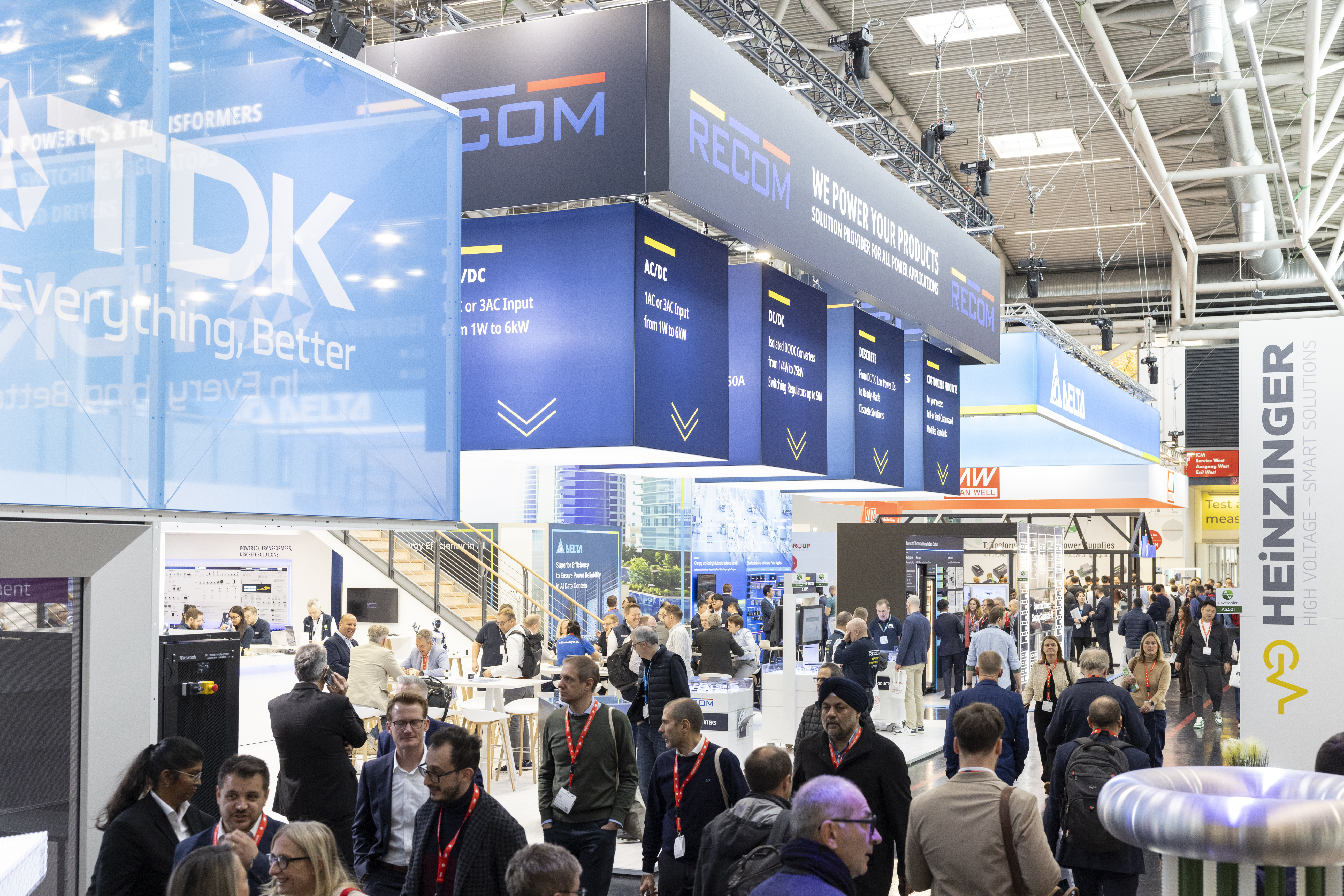
Visitors on the show floor at electronica 2026 in Munich. © Messe München. Official photo gallery · Editorial usage terms
How HCP Sense measures the load on a bearing
The last day of electronica started with a prize for a part that usually spends its life hidden inside a machine. HCP Sense won the Fast Forward award for using a rolling bearing to measure the load it’s carrying. When there’s a film of lubricant between the metal surfaces, the contact behaves like a tiny capacitor. As the load changes, so do the thickness of that film and the size of the contact area, and HCP Sense measures the resulting change in electrical impedance to work out what’s happening inside the bearing while it runs.
The same approach can tell you something about the lubrication itself. HCP Sense says Knorr-Bremse has used it to test bearing lubrication during development, which makes the idea a bit easier to picture. You can change how the bearing is lubricated and see how it responds on the test rig, while there’s still time to change the design.
A fan without blades and a wearable that reads glucose with light
Myvox took the Best Tech award for a silicon microfan that uses vibrating piezoelectric membranes to move air. The appeal is easy to see when you’re trying to cool a board in a shallow enclosure, although the interesting number will be how much air it can move once you put a lid on and give the air a route past the other components. LIOM, which won the Future Impact Award, is working on a different sort of packaging problem. It’s trying to fit the optics for Raman spectroscopy into a wearable, where tiny changes in the wavelength of scattered laser light could give it a way to track glucose through the skin.
DeepGate puts AI models to the test on real hardware
DeepGate won the ST Innovation Award for a tool that takes a trained model, compiles it for a microcontroller and measures how it runs on the hardware itself. If a model misses its timing budget, the layer-by-layer results give an engineer somewhere to start looking. Over at the Embedded Developer Forum, Nordic Semiconductor tackled the hardware side of that question, explaining how it’s using the same Axon neural accelerator in a Bluetooth chip and its nRF92 cellular IoT series. A remote sensor could use that processing to decide whether a reading warrants an alert before it spends power sending anything.
CHERI puts memory checks in the processor
Next door at SEMICON Europa, the CHERI Alliance devoted its Friday session to a processor architecture that gives memory pointers their own limits and permissions. If a piece of software is given access to a buffer, the processor can check that a read or write stays inside it. The idea has been around for years, and the Munich programme looked at the work involved in getting it into actual processors and software.
And finally, a bin lorry that looks for batteries
One of the projects at Friday’s COSIMA student finals started with a problem familiar to anyone who’s ever wondered where to put a dead rechargeable toothbrush. The CellScan team from Karlsruhe Institute of Technology is developing a scanner for bin lorries that uses impedance spectroscopy to look for lithium-ion batteries in household rubbish. The idea is to spot the battery while it’s still in the wheelie bin, before it has a chance to start a fire in the compactor.
And that’s it for Munich this week. We started with Infineon’s 300 mm silicon carbide wafer, got into the finer points of wiring a factory with a single Ethernet pair and somehow ended up with a robot mower trying to find the lawn under a pile of leaves. We’ll come back next week with a proper look at what’s likely to matter once the stands have come down. In the meantime, if you spent four days crossing those halls, I hope you’ve got a seat on the way home.