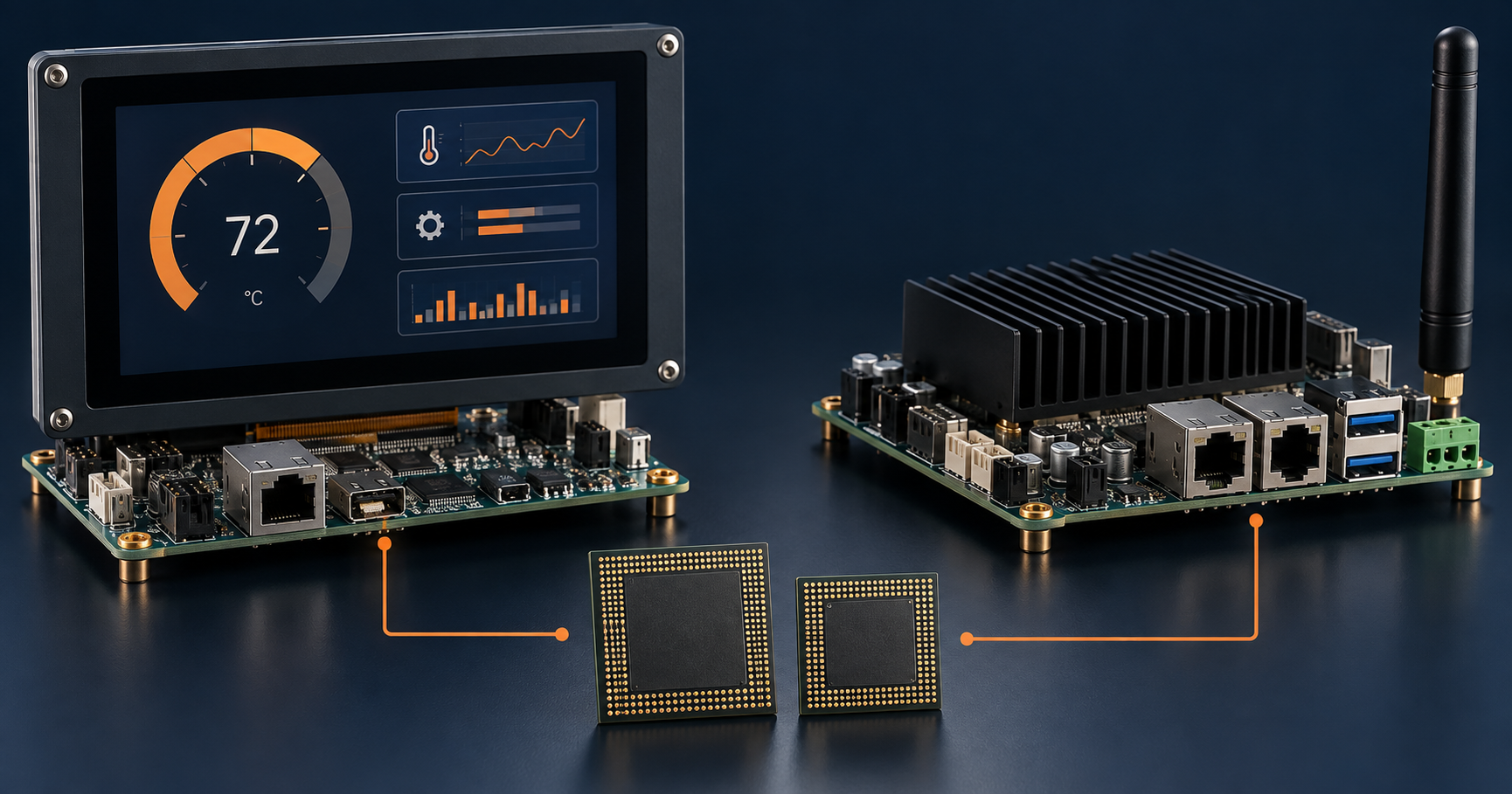
Renesas has introduced the RZ/G3L and RZ/G3SE as pin-compatible 64-bit microprocessors for product families ranging from graphical HMI equipment to headless IoT gateways. Both combine Arm Cortex-A55 application cores with a Cortex-M33 core; the G3L adds an Arm Mali-G31 graphics engine, H.264 capability and display-oriented interfaces that the simpler G3SE does not provide.
The commercial attraction is a shared hardware platform. A manufacturer could use one PCB architecture across a display-equipped premium product and a lower-cost headless variant, reducing layout work and the number of assemblies that must be maintained.
A common footprint does not guarantee that every surrounding choice can remain identical. Teams need to confirm power rails and sequencing, DDR4 or LPDDR4 layout and qualification, boot configuration, thermal headroom, clocks and the interfaces fitted to each variant. Unused high-speed interfaces can still influence layout and EMC decisions.
Software is equally important. A common SDK and operating-system base can reduce maintenance, but graphics, video and display dependencies should be isolated so the headless build does not inherit unnecessary complexity. Secure boot, update and key-management processes need to be proven for both configurations.
The RZ/G3L product information lists dual- or quad-core Cortex-A55 options, a Cortex-M33, Mali-G31 graphics, H.264, camera and display interfaces, PCIe Gen2, two USB 2.0 channels, three SD interfaces, CAN FD and two Gigabit Ethernet channels with TSN. Memory support includes a 16-bit LPDDR4-2133 or DDR4-2133 interface. Package options include 14mm and 17mm LFBGA devices.
Those capabilities make the part a plausible anchor for an HMI or connected industrial platform. The purchasing case still depends on the exact orderable device, production status, package, lifecycle commitment and memory combinations validated by Renesas.
The useful promise is therefore controlled reuse rather than automatic substitution. Teams that define the common platform around the least-common denominator, then document the power, software and thermal differences, are most likely to realise the intended saving.
Sources: Renesas RZ/G3L product information and September 2026 launch material.