Why the new Xbox handheld cools more than its processor

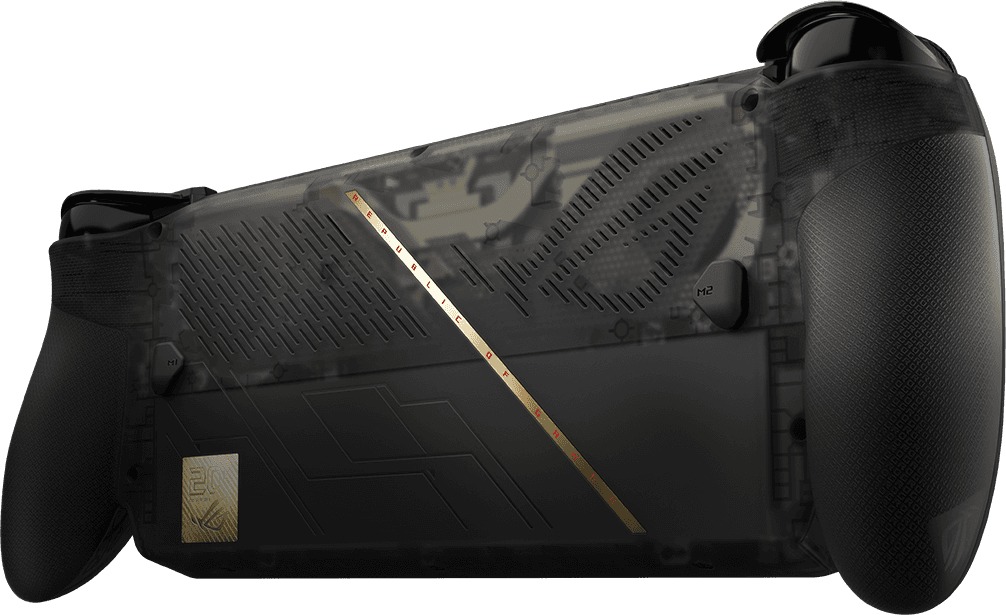
Image: ASUS / Republic of Gamers
A handheld gaming PC has a thermal limit that does not appear in a processor specification: someone has to hold it. Cooling the silicon is necessary, but it is not the whole design problem when a warm enclosure sits between two palms and a bright display occupies most of the front.
ASUS’s new ROG Xbox Ally X20 makes that distinction unusually visible. Its cooling system directs air along three paths, serving the OLED panel, heatsink fins and processor. The company describes the arrangement as a way to control component temperatures while keeping the handgrips comfortable.
The layout is worth examining separately from the anniversary colour scheme. It puts several different temperature constraints inside the same small enclosure, and the processor is only one of them.
Airflow is not a temperature measurement
ASUS says larger-diameter fans with fewer blades improve airflow by 20%, while heatsink fin area increases by 11%. These are manufacturer comparisons, not measurements made by The Electronics Brief. They do not mean the processor runs 20% cooler or delivers an equivalent increase in performance.
Moving heat from a chip to the room involves a series of steps. Heat must cross the package and its thermal interface, reach a heat-spreading structure and pass into the air. Increasing airflow changes one part of that path. Its benefit depends on the remaining thermal resistances, the air’s temperature and how much power the system is dissipating.
Routing some air behind the OLED panel also recognises that the screen is an active component with its own heat to manage. The display and processor need not reach their highest dissipation at the same time, and a comfortable grip temperature is a different constraint again. A single reported CPU temperature cannot describe all three.
The X20 has a 7.4-inch OLED display, an AMD Ryzen AI Z2 Extreme processor and an 80Wh battery. Battery energy is not a direct statement of operating time: an illustrative 80Wh divided by a constant 40W load gives two hours before allowing for losses, reserve capacity or a changing workload. That is arithmetic, not an X20 runtime prediction.
The joysticks use a different kind of sensor
The controls offer another electronics story. ASUS has moved to magnetic tunnelling magnetoresistance, or TMR, sensing in the joysticks and quotes a 3% dead zone. A magnetic position sensor avoids using an electrical wiper sliding over a resistive track to measure movement.
Inside a TMR sensing element, magnetic layers are separated by a thin insulating barrier. Changes in their relative magnetic alignment alter the junction’s resistance. A readout circuit turns that response into a usable position measurement. The magnet, sensor geometry and signal processing therefore matter alongside the sensing material.
Allegro MicroSystems’ application note on TMR angle sensing shows one implementation using two bridge outputs, signal conditioning, digitisation and an angle calculation. It also explains how magnetic-field conditions and temperature affect error. That is background on the technology, not an identification of the sensor supplier or circuit fitted inside the X20.
Contactless sensing removes a particular wear mechanism. It does not remove the joystick’s springs, bearings, mechanical tolerances or need for calibration. The dead zone is also a system setting: the software must decide how much movement around centre counts as an intentional input.
ASUS lists the standalone X20 at £1,299.99 on its UK site. Its Travel Mode caps charging power at 65W for compatibility with travel power outlets; that figure describes charging, not the processor’s power allowance.
Sources: ASUS availability release: cooling paths, fan comparisons and charging mode; ASUS UK product page: hardware, price and official images; Allegro AN119: TMR sensing mechanism, readout and error sources.