Why Singular Photonics counts photons on one grid and times them on another
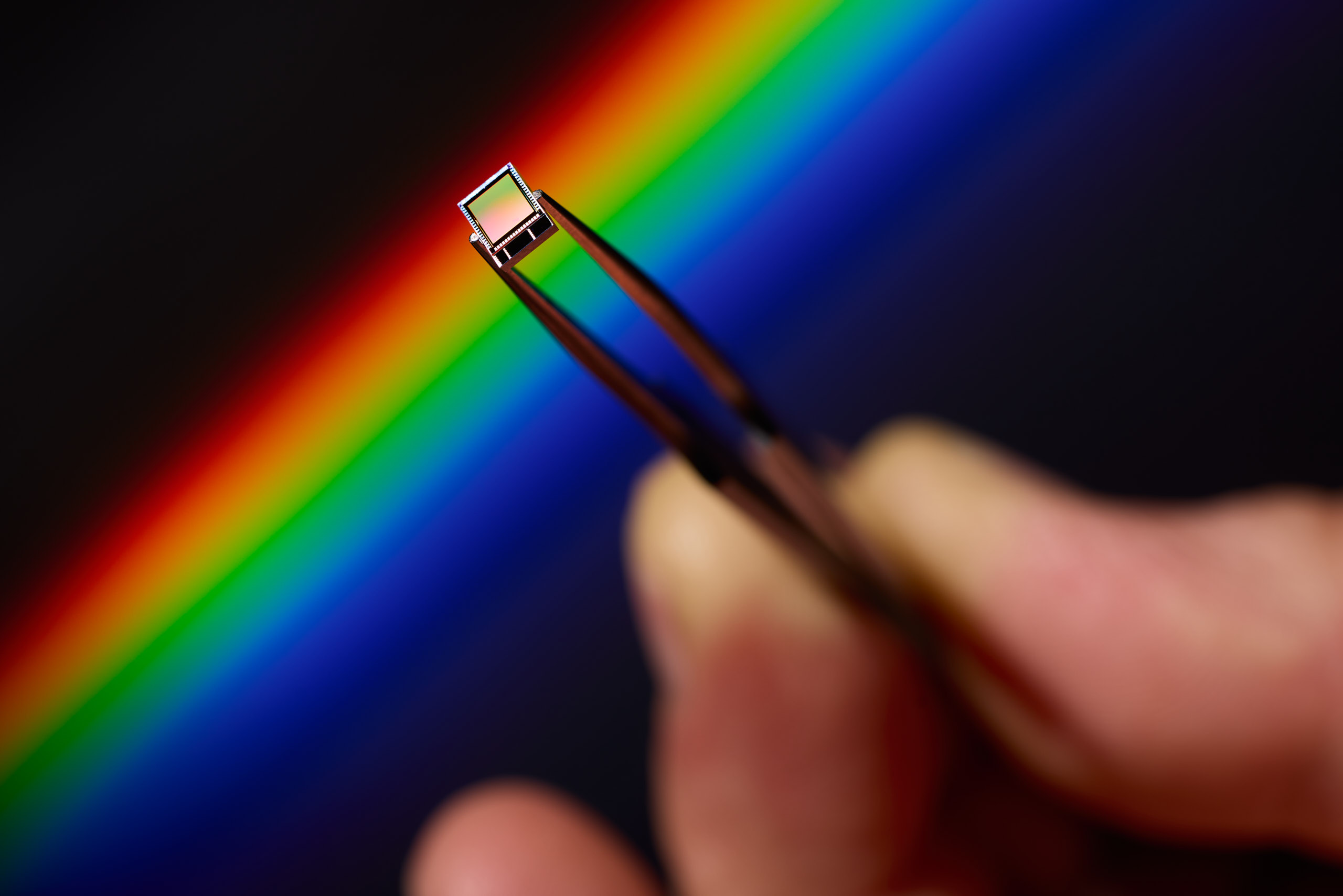
Image: Singular Photonics
In fluorescence lifetime imaging, two regions can return the same number of photons after a pulse and still look different once you plot when those photons arrived. A faster decay can distinguish one region from another even when their brightness looks alike. The sensor has to retain a timing relationship with the pulse across many detections, and the electronics have to decide whether to send those detections out individually or reduce them to counts in time bins.
Litavis, the sensor Singular Photonics launched in September, is built around single-photon avalanche diodes. An avalanche turns a detection into an electrical event that CMOS logic can count or time. The chip produces a 256 × 256 photon-counting image while generating a lower-rate stream of timestamped events on a 64 × 64 macropixel grid. The timing grid is four times coarser along each axis, with one sixteenth as many positions as the intensity image. A bright feature in the full image can therefore be located more finely than the time signature associated with it.
The sensor can also accumulate arrival-time histograms in the array and limit acquisition to a programmable window. Histogramming retains how many events landed in each interval without asking an external processor to sort every one. It also discards the order of events within each bin. That is a sensible exchange for a decay measurement, where the distribution is what gets fitted, but less attractive if the later analysis needs the original sequence of individual detections. Singular describes timestamping and histogramming as configurable modes, so which data are retained depends on the acquisition setting.
If a small feature and its background occupy the same timing position, the histogram can contain photons from both even when the full-resolution image shows two distinct regions. The gain from doing more work on the chip therefore depends on the size of the feature in the image and the timing information the application has to preserve. Singular describes the timing as picosecond resolution; its public release does not give a timing-jitter or throughput figure for the combined mode.
Sources: Singular Photonics Litavis launch and technical details; Singular Photonics product portfolio; University of Edinburgh research on SPAD histogramming for fluorescence lifetime imaging