SPS 2026 preview: who gets to decide which grapes make the wine?
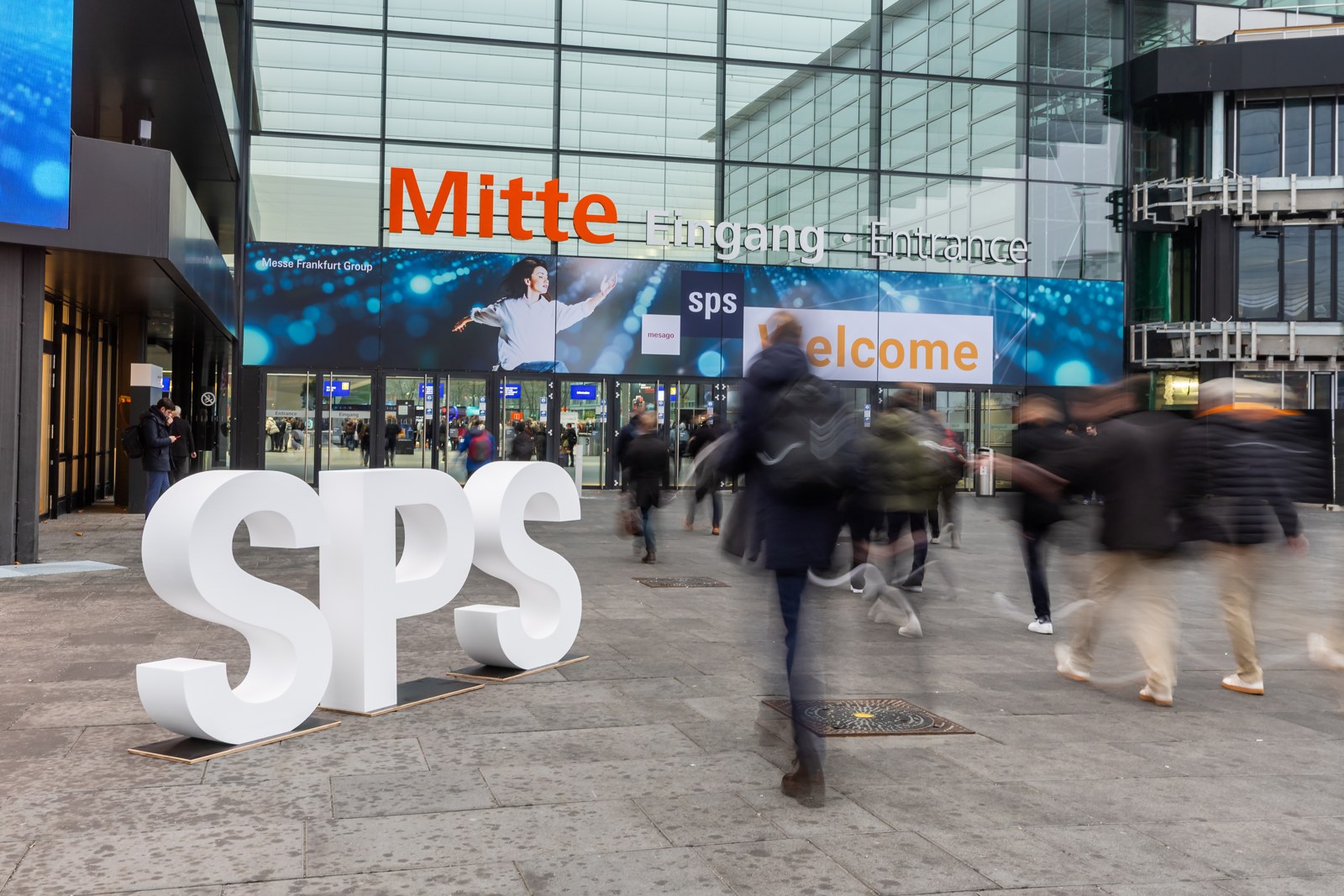
Visitors arrive at SPS 2025 in Nuremberg. Image: Mesago Messe Frankfurt GmbH / Arturo Rivas Gonzalez.
Of all the things you might reasonably expect to do at an automation show, sorting grapes probably comes some way down the list. But if I had one free hour at SPS next week, I’d start in Hall 1. Schneider Electric is inviting visitors to try a machine built for a winery. There’s a camera, a moving belt and a bank of air nozzles. By the time you’ve decided whether a grape looks any good, the machine has already sent it on its way.
The machine is Scharfenberger’s ESOS 800 AI, on stand 540. Its 4K line-scan camera catches the fruit in mid-air as it leaves the belt. About 75 mm further on, 160 individually controlled nozzles can blow unwanted material out of the stream. Schneider quotes a decision time below half a millisecond, but the detail I like is that the team took the prototype out during the harvest and tried it on Riesling, Gewürztraminer and Dornfelder. If someone offers to run it for you, ask to see the reject pile. That’s where you’ll find out what a wrong decision costs the grower.
SPS runs from 24 to 26 November across 15 halls. Industrial AI and cybersecurity head the organiser’s programme, although neither quite conveys the range of hardware coming to Nuremberg. A robot, a pair of valves and a collection of controllers that spent four days getting acquainted are all worth a detour.
Walk past the robot. Come back for the valves.
Analog Devices has a humanoid on stand 110 in Hall 5. It also has two ways of driving an industrial valve, side by side. One uses fixed control. The other adjusts the energy delivered for each actuation and monitors the device as it works. Heat is the visible result ADI wants visitors to compare. Ask what duty cycle both valves have been running: a thermal comparison means rather more once you know how hard each coil has worked.
Stay in Hall 5 for the OPC Foundation’s stand 140. Its new demonstration wall had a four-day rehearsal at Festo, where 28 people from 16 companies connected controllers running virtual machines to build a production line. Connections between controllers could be established and closed on demand. Prototype drives and I/O were involved too. NXP, on stand 138, puts part numbers to the problem with an i.MX 943 controller communicating with an i.MX RT1180 device. Between the two stands you can see a mixed-vendor line and ask which bits you could put on a purchase order today.
Inside the motor and out on the factory floor
At Kübler in Hall 7A, stand 506, there’s a neat question to put to the encoder team. Turn an unpowered shaft through three complete revolutions and it finishes at precisely the angle where it started. How does the drive know it moved? Kübler’s integrated magnetic encoders use energy harvesting for the multiturn count. Over in Hall 4, STMicroelectronics takes the motor-drive story in a different direction with a 15 kW inverter on stand 271. Its silicon carbide devices take heat out through the top of the package, making the route to the heatsink worth a look.
Two of the most useful tips for walking the show came from people who will be there. Siemens’ Ralf Hummel has picked out the 3UG5 monitoring relays with IO-Link among his own highlights in Hall 11. It’s a small detail on a stand devoted to industrial AI and digital twins, but a good place to ask which measurements a technician can actually retrieve when a machine stops. At Pepperl+Fuchs, Johannes Balter points visitors to live expert talks in Hall 7A, stand 330. One pairs vision and LiDAR, another tackles Ethernet-APL in process plants. The choice rather depends on whether your troublesome sensor is struggling to see the target or to get its reading back to the control room.
Phoenix Contact’s Sophia Hardeck has been highlighting control cabinet construction. On the company’s Hall 9 stage, stand 310, Tuesday’s 3.30pm session looks at the new connector interface for industrial Single Pair Ethernet. On Wednesday, visitors responsible for supporting equipment already in service can head to the Hall 3 Technology Stage. HEITEC’s Moises Lorenzo-Leon is due at 4.05pm to discuss the Cyber Resilience Act’s implications for existing products, with a practical implementation session following at 4.25pm.
And for anyone who does start with the grapes, Mouser is personalising stainless-steel bottles on stand 250 in Hall 4. Between Schneider and Mouser, somebody seems to have thought of everything except the corkscrew.
SPS runs from Tuesday 24 to Thursday 26 November at NürnbergMesse. All session times are local.