Sixfab brings 25-TOPS, 3W AI acceleration to Raspberry Pi 5
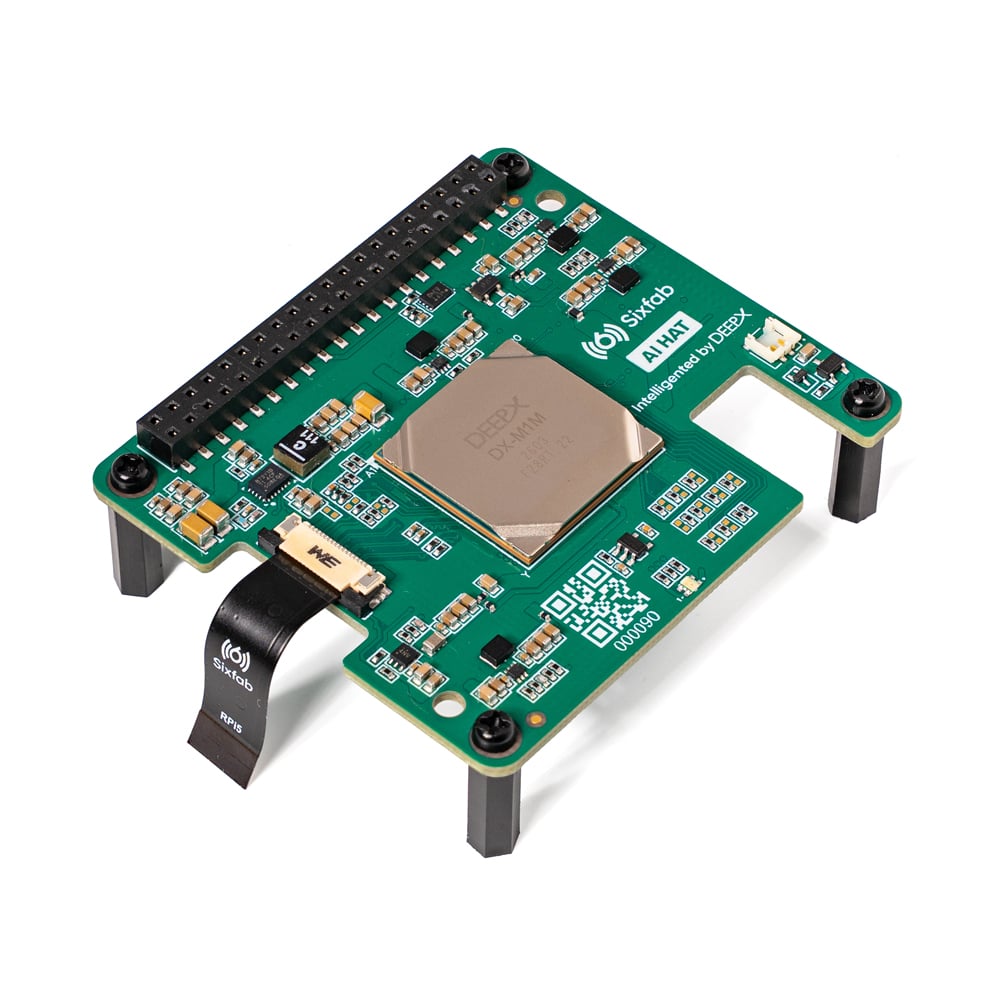
Sixfab has introduced the AI HAT+ 2 for Raspberry Pi 5, combining a DEEPX DX-M1 neural-processing accelerator with up to 8GB of dedicated LPDDR5 memory.
The module is rated at up to 25 TOPS and Sixfab quotes approximately 3W for the accelerator. It connects through the Raspberry Pi 5 PCI Express interface and is intended to run computer-vision, vision-language and small language models locally.
Dedicated memory changes the workload
The original AI HAT+ uses an accelerator aimed principally at neural-network inference. Adding LPDDR5 on the AI HAT+ 2 allows model weights and working data to be held beside the accelerator instead of relying entirely on the Raspberry Pi's system memory.
Sixfab and Raspberry Pi say the board can support convolutional neural networks as well as selected vision-language and small language models. The practical limit will depend on the model size, quantisation, supported operators and the memory required for intermediate tensors and context.
The quoted TOPS figure describes peak integer operations under supported conditions. It is not a direct measure of application speed. Camera capture, preprocessing, model compilation, memory transfers and post-processing can all determine end-to-end latency.
Power and software
A 3W accelerator budget is low enough for compact edge systems, but it excludes the Raspberry Pi, memory, camera, storage and power-conversion losses. Thermal design must be based on the complete assembly and its enclosure.
The software stack provides tools for converting and deploying supported models to the DX-M1. Compatibility needs to be checked at operator level because an unsupported layer may prevent a model from running wholly on the accelerator or require changes to the network.
The board follows the Raspberry Pi HAT+ mechanical format. Sixfab positions it for local vision and language processing where sending continuous sensor data to a cloud service is undesirable or impractical.