Rakon expands AI data centre timing range with digital OCXO
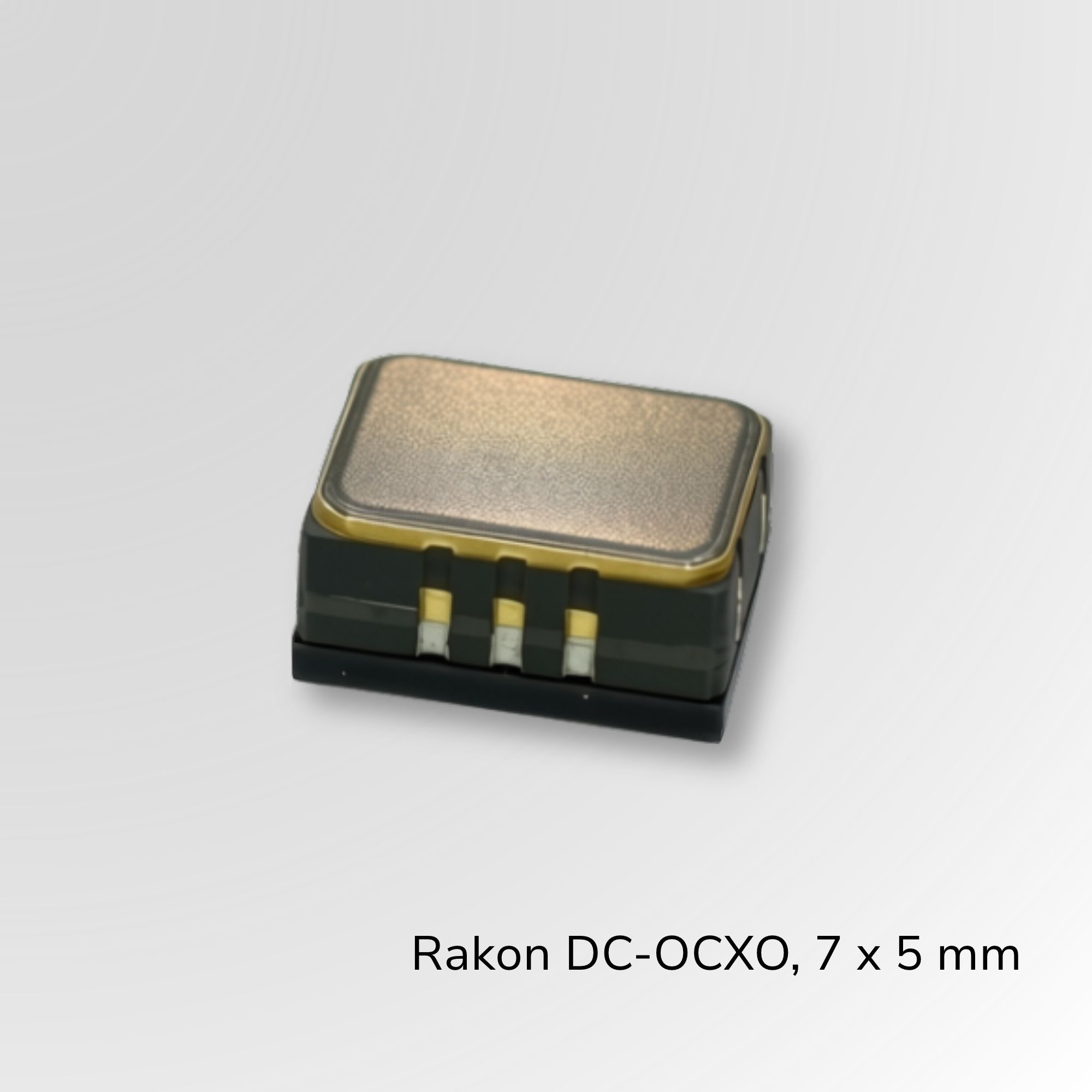
Image: Rakon
Rakon has launched a timing portfolio for AI and hyperscale data centres, covering optical communications, network synchronisation and the compute tray with oven-controlled, temperature-compensated and other crystal oscillators.
The range includes the new Vulcan ROV7050XD digitally controlled oven-controlled crystal oscillator, which is sampling. Rakon specifies outputs up to 1 GHz, frequency stability of ±10 ppb and a frequency slope of ±0.5 ppb/°C in a 7 × 5 mm class hermetic package.
The ROV7050XD supports I²C digital control and programmable frequencies for network timing and synchronisation. Rakon positions its digitally controlled OCXOs, IC-OCXO technology and long-holdover discrete OCXOs across scale-up, spine, leaf and top-of-rack switching infrastructure.
Higher-frequency reference clocks
Rakon is also extending its High Frequency Ultra Low Jitter XO series. The current RXO2520NT and RXO2016NT models operate at 500 MHz, with specified RMS phase jitter of 30 fs and frequency variation over temperature of ±10 ppm. Package sizes are 2.5 × 2.0 mm and 2.0 × 1.6 mm.
Models at 625 MHz and 1.25 GHz are scheduled to follow in 2027. A smaller 1.2 × 1.0 mm package is targeted for late 2027. These are roadmap developments, distinct from the current 500 MHz parts and the sampling ROV7050XD.
The communication portfolio includes low-jitter XOs and precision TCXOs for optical transceivers and serializer-deserializer interfaces. For the compute tray, Rakon offers digitally controlled OCXOs and TCXOs, Niku Ultra Stable TCXOs and compact high-stability TCXOs for network interface cards, data processing units and AI accelerators.
“AI performance isn't determined by processing power alone,” said Wil Hsieh, Head of Products, Commercial BU, at Rakon. “Keeping data moving quickly and compute resources working efficiently also depends on the timing infrastructure around them.”
Rakon says the portfolio provides different levels of stability, noise performance, frequency and digital control according to where the timing component sits within the data centre architecture.