NVIDIA’s robot ducks have learnt a useful trick: sharing
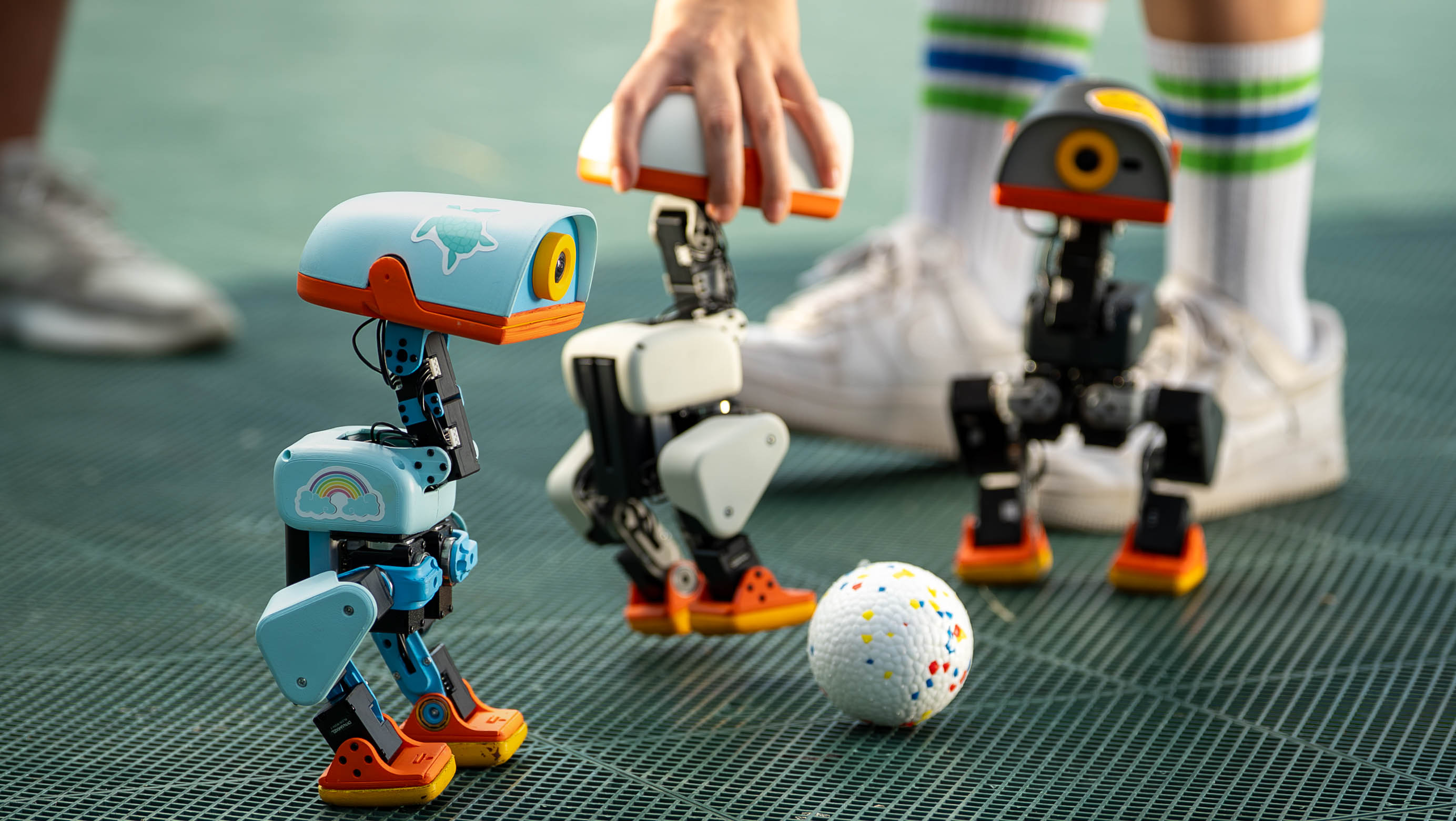
Jensen Huang could have finished his NVIDIA presentation with another performance chart. Instead, four little robotic ducks joined him on stage, which is a considerably better way of getting people to remember your laptop.
The Microducks, developed by Pollen Robotics and Hugging Face, appeared at GTC Berlin alongside NVIDIA’s RTX Spark computers. NVIDIA described a workflow that used simulation and cloud training to prepare behaviours for the physical robots. Watching a small mechanical bird sit down is entertaining; understanding how somebody else’s duck could acquire the same skill is where this gets interesting. 1 Pollen has made the robot’s control software and reinforcement learning tools open source. Developers can train a behaviour, publish the resulting controller on the Hugging Face Hub and let other owners install it. The public training code already includes a forward-roll task. 2
So, if someone develops a better somersault and shares it, other ducks need not start their own gymnastics programme from scratch. Their owners can install the published behaviour and build on the work. Think of it as a growing skills library for the duck army, with humans still deciding what goes in.
There is no automatic collective memory in that process. One duck learning a trick does not instantly enlighten every other duck on the planet. What the documentation describes is potentially more useful: a practical way to distribute learned physical skills, rather than making every developer repeat the same training. 2 That deserves more attention than the novelty of the beak. A robot’s repertoire can grow through contributions from people who never designed its hardware, while another developer can adapt a shared controller rather than begin with a blank screen.
The hardware is no trivial undertaking either. Pollen describes a 25cm robot with 15 motors, a camera, depth sensing, two inertial measurement units and a grasping beak. As its launch post puts it: “Learning movement is messy.” Keeping the machine small makes experimentation more manageable outside a robotics laboratory. 3 Even so, the electronics and mechanics retain their right to be awkward. Pollen’s training code accounts for motor friction, battery voltage sag and gear play. A downloadable somersault still has to survive contact with an actual floor. 2
For NVIDIA, this is also excellent business. Make robotics development appealing and more people have a reason to explore the computing infrastructure behind it. The ducks give that proposition a personality, although an expressive performance tells us little about how reliably a new behaviour will work elsewhere.
The convincing part will be what the community can reproduce and improve. If shared controllers make useful movement easier to develop, Microduck could earn its place on an engineering bench long after the keynote has been forgotten.
And if these are the Terminators that eventually take over the world, at least they’ll look cute whilst doing it.
Sources
- NVIDIA: GTC Berlin keynote
- Pollen Robotics: Microduck training code and sharing behaviours
- Pollen Robotics: Meet Microduck
Image: Pollen Robotics / Hugging Face. Launch photograph supplied through the official Microduck press kit.