Component obsolescence: deciding whether a last-time buy is worth it

An end-of-life notice is an awkward way to reopen a product strategy discussion, particularly when the product in question still sells, its customers seem happy and nobody has budgeted for another board revision. Nevertheless, that is the discussion it can force. Someone has to decide how much longer the business wants to build and support the product, then put a price on doing so.
The component itself may be cheap enough to make a large purchase look like the obvious answer. Compared with engineering time, qualification and the disruption of changing a working design, a few reels in a stockroom can seem reassuringly uncomplicated. The complication arrives when those reels have to cover several years of uncertain sales and repairs, or when a replacement programme slips and consumes the stock intended for service.
A last-time buy can be a perfectly sensible use of money. It deserves the same scrutiny as the redesign it is supposed to avoid, including a serious attempt to establish when the existing product will finally be allowed to retire.
Before buying anything, read the notice
There is little glamour in checking suffixes, but this is a good place to start. The manufacturer's original discontinuation notice should identify exactly which orderable parts are affected; the news that a familiar family is going end of life may turn out to concern one package or grade rather than every version used across the business. Equally, a family-level search result can offer false comfort if the particular variant on the BOM is being withdrawn.
Lifecycle descriptions need similar care. NXP, for example, distinguishes between not recommended for new designs, end of life and no longer manufactured. Treating all three as shorthand for unavailable loses information that could materially change the response. [1] The useful record is the complete affected part number, the original notification and the dates and conditions attached to the withdrawal.
The last order date and final delivery date are separate commitments. TI describes a standard withdrawal schedule of 12 months for last orders followed by a further six months for final delivery, while allowing accelerated withdrawal in rare circumstances. [2] That is an example of a supplier policy, not a timetable to apply to everybody else. The notice in front of the team takes precedence, along with the actual order terms, cancellation provisions and any limits on what the supplier will accept.
It is also worth establishing whether the original manufacturer's withdrawal really ends authorised supply. Rochester Electronics describes arrangements covering stocked components and continued manufacture with original manufacturers. [3] These can offer a useful alternative to an immediate redesign, although the existence of a lifecycle supplier says nothing about the availability of a particular device until somebody asks. Confirm what material is offered, how it was manufactured and whether future supply means a finite stockholding or a continuing production arrangement.
The forecast needs an end date
The hardest number in a last-time-buy calculation is often the remaining production requirement. Without an agreed withdrawal date or a defined transition to a successor, demand can expand to absorb almost any quantity purchasing proposes. Engineering expects a replacement next year, sales assumes the old model will remain available if a customer asks and service understandably wants enough material to avoid disappointing an installed customer. Each assumption is plausible; together they can produce an order nobody can explain.
Separate those requirements before calculating a total. Production demand should follow the commercial plan for the existing product, while service provision needs to reflect the installed base, support commitments and repair method. A repair that replaces a complete board does not consume stock in the same way as replacing an individual device. Manufacturing losses and qualification samples may need their own allowance, with a reason for the quantity rather than an unexplained percentage added at the end.
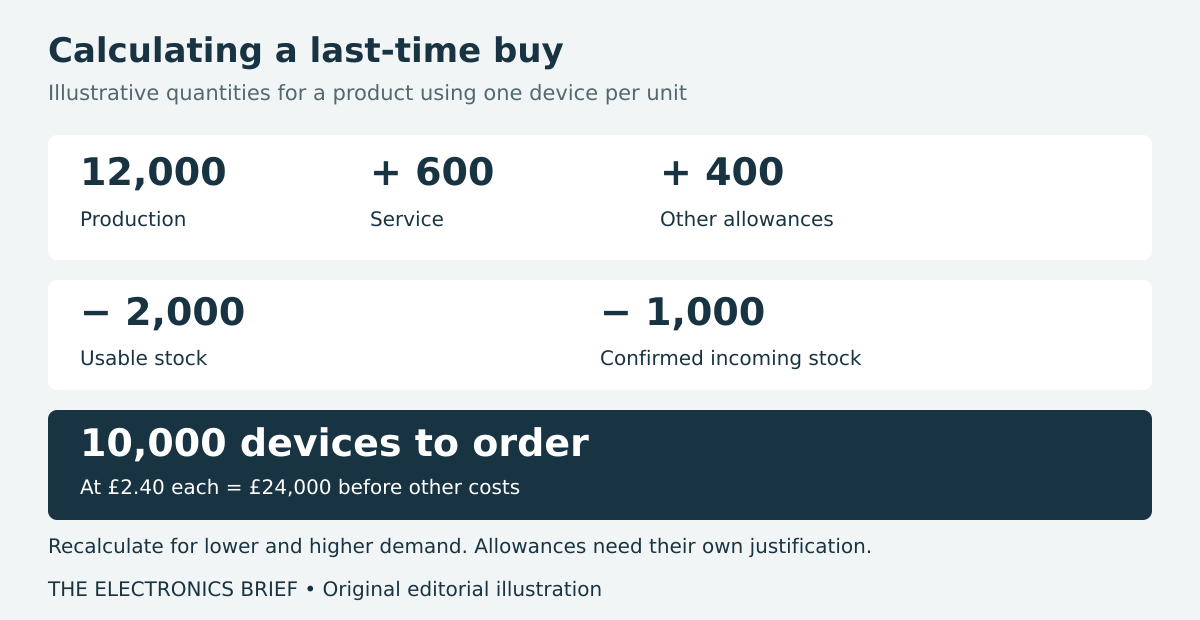
For illustration, take a product requiring one device per unit, with 12,000 units of remaining production, 600 devices for service and 400 for qualification and manufacturing losses. If 2,000 usable devices are already held and another 1,000 are on confirmed incoming orders, the additional requirement is 12,000 + 600 + 400 − 2,000 − 1,000 = 10,000 devices. At an illustrative £2.40 each, that means £24,000 in component expenditure before financing, storage or other costs. None of these quantities is an industry benchmark.
The arithmetic is straightforward once the assumptions are agreed. Getting agreement is the work. Stock held by a manufacturing partner must not be counted again in the OEM's figures, material committed to another build is not spare and a quarantined reel cannot quietly become usable inventory to make the calculation balance.
There should be a lower-demand case as well as a shortage case. An order sized for an optimistic sales forecast can leave the business funding components it will never use. Conversely, service stock can disappear remarkably quickly on paper if the production plan assumes access to everything on the shelf. Decide which quantities are protected and who may authorise their release.
Someone has to look after the stock
Storage is easy to omit from a discussion dominated by purchase deadlines, yet a lifetime buy effectively gives the business a small materials-management project for as long as the product needs support. That includes deciding who controls the stock, where its history is recorded and what happens when a sealed package is opened to issue a handful of parts.
TI's shelf-life guidance identifies materials, packaging, moisture sensitivity and customer storage conditions among the relevant factors. Its findings about devices kept under its own controlled conditions should not be read as a general assurance about any old component with an intact label. [4] For the actual material being purchased, quality and manufacturing need to agree the storage and handling arrangements, required records and acceptance checks. Any recovery process for moisture exposure should follow the applicable guidance rather than a convenient generic baking instruction.
Date codes deserve some perspective here. Age alone does not establish condition, but neither does original packaging establish a satisfactory history. The useful question is whether the business has evidence to support the intended use when the parts are eventually issued. There is also little benefit in preserving devices for years if the programming equipment or production fixtures needed to use them have meanwhile been discarded.
Buying time may be better than buying a lifetime
A bridge purchase can be attractive when the existing design has a clear successor but the engineering and approval work will take longer than current stock allows. It limits the amount committed to the old product while giving the replacement a realistic development window. The danger is defining that window as the time required to make a prototype work and forgetting everything between that point and an approved production build.
Compare the complete routes. Redesign may involve firmware, tooling, production tests and customer approval as well as the board itself; a stock purchase carries handling costs and the possibility of material left unused. Where product approval or contractual obligations are affected, include those activities in the schedule. A nominal nine-month redesign followed by a possible six-month customer approval cannot comfortably be funded with nine months of stock.
There is another option that deserves an honest hearing: stop selling the old product. Commercial teams may dislike that answer, but preserving a legacy design is not automatically the best use of scarce engineering time. If its support burden obstructs development of a more viable replacement, extending its life can become an expensive habit.
Longevity programmes help future selections, provided their dates are understood. NXP measures its participating products' availability periods from launch and sets conditions that can include manufacturing transfers or migration to compatible products. [5] Selecting a device covered by a 15-year programme does not restart the clock.
The decision worth recording is therefore more substantial than an order quantity. It should explain the period being covered, the assumptions behind the demand and the milestones for moving away from the device. If those milestones slip, somebody needs to revisit the calculation while stock remains. By the time a service engineer asks for the last available part, the opportunity for a cheap decision has usually passed.
Sources
[2] Texas Instruments, Product change notification and semiconductor withdrawal.
[3] Rochester Electronics, Extending the Life of Semiconductor Components.
[4] Texas Instruments, Product shelf life.
[5] NXP, Product Longevity, including programme requirements.