Why a smaller DLSS model leaves more room for the game
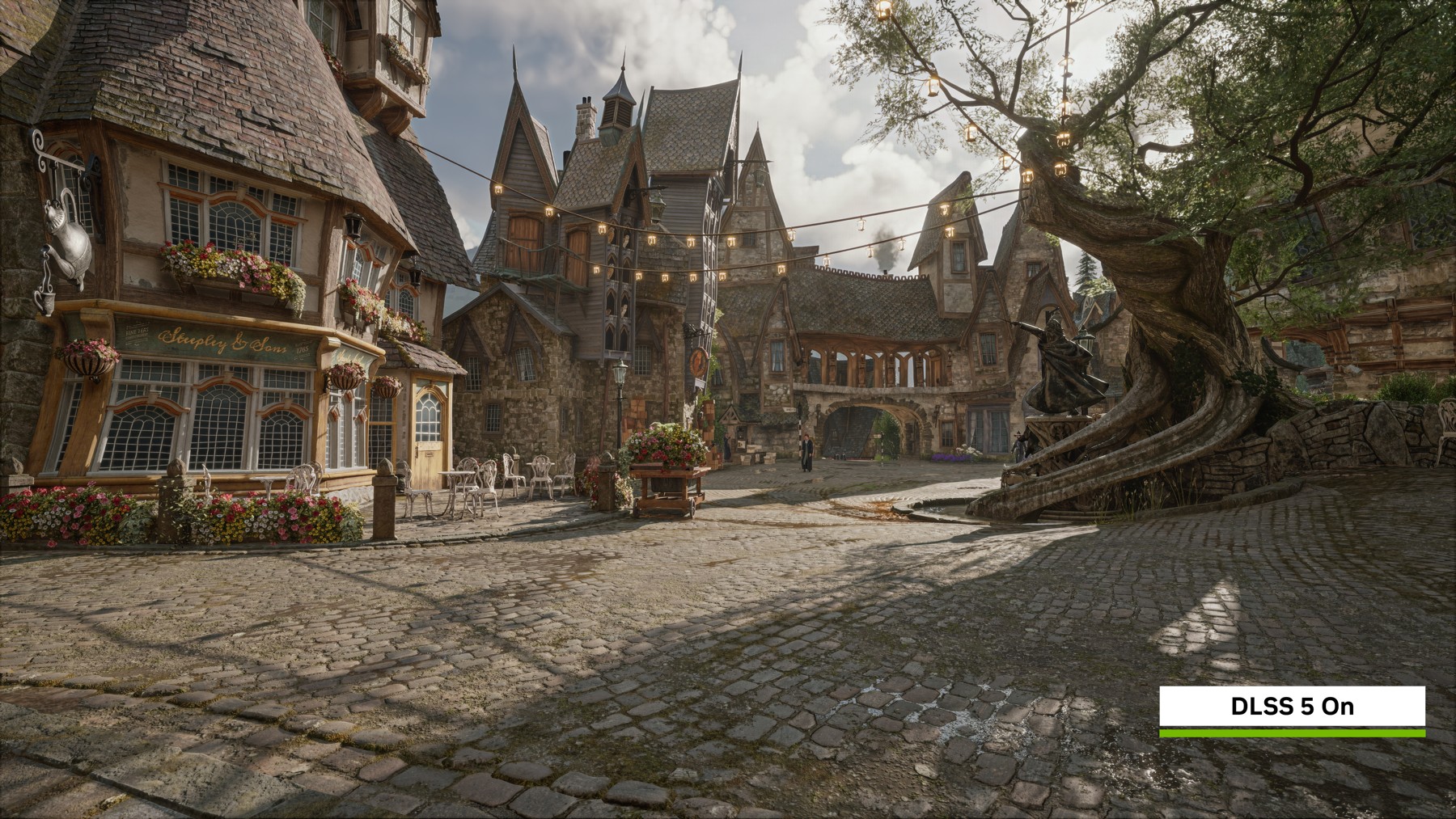
Image: NVIDIA / Warner Bros. Games
The striking number in Nvidia’s latest DLSS update is not the frame-rate claim. It is the memory saving. The company says its revised DLSS 5 neural rendering model uses 20% less VRAM at 4K, while its parameter footprint falls by 24% to about 118 million.
A graphics card has to accommodate that model alongside the game it is helping to render. Geometry, textures, frame buffers and intermediate rendering data already make demands on memory. Adding neural processing brings another workload to the same device, with its own storage and execution costs.
Nvidia says pipeline optimisation and model refinement have halved the GPU overhead of the September version while retaining comparable visual fidelity. That is a claim about this part of the rendering pipeline. It is not the same as saying every game will run twice as fast: the company’s stated frame-rate increase for NBA 2K27 is up to 1.4 times.
The distinction matters because ‘DLSS’ now covers several different jobs. Super Resolution reconstructs a higher-resolution image from lower-resolution frames, using motion information and feedback from earlier frames. Ray Reconstruction replaces conventional denoisers. Frame Generation creates additional frames. DLSS 5’s 3D-guided neural rendering adds its own work on lighting and materials.
Those tasks should not be rolled into one interchangeable performance figure. Reducing the cost of a model gives time or memory back to the rest of the pipeline, but the final gain depends on where the workload was constrained. A scene limited elsewhere will not inherit the full speed-up of a faster neural stage.
Nvidia has not published enough information in this announcement to calculate how much energy the update saves, or to separate the benefit of fewer parameters from changes to scheduling and execution. Nor does the 20% figure mean the whole game consumes one-fifth less VRAM; it describes the model’s VRAM use at the stated resolution.
The revised model is being introduced across GeForce RTX 50 Series GPUs, RTX Spark laptops and GeForce NOW. Nvidia schedules the Hogwarts Legacy integration for 5 November, with an RTX Remix update due earlier, on 23 October.
Sources: NVIDIA’s DLSS 5 update and stated measurements; NVIDIA developer explanation of DLSS technologies.