What Dukosi can learn by measuring a battery cell at its terminals
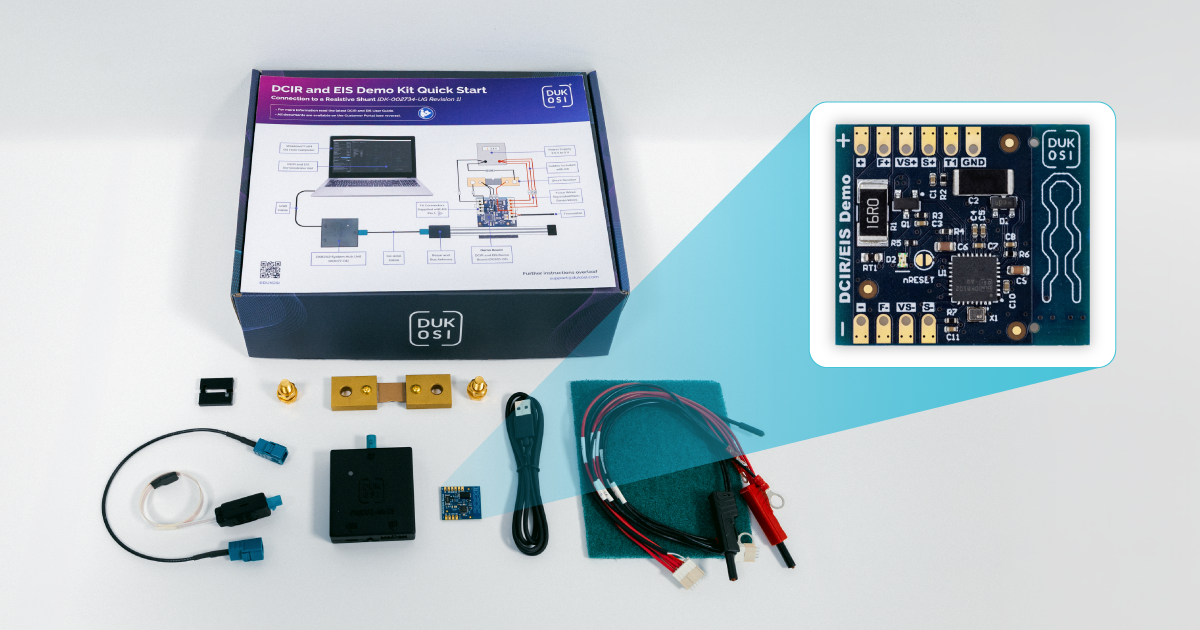
Image: Dukosi
Dukosi’s battery evaluation kit asks each monitored cell for its own resistance or impedance reading. The circuit on the cell generates a test signal and captures the response there, instead of depending on a stimulus sent through the pack. That moves most of the busbars and interconnects out of the measurement path. It also means the kit can give a result for a cell whose behaviour would otherwise be buried among all the others in a pack-level reading.
Dukosi specifies a direct-current internal resistance measurement, reported as R₀ in as little as one second, as well as electrochemical impedance spectroscopy at selected frequencies between 0.1 Hz and 3.5 kHz. A resistance result gives a compact view of the voltage drop associated with a current change. It is quick to compare across cells, provided the conditions and measurement timing are comparable. The impedance measurement instead shows how the cell responds as the frequency changes. Responses that happen over different timescales can then show up in different parts of the sweep, even where two cells looked similar in the fast measurement.
At 0.1 Hz, a single cycle lasts 10 seconds before allowing for repeated cycles or any settling the measurement requires. A full sweep with low-frequency points serves a different purpose from a reading intended for rapid comparison. Depending on what a battery team is trying to separate, a few chosen frequencies may be more useful in practice than taking a whole spectrum every time.
The evaluation kit uses one monitor board per cell and a hub that supports up to 216 monitor boards. Moving the measurement closer to the terminals removes a source of ambiguity, but temperature and state of charge can still move the result. Two cells at different states of charge may look more different than two cells of different ages tested at the same charge. Comparing like with like is how the kit could show whether a particular frequency adds information the fast test missed. Dukosi has made an evaluation kit available; it has not shown that one set of thresholds would transfer across different chemistries or pack designs.
Sources: Dukosi kit availability announcement; Dukosi kit specification and measurement functions; Dukosi technical note on cell-level measurement