MacDermid Alpha brings a sintered copper bonding surface to SiC dies
MacDermid Alpha will present its forthcoming BondPad technology at electronica, using silver sintering film to attach copper foil to the top of a silicon carbide die. Copper wire or ribbon can then be bonded to the exposed foil using established bonding equipment.[1]
Power modules experience repeated heating and cooling as their electrical load changes, placing strain on joints between materials that expand by different amounts. MacDermid’s technical material identifies two recurring failure mechanisms in earlier packages: fatigue in the solder beneath the die and lifting of the aluminium wire bonds above it. Improving the lower attachment leaves the upper connection as another potential limit on endurance.[2]
SiC adds a mechanical complication because it is considerably stiffer than silicon. During a temperature excursion, the die flexes less and more of the strain reaches its attachment layer, according to MacDermid’s packaging guidance. Its wider Argomax range therefore covers several interfaces in a module, including the die attachment, upper interconnect and package attachment, with paste and film formats suited to different assembly operations.[2]
BondPad uses nominally 50 µm copper foil over an approximately 20 µm sintered bond line. The film fixes the starting material thickness without paste printing or dispensing, while the foil provides a level landing surface for the next bonding operation.[1]
In the company’s comparison, the assembly exceeded 75,000 power cycles against 2,500 for a conventional aluminium wirebond reference. The test used 180 A, a 110 °C temperature swing and a maximum junction temperature of 175 °C, with failure defined by a 5% increase in drain-to-source voltage.[1]
Silver sintering joins particles into a conducting structure through diffusion, allowing an attachment to be formed without melting a bulk silver layer. MacDermid describes this as an alternative to conventional solder attachment in high temperature power electronics. Applying it above the die also creates a manufacturing route for copper connections, extending the same joining approach to another part of the current path.[3]
The planned Munich presentation runs from 10 to 13 November. BondPad is described as upcoming technology; the cycling result is a supplier test under the stated conditions, rather than a universal service-life rating for every SiC module.[1]
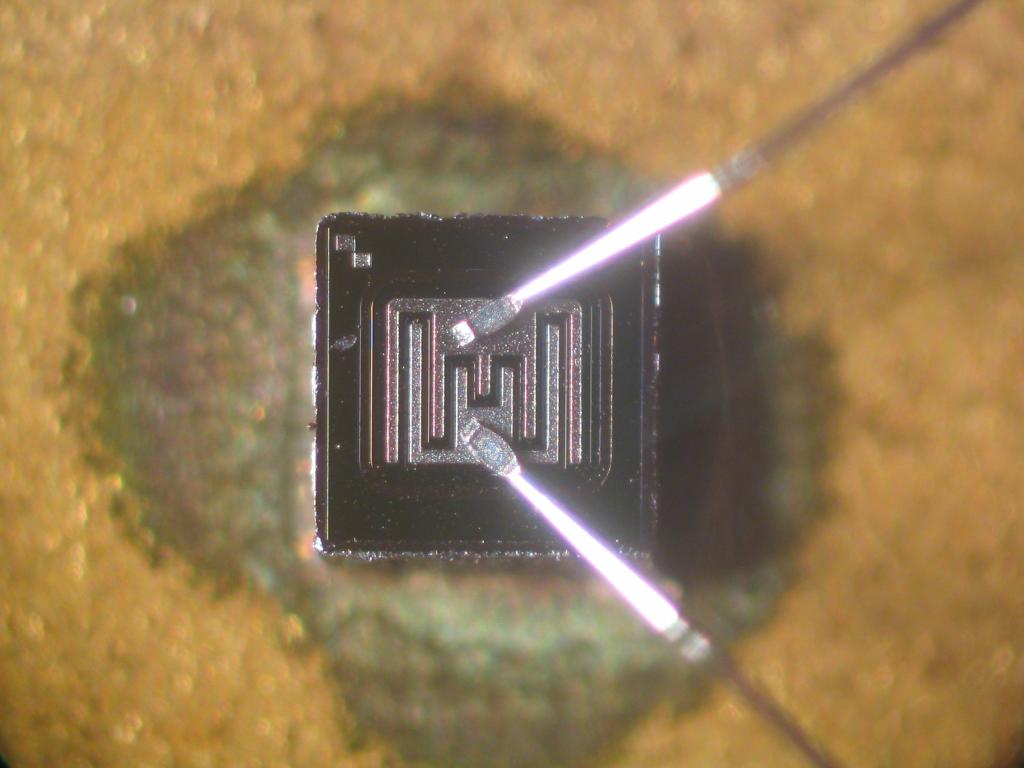
Wire bonds on a legacy transistor die, shown under a microscope. Illustrative photograph. Photo: Shaddack / Wikimedia Commons, Public domain. Image source. Public domain.