Buying outside authorised distribution: what would make the decision defensible?

For a buyer facing a stopped production line, advice to use authorised sources can feel incomplete. The authorised route has already been checked, the next delivery misses the build and another supplier says it has exactly the quantity required. Repeating the preferred sourcing policy does not resolve the order, although abandoning it without understanding the consequences is hardly a solution either.
Independent distribution needs a more useful discussion than an assumption that every transaction is suspect or an assurance that a reputable-looking business must be safe. What matters is the material being offered, the evidence behind it and whether that evidence is sufficient for the application. A supplier can be well intentioned and still be unable to establish something the customer needs to know.
There are circumstances in which an exceptional purchase may be defensible. Urgency will explain why it is being considered; it cannot establish that the parts are acceptable.
Establish what the seller is actually offering
Before commissioning a provenance investigation, make sure the proposed route really is outside the manufacturer's authorised channels. Authorisation is specific to the manufacturer and relevant arrangement, so a distributor's relationship with one brand does not establish its position for another. For a marketplace purchase, the legal seller and source of the stock matter more than the platform's familiar name.
Obsolete devices deserve another check because original production ending does not necessarily end authorised availability. Rochester Electronics describes authorised distribution and licensed manufacturing routes, which may offer an option for particular discontinued parts. [1] Confirm the exact device and arrangement rather than assuming that every listing for an old component belongs to the independent market.
Once those possibilities have been exhausted, the enquiry needs to concern the actual offered lot. Ask for its full identity, quantity, condition, packaging and available date and lot information, including whether the quoted quantity combines material from several sources. Photographs of the goods can support that enquiry, although a convincing photograph cannot establish the history of the contents.
The warranty position also needs checking before the price comparison goes any further. TI explicitly excludes manufacturer warranty coverage and customer support for semiconductor products bought outside its authorised distribution network. [2] Other suppliers' terms need their own review. A warranty offered by the independent seller may have value, but it is a different promise from the original manufacturer's support.
A certificate is the beginning of an enquiry
A certificate of conformity can look authoritative while answering rather less than the buyer assumes. Its usefulness depends on who issued it, the material it identifies and the statement being made. A seller confirming that its goods meet an order description is not necessarily providing evidence of an unbroken chain back to the original manufacturer.
Ask what records support the chain of custody for the proposed lot and what cannot be established. A seller may have understandable commercial reasons for withholding an earlier owner's identity, but those reasons do not remove the resulting uncertainty. If the application requires evidence that the seller cannot supply, the parties may simply be unable to complete the transaction on acceptable terms.
ECIA's quality resources include traceability and counterfeit-mitigation material, providing useful reference points for a sourcing review. [4] Any supplier certification still needs checking for its scope and relevance, rather than being treated as a general approval of every component the business sells. The same applies to a laboratory relationship: establish what work can be performed, by whom and how its results will be tied to the delivered lot.
Condition matters alongside authenticity. Genuine material may still be unsuitable because of its grade, handling or storage, and an old date code cannot resolve those questions in either direction. TI's shelf-life guidance distinguishes its controlled internal practices from customer storage responsibilities. [3] The relevant enquiry is what is known about this material's history, particularly where packaging has been opened or replaced.
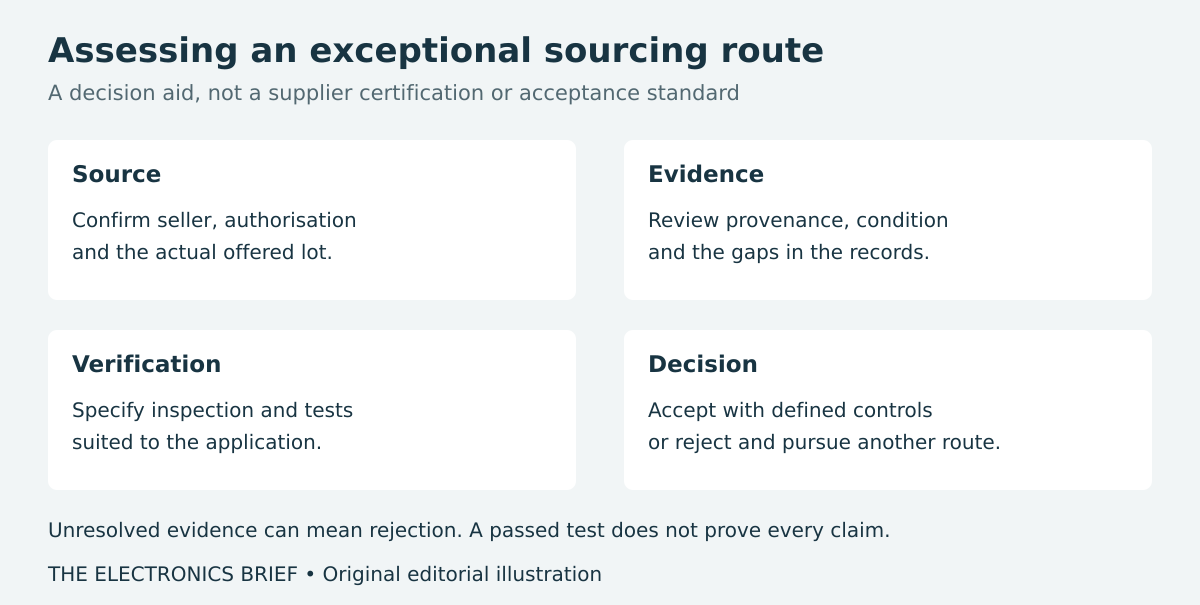
What a passed test can reasonably tell you
Testing can add valuable evidence, but the purchase of a test package should not become a way to avoid deciding what the organisation needs to establish. The appropriate methods depend on the concerns about the material, the consequences of failure and what can realistically be examined.
NASA's verification guidance discusses combinations of inspection and testing for counterfeit detection, including their limitations. Its mission-assurance context is much more demanding than many industrial applications, but the basic point is relevant: a device can function without its origin or wider quality having been established. [5] A successful functional check should therefore be described in terms of the conditions tested, rather than expanded into a general statement that the lot is genuine and suitable for every intended use.
External inspection may reveal damage or inconsistent markings; other work can examine electrical behaviour, internal construction or material composition. Some methods consume samples, while any sampling plan leaves questions about how well those samples represent the rest of the material. Mixed-source lots make that discussion especially important, because evidence from one group cannot casually be attributed to another.
The buyer should expect a clear explanation of what the proposed work can establish and what it will leave unresolved. That discussion belongs before the order, when the test scope, sample quantities and commercial terms can still be agreed. It is an awkward discovery that the seller's return policy excludes the analysis needed to make an acceptance decision.
Put a price on the whole decision
Comparing an exceptional purchase with a missed shipment requires more than a unit-price calculation. Include assessment, testing, any destructive samples and the possibility of rejection, alongside the consequences of a problem discovered during assembly or after delivery. Where the evidence will not support a credible failure probability, do not manufacture one merely to make the spreadsheet appear complete.
The alternatives deserve equal attention. A released substitute, resequenced production or a negotiated delay might be less damaging than they first appear once the full exceptional-purchase process is included. A limited redesign may also be preferable if the same shortage is likely to recur, although its approval and production times must be realistic.
Application and contractual obligations can settle the matter before that commercial comparison is complete. A customer may restrict sourcing routes, and a safety-related or inaccessible product may require evidence that the offered material cannot provide. A lower price or a sympathetic delivery deadline cannot remove those requirements; the organisation needs to establish whether a change or concession is possible and appropriate.
If the transaction proceeds, the acceptance conditions should be explicit about the material description, required records, inspection or testing and the handling of discrepancies. Agree rejection rights and costs in advance, including how destructive work affects those rights. On receipt, retain lot identity and keep the material separate until the required acceptance process has been completed.
This is a decision for purchasing, engineering and quality together, with the relevant commercial obligations understood. It is unreasonable to leave a buyer carrying a technical judgement simply because they found the stock, just as it is unhelpful for engineering to say only that it would prefer an authorised source without assessing the available choices.
The purchase should also have a consequence for the longer-term plan. If it buys time, use that time to qualify an alternative, change the design or agree the product's remaining life. Otherwise the next production order will reopen the same argument, perhaps with less evidence and a more expensive offer. An exceptional sourcing route is easiest to defend when the organisation can explain both why this lot was accepted and how it intends to become less dependent on finding another one.
Sources
[1] Rochester Electronics, Authorised Distribution.
[2] Texas Instruments, Authorised distributors FAQ.
[3] Texas Instruments, Product shelf life.
[4] ECIA, Quality resources, including traceability and AS6496 resources. Referencing these resources does not establish a supplier's certification.
[5] NASA, Guidelines for Verification Strategies, NASA/TM-2018-220074, Appendix B.