Bourns adds a 100 A four-terminal shunt for cleaner current measurement
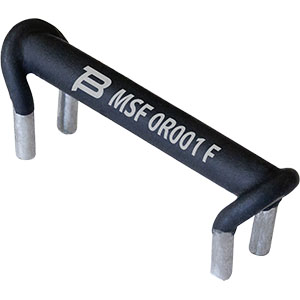
Bourns has introduced the MSF series, a radial current-sense resistor with separate current and voltage-sensing terminals, rated for up to 100 A. Its four-terminal construction keeps the voltage drop in the power connections out of the sense path, an increasingly useful advantage when the resistance being measured is only a fraction of a milliohm.
At 100 A, a 0.5 mΩ element develops 50 mV, so even a small resistance in a shared lead or solder joint can distort the result. Dedicated Kelvin terminals let the measurement circuit pick up the voltage across the element without including most of those external drops, although the PCB sense routing still needs the same care as the resistor connection.
The series covers 0.5 mΩ to 5 mΩ, with a 5 W power rating and a maximum current of 100 A. Bourns specifies a temperature coefficient of ±100 ppm/°C from 0°C to 85°C and offers resistance tolerances from ±0.5% to ±10%. The operating temperature range extends from -55°C to +275°C.
Construction suited to a hot current path
Inside the part, a Manganin resistance element is welded to oxygen-free high-conductivity copper terminals, with a flame-retardant silicone coating protecting the assembly. The radial format is self-supporting and mounts directly to the PCB.
The 100 A figure needs to be considered alongside resistance and cooling. At 0.5 mΩ, that current already dissipates the full 5 W rating, calculated from I²R, while a 5 mΩ part would dissipate 50 W at the same current. The upper resistance values therefore require a lower current, with further derating dependent on the installation and operating temperature.
Bourns lists battery management, power conversion, motor control, welding equipment, energy storage and industrial current monitoring among the intended applications. Resistance tolerances extend down to ±0.5%, although the final measurement accuracy also includes temperature drift, amplifier error and the way the sense traces reach the part.
Sources
Image: Bourns. Bourns MSF four-terminal current-sense shunt. https://www.bourns.com/news/new-products