Ambient Scientific's GPX10 Pro joins CELUS design platform
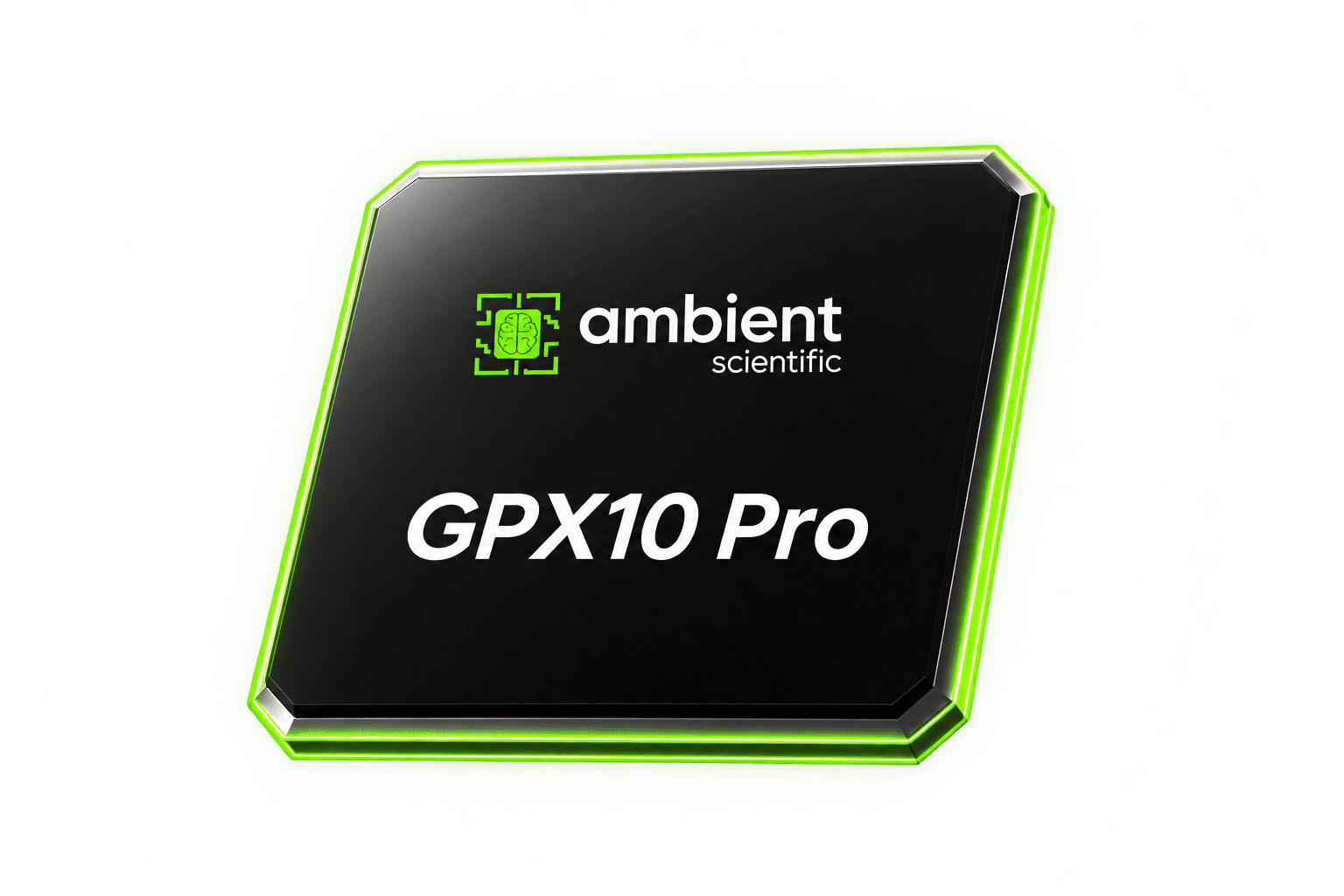
Ambient Scientific and CELUS have announced a partnership that brings Ambient Scientific's AI-native edge processors, starting with the GPX10 Pro system-on-chip, into the CELUS Design Platform, a cloud-based electronics design automation tool. Under the arrangement, Ambient Scientific devices are represented as CUBOs, the platform's reusable, application-ready design content, which combine datasheet specifications with application circuits, bill-of-materials detail and implementation guidance drawn from Ambient Scientific's own schematics and documentation.
The GPX10 Pro is built on Ambient Scientific's A-Cube architecture, which maps matrix-multiply and activation operations onto in-memory analog compute blocks. The SoC combines ten MX8 AI cores across two power domains, with one set of five cores forming an always-on block for sensor interfacing and fusion, delivering up to 2,560 multiply-accumulate operations per cycle and 512 GOPS peak AI throughput. It also includes an Arm Cortex-M4F core for control functions, 2 MB of on-chip SRAM, an ultra-low-power ADC, enhanced I2S logic and interfaces supporting up to eight analog and 20 digital sensors simultaneously. The company states the device performs always-on keyword spotting below 100 microwatts and supports CNN, RNN, LSTM and GRU model types.
"Edge AI products are decided at the architecture stage, when the processor, the sensor set and the power budget are chosen together," said Tobias Pohl, CEO of CELUS. "Our partnership with Ambient Scientific will give engineers an always-on AI processor they can place in their architecture from the start, with its sensor interfaces and supporting circuitry, and size the rest of the system around it."
Saharsh Singhania, VP Sales and Marketing at Ambient Scientific, said: "Engineers adding AI to a battery-powered product often start from a microcontroller they know and discover later that the model does not fit the power budget. Partnering with CELUS puts our AI-native processors in front of engineers at the moment they define their architecture, with the application context they need to design them in."
The two companies presented the partnership at electronica 2026 in Munich. CELUS states its platform is used by more than 30,000 engineers in over 100 countries, drawing on a library of over 560,000 components, with designs continuing in Altium Designer, KiCad, Siemens EDA or Autodesk Fusion once the architecture stage is complete.