Advantech ASR-D501 puts vision processing alongside the flight controller
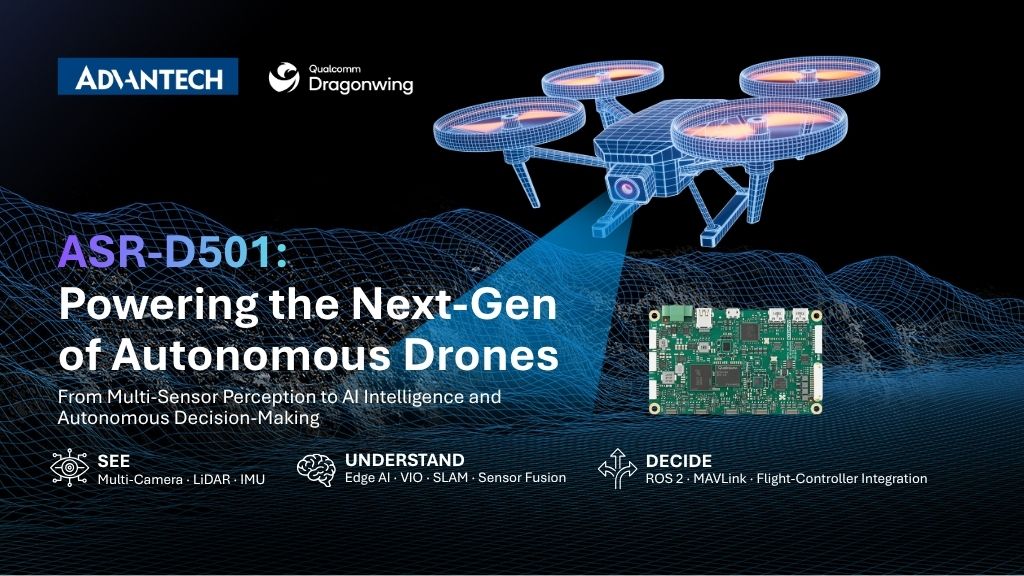
Image: Advantech
Advantech’s ASR-D501 is a 100 × 60 mm companion computer for drones, built around Qualcomm’s QCS6490. Camera processing, AI inference and mission software run alongside the aircraft’s flight controller, with the two systems exchanging information through supported communication interfaces.
That division gives perception software its own computing resources. Processing several camera streams can produce an uneven workload, particularly when inference and mission tasks run together. The flight controller can continue handling stabilisation while the companion board works through that information.
The QCS6490 combines an eight-core Kryo 670 CPU with Adreno 643 graphics and an integrated neural-processing unit. Advantech supplies the board with 8 GB of onboard LPDDR5 and 128 GB of UFS storage.
Interfaces and integration
Five MIPI-CSI connections provide the camera inputs, with four lanes per interface described in the launch information. The sensors and complete processing pipeline determine which streams can run simultaneously and at what resolution and frame rate.
| Connection | Provision |
|---|---|
| Camera inputs | 5 × MIPI-CSI |
| Ethernet | 1 × 2.5GbE |
| Vehicle networks | 2 × CAN FD; 3 × UART |
| Other peripherals | 2 × USB Type-C; 2 × I²C |
| Expansion | M.2 E-key and M.2 B-key |
| Display | Mini DisplayPort |
Advantech supports Ubuntu and its robotics suite, including ROS 2 and MAVLink integration through MAVROS and MAVSDK. PX4 and ArduPilot are named among the supported flight-control ecosystems.
The board weighs approximately 50 g without a heatsink. That exclusion is relevant in an aircraft: the installed computing assembly also needs whatever thermal provision its workload and enclosure require. Advantech specifies a 5–12 VDC input and an operating range of −20°C to +70°C.