When cracks become the sensing element
A strain sensor can become more sensitive because its conducting film is cracked. In one example examined by a new Communications Materials review, controlled microfractures produced a gauge factor of 647, with an operating strain range up to 0.22%. That combination suits a small movement far better than a large stretch. The mechanism is electrical as well as mechanical. Stretching alters the gaps between conducting regions, changing the paths available to current and the probability of tunnelling between neighbouring particles. Small movements can therefore produce a large resistance change. The useful range ends when that response ceases to meet the sensing requirement, which can happen well before the bulk material tears.
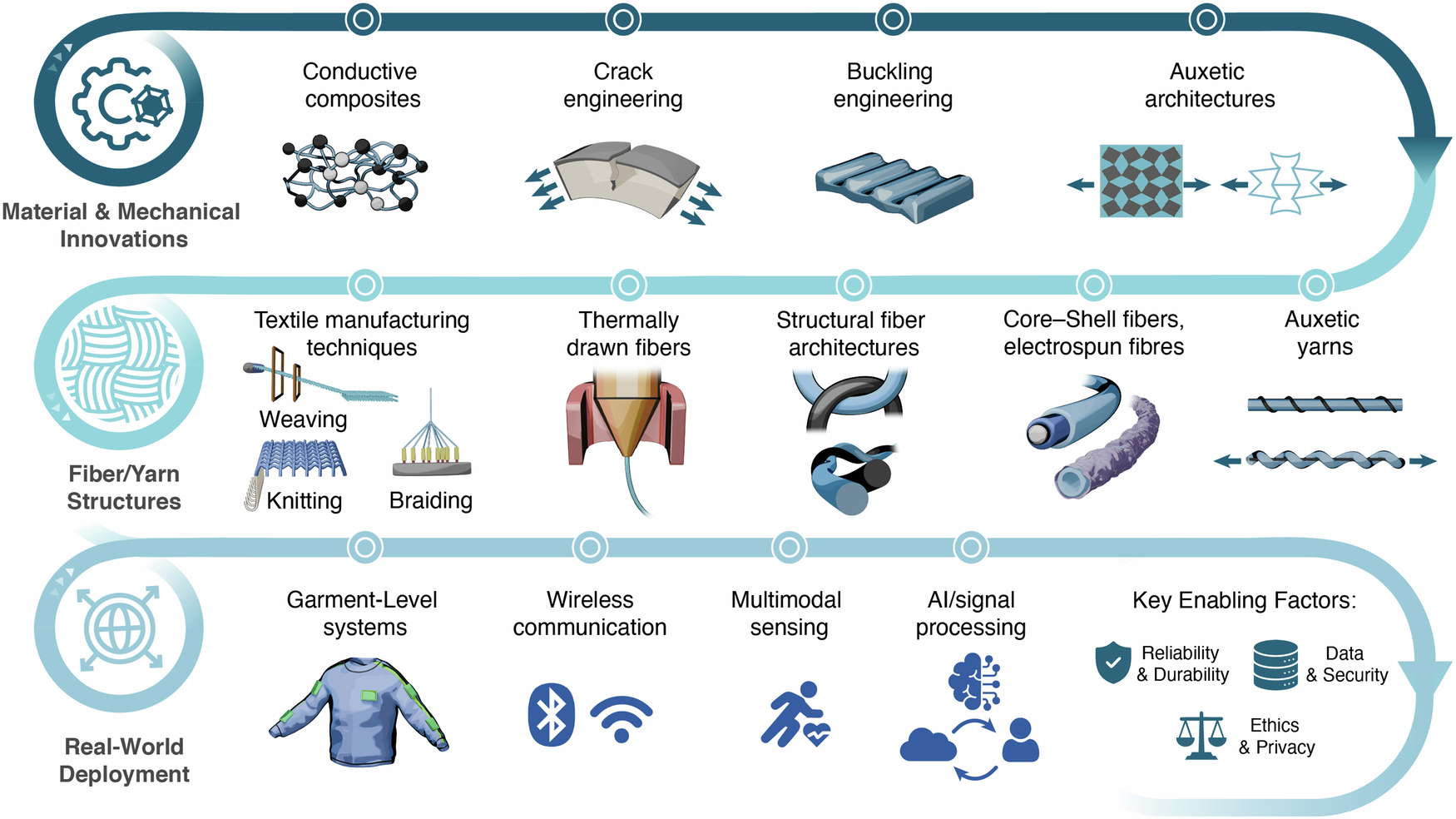
The review brings together several ways of arranging those conductive paths, from controlled cracking to buckled structures that accommodate movement while preserving electrical connections. Their intended functions differ. A sensing film needs a measurable response to strain; the track carrying its signal needs a sufficiently predictable resistance.
A capacitive approach can avoid stretching the sensing element with the skin. In a Scientific Reports study, researchers built conductive patches into garments and measured changes associated with deformation, proximity and contact. The patches could follow the movement of the cloth without requiring direct skin contact. Their shape and placement then became part of the sensing geometry. The prototypes ranged from individual joint measurements to tracking several joints.
The rigid component is another mechanical boundary
The connection between a soft track and a packaged component has a different job again. A Nature Communications study explored a composite of particles of liquid metal, small molecule modifiers and a polymer matrix, using it to attach electronic components to a stretchable substrate. The researchers reported conductivity above 200,000 S/m. With a 0 Ω surface mount resistor attached, the specimen maintained function for more than 10,000 loading cycles at 50% strain and 2,500 cycles at 100% strain. The tests loaded the junction to a packaged component as well as the surrounding conductor.
The electrical change during that loading was also measured. At 200% strain, normalised resistance stayed below five times its initial value. At about 600% strain, the researchers observed a visible increase associated with mechanical failure at the interconnect. The bulk composite could stretch to roughly 1,000% in the material test, leaving a substantial difference between the sheet’s maximum extension and the behaviour of the connection to the resistor. The same composite was used in demonstrations of component replacement and thermoformed circuits.
Sources
- Communications Materials review of textile sensing systems
- Scientific Reports: textile capacitive sensing
- Nature Communications: stretchable solder and component interfaces
Image: Maria Papaefstathiou, Mohamed Elgendi and Carlo Menon, Communications Materials (2026), Figure 1. CC BY 4.0. Unmodified.