TDK’s programmable Hall sensor makes the magnetic assembly part of the design
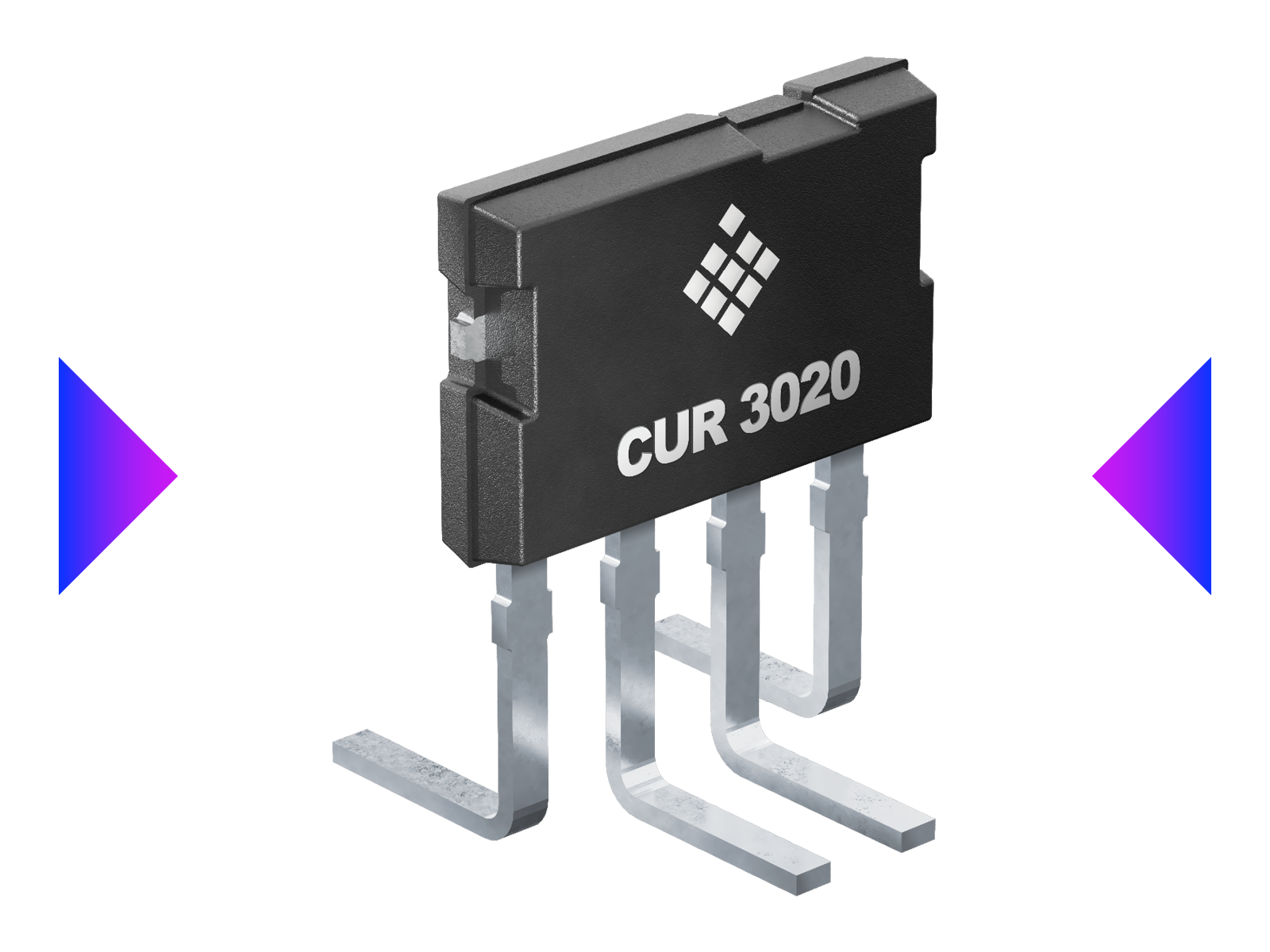
Image: TDK-Micronas
The useful question about a current sensor is usually how many amperes it can measure. TDK’s CUR3020 begins somewhere else: its sensitivity is specified in millivolts per millitesla. Turning that into an answer in amperes requires the surrounding magnetic assembly.
This is a Hall-effect IC for use with a C-core concentrator, which directs magnetic flux from the current-carrying conductor towards the sensor. The designer chooses the magnetic arrangement and calibrates the electrical output to it. The IC is therefore a building block for a current-sensor module, with more freedom over the assembly than a fully integrated current path provides.
TDK supplies several adjustments for that work. Sensitivity is programmable from 4.2 to 67.4mV/mT, the zero-field output can be set around a nominal 2.5V, and EEPROM retains the settings. The output offset is useful in bidirectional measurement, where current flowing in opposite directions must be represented on either side of the zero-current level.
Bandwidth is selectable at 250kHz or 500kHz. TDK’s noise figures make the choice tangible: at 25°C and 10mV/mT sensitivity, typical output noise is 0.75mV RMS in the lower-bandwidth setting and 1.5mV RMS in the higher setting. Choosing the faster response therefore changes the noise presented to the following measurement circuit.
Temperature specifications need equally careful reading. TDK gives a maximum sensitivity drift error of 1% across −40°C to 150°C. That is one contribution to the error budget, separate from offset drift and the behaviour of the external assembly; it should not be presented as a 1% accuracy guarantee for a finished current measurement.
TI’s TMCS1126-Q1 takes a different physical approach, routing current through an integrated conductor and using coreless Hall sensing. The CUR3020 leaves the conductor and concentrator outside the IC, so its output is calibrated to that external magnetic arrangement. Sensitivity programming changes the voltage produced for a given field; the relationship between conductor current and field is still set by the assembly.
TDK supplies the CUR3020 in a four-pin TO-92 package and lists traction inverters, battery-management and disconnect systems, and industrial current-sensor modules among its target applications. Samples are available on request.