ADI cuts robot position errors by changing which sensors it trusts
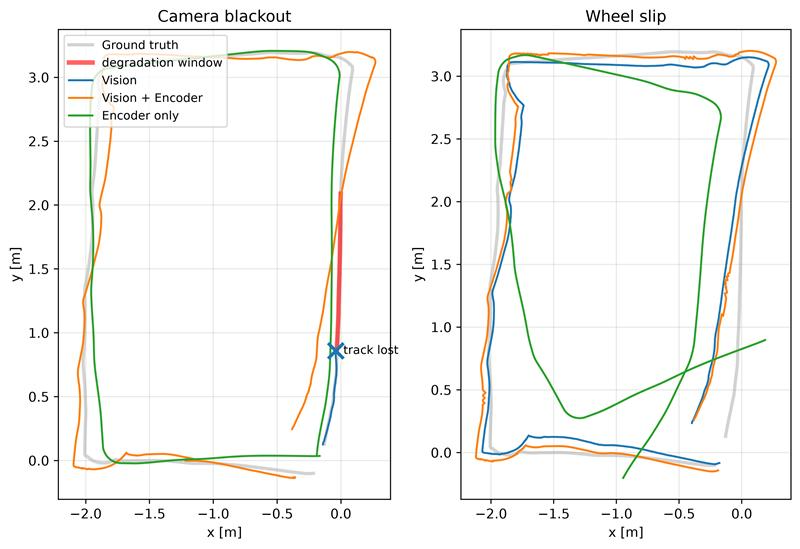
Image: Analog Devices
The worst position error in ADI’s reported robot trials fell from 1.923 m to 0.275 m after wheel measurements were integrated into NVIDIA’s cuVSLAM estimator. Across 13 trajectory segments, average error dropped from 24.2 cm to 9.7 cm.
Those are encouraging results. The stronger evidence, though, comes from deliberately making the sensors unreliable.
During a five-second camera blackout, the combined system continued estimating the robot’s position and limited the error to 13.2 cm until visual tracking returned. The camera-only system lost tracking. When the team introduced wheel slip, wheel odometry alone produced 1.106 m of error, while the combined system held it to 28.7 cm.
The wheel-slip result gives the work some weight. Adding an encoder is an obvious response to a camera losing sight of its surroundings, but wheel rotation is not a dependable measure of vehicle displacement once traction disappears. Increasing encoder resolution would simply measure the misleading rotation more precisely.
ADI’s extension brings wheel observations into the same estimation process as the camera measurements. It can use the wheels when visual information deteriorates, then reduce their influence when the camera indicates that the vehicle is moving differently from the wheel model’s prediction. Differential-drive and Ackermann steering arrangements are supported.
There is a computational cost. Processing time increased from 1.40 to 1.81 ms per frame on the evaluated Jetson platform. The extra 0.41 ms accompanies a substantial reduction in the reported trajectory errors, although that timing belongs to the tested processing stage and platform rather than a complete robot’s response time.
Reliability changes while the robot moves
A second strand of the work adjusts the balance between camera and inertial measurements. The usual calibration establishes a relationship between their expected errors, but a well-lit, textured room and a dark, plain corridor do not give the camera equally useful information.
The Smart Fusion implementation uses a neural network containing 914 trainable parameters to select a weighting regime before each bundle-adjustment call. Its ten inputs come from information already collected by the tracker, including measures of visual feature quality.
The research preprint reports mean position-error reductions of 27.7% on EuRoC MAV and 14.9% on TUM-VI Room under leave-one-out evaluation. The sequence being assessed was held out from training, which makes the result more informative than testing on trajectories the model has already seen.
These gains come from separate experiments and cannot be added together. They nevertheless support a clear engineering argument: additional sensing earns its place when the estimator can recognise the conditions under which that information becomes misleading. The wheel-slip experiment demonstrates that argument more convincingly than a larger sensor count ever could.