A third quantum dot gives a fast spin qubit more room for adjustment
Adding an auxiliary quantum dot has helped researchers make a fast gallium arsenide spin qubit less sensitive to electrical noise. The extra dot changes the energy landscape available to the electron, providing an adjustment that a two dot device lacks.
In a flopping mode qubit, electrical control moves the electron between dots so that it experiences a changing magnetic field. Coupling spin control to charge motion makes rapid rotations possible. It also makes the qubit frequency sensitive to voltage fluctuations. A small drift in the electrical operating point can then upset a carefully calibrated pulse.
The third dot gives the researchers another way to shape that response. Adjusting its energy flattens the relationship between qubit frequency and detuning around the chosen operating region, while retaining strong coupling for control. The method is described as orbital band engineering.
“By adding an auxiliary quantum dot, we introduced an extra degree of freedom for tuning the qubit frequency,” said Takafumi Fujita.
The team paired this device adjustment with neural network feedback to track slower frequency drift. Its paper reports a standard deviation of 388 kHz for those slow fluctuations with feedback, and a 99.56% fidelity for a 4.05 ns π/2 gate. The accompanying university release reports 99.72% after additional pulse optimisation. A peak rotation frequency of 271 ± 20 MHz was obtained under a different tuning condition.
The attraction is the ability to tune the device after fabrication. Fabricated dots will not all have identical electrical behaviour, and an additional control variable provides some freedom to accommodate that variation. The reported demonstration is in GaAs; the researchers identify silicon and germanium as possible extensions of the approach.
Sources
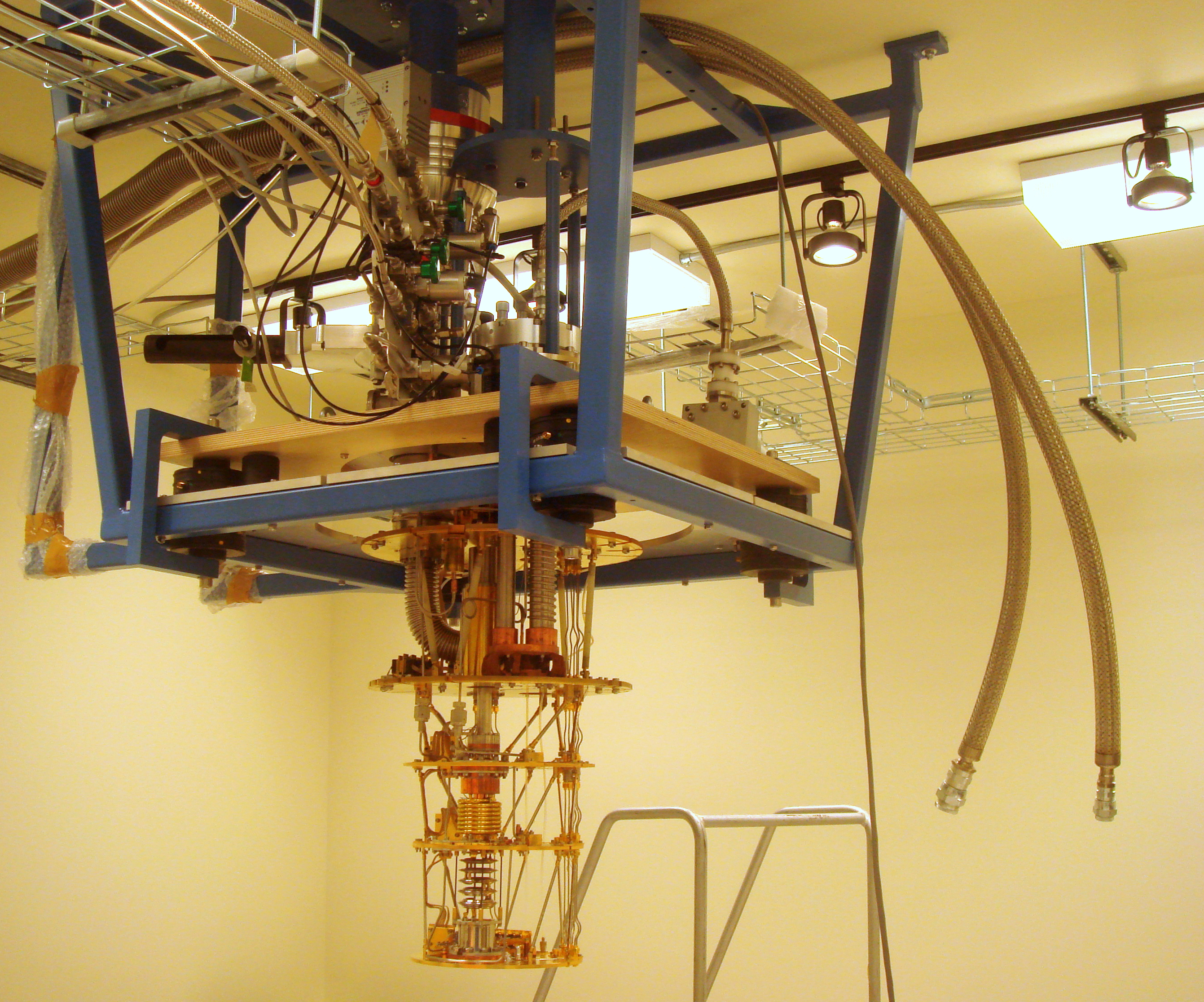
Image: Dilution refrigerator at BBN Technologies in 2009. Illustrative laboratory image, not the Osaka apparatus. Daderot. Image source. CC0.