Microchip adds radiation tolerant LX-820 oscillator for LEO satellites
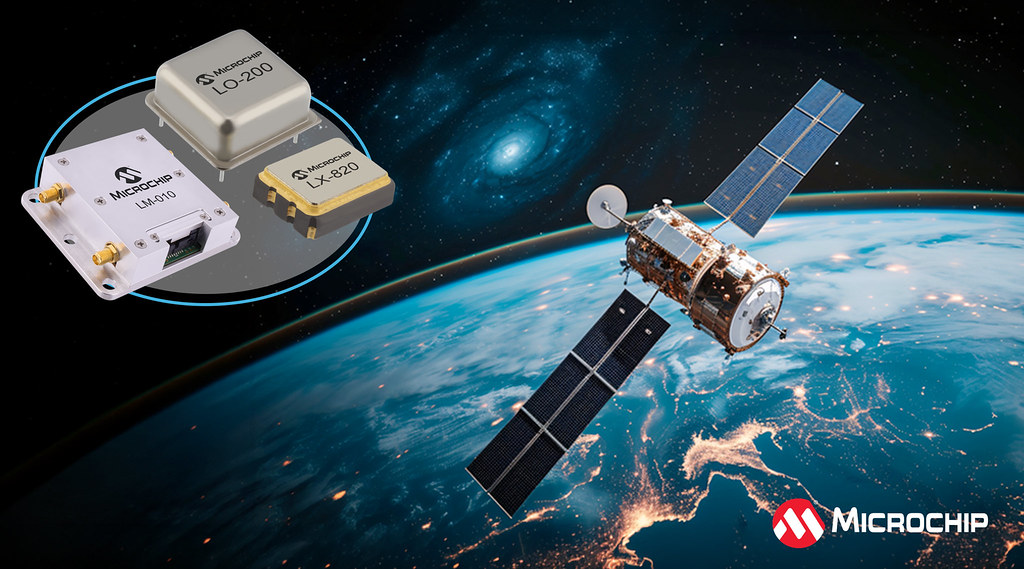
Image: Microchip Technology
Microchip Technology has expanded its L-Series timing portfolio with the LX-820 radiation-tolerant quartz oscillator, aimed at Low Earth Orbit (LEO) and other space applications. The L-Series sits between commercial off-the-shelf oscillators and traditional high-reliability space products, combining commercial- or military-grade components with production inspection, electrical and thermal analysis and hybrid manufacturing.
According to Microchip, L-Series oscillators have passed Total Ionizing Dose (TID) and Single-Event Latchup (SEL) testing as complete, functioning devices, with radiation tolerance up to 50 krad and SEL testing to 40 MeV·cm²/mg. Most products in the range also use swept quartz to reduce radiation-induced frequency drift, and the L-Series OCXOs incorporate ruggedised construction with four-point crystal mounts intended to survive launch and the subsequent mission profile.
The LX-820 itself is supplied in a 3.2 mm by 2.5 mm surface-mount package and is designed to operate across a temperature range of -55°C to 125°C. The device is engineered to meet MIL-PRF-55310 Level B and offers ±100 ppm performance. It supports CMOS output frequencies from 1.25 MHz to 135 MHz and low-voltage differential signalling (LVDS) output frequencies from 100 MHz to 250 MHz.
Positioning on lead time and cost
Microchip says the L-Series is intended to address lead time and budget pressures associated with space-qualified timing components, many of which carry extended lead times and significant procurement costs. The company states that many L-Series configurations are available from stock or with lead times of less than 20 weeks, and that the range may lower overall programme costs by reducing the component pedigree, documentation and inspection overhead typically associated with traditional high-reliability space-grade timing products. These are supplier claims rather than independently verified figures.
Randy Brudzinski, corporate vice president of Microchip's frequency and time systems business unit, said: "Satellite developers should not have to choose between dependable precision timing and the cost and schedule requirements of their mission. Our L-Series oscillators bring together the performance, radiation tolerance and supply availability our customers need to confidently deploy their New Space applications using a precision timing solution that helps reduce both schedule and mission risk."
Portfolio breadth
The L-Series spans crystal oscillators (XOs), temperature-compensated crystal oscillators (TCXOs), oven-controlled crystal oscillators (OCXOs) and a pulse-per-second (PPS) disciplined oscillator, allowing developers to select compact XOs where size and broad frequency coverage are priorities, TCXOs where tighter temperature stability and lower power are needed, OCXOs for more demanding stability and phase-noise requirements, and the disciplined oscillator where PPS synchronisation and holdover are required. Microchip positions the portfolio as supporting satellite communications, navigation, Earth observation, mapping and lunar mission timing references.
Microchip states that the LX-820 and other L-Series oscillators are now available in production quantities.